
Peloni: Vahidi is betting on Trump becoming frustrated with Iran, and thus gaining victory from the essence of the Iranian regime to hold out no matter the cost to their war machine, infrastructure and leadership personel. Will he be proven right in this, or does Vahidi stand as the remaining straw needed to be targeted to bring the regime to its knees?
Jalal Tagreeb
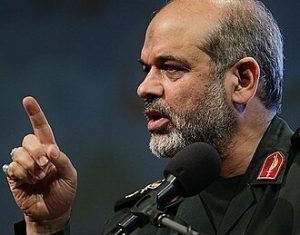 Ahmad Vahidi. Photo by Tasnim News Agency, CC BY 4.0, Wikipedia
By the time Donald Trump sent his latest ultimatum to Tehran in April 2026, the man effectively deciding Iran’s response was not a president, not a foreign minister, and not even a supreme leader newly installed after Ali Khamenei’s death. It was a brigadier general with a warrant out for his arrest in Argentina, a man who has operated in the shadows of Iran’s security state for nearly half a century — Ahmad Vahidi.
From the Revolution’s First Days
Ahmad Vahidi’s biography is, in many ways, a biography of the Islamic Republic itself. Born in 1958, he was a young man when the revolution swept the Shah from power in 1979, and he joined the newly formed Islamic Revolutionary Guard Corps almost immediately after its founding. The IRGC was created not as a conventional army but as a guardian of the revolution — ideologically committed, directly loyal to the Supreme Leader, and operating parallel to and often above the regular military. Vahidi was there from the beginning.
His early career was shaped by the brutal crucible of the Iran-Iraq War (1980–1988), a conflict that killed hundreds of thousands and forged the IRGC into a hardened, battle-tested institution. By 1981, he had risen to deputy chief of intelligence within the IRGC — a remarkable ascent for a man still in his early twenties. He was not merely a soldier. He was an intelligence operator, a bureaucratic climber, and a true believer in the revolutionary project. French sanctions records describe him as having played a central role in organizing the IRGC’s intelligence arm and establishing several IRGC garrisons responsible for covert and overseas operations.
In 1983, he moved into the Quds Force, the IRGC’s elite extraterritorial unit specializing in unconventional warfare, proxy support, and intelligence operations abroad. By 1988, when the Iran-Iraq War ended, he was its commander — the very first man to lead what would become Iran’s most feared instrument of foreign policy. He held that post until 1997, nearly a decade of building the Quds Force’s networks across Lebanon, Iraq, and beyond.
His successor was a then-relatively unknown general named Qassem Soleimani.
The Shadow Minister
In 1997, Vahidi transitioned to the Ministry of Defense, beginning a parallel political career that would distinguish him from most of his IRGC contemporaries. He served as deputy defense minister from 2005 to 2009, then was appointed Defense Minister by President Mahmoud Ahmadinejad in August 2009, winning a remarkable 79% confirmation vote in parliament. He served in that role until 2013.
As defense minister, Vahidi oversaw Iran’s missile and drone programs during a period of rapid acceleration. He prioritized Iran’s relationship with Lebanon — specifically Hezbollah — as a core strategic objective, deepening the web of military and financial ties that would define the so-called “Axis of Resistance” for the following decade. He was, by this point, a figure of genuine international notoriety. The US Treasury had sanctioned him. The European Union had sanctioned him. And Argentina wanted him extradited.
The Argentina matter is the darkest chapter of Vahidi’s history and the one most likely to define his legacy in the West. On July 18, 1994, a suicide bomber drove an explosives-laden van into the Argentine Israelite Mutual Association (AMIA) building in Buenos Aires, killing 85 people and wounding hundreds more. It remains the deadliest terrorist attack in Argentine history. Argentine prosecutors spent years building a case that the attack was planned by Iran and carried out by Hezbollah. In 2007, Interpol issued red notices for several Iranian officials. Vahidi was among them — accused of playing a direct role in approving and organizing the operation during his time running the Quds Force.
When Ahmadinejad appointed Vahidi as defense minister in 2009, it triggered an international incident. Argentine President Cristina Fernández de Kirchner formally protested the appointment of a man her country considered a terrorist suspect. Iran denied any involvement in the AMIA bombing. Vahidi denied any involvement. He has continued to deny it ever since. In 2024, Argentina’s Court of Cassation ruled that the attack had been planned by Iran and carried out by Hezbollah, and Interpol issued a new, updated red notice for Vahidi’s arrest — one that remains active today.
The Bureaucrat Who Built the Machine
After leaving the Defense Ministry in 2013, Vahidi did not retire into irrelevance. He was entrusted by Supreme Leader Ali Khamenei with a project that, in retrospect, reveals just how far his ambitions — and Khamenei’s — extended. Vahidi was placed in charge of the Supreme National Defense University and given a specific mandate: to prepare the next generation of Iranian political elites from within the military.
To that end, he established the Shahid Beheshti School of Governance, described as the first and only institution in Iran open exclusively to military personnel for political training. Its purpose was explicit: to ensure that the country’s future decision-makers would be IRGC officers, shaped by revolutionary ideology and loyal to the Guard’s institutional interests. The school was, in effect, a long-game play for IRGC supremacy over Iran’s civilian government — a project Vahidi now finds himself at the apex of.
He returned to cabinet in 2021, appointed Interior Minister under President Ebrahim Raisi. In that role, he oversaw Iran’s internal security apparatus during one of the most turbulent periods in the Islamic Republic’s history. When protests erupted following the death of Mahsa Amini in September 2022, Vahidi’s ministry was central to the crackdown. Tens of thousands were arrested. The internet was disrupted. EU sanctions followed, citing his direct role in suppressing the Woman, Life, Freedom movement.
He left the Interior Ministry in 2024, having also been named to the Expediency Discernment Council — yet another institutional perch in Iran’s layered power structure.
A Dangerous Promotion
On December 31, 2025, Supreme Leader Ali Khamenei appointed Vahidi as deputy commander of the IRGC. The appointment came with a specific wartime mandate: prepare Iranian forces for potential US and Israeli strikes, and manage the violent suppression of the nationwide protests that had erupted across all 31 of Iran’s provinces in the preceding weeks. The crackdown was severe — by multiple accounts, tens of thousands were killed, injured, or arrested.
The IRGC’s top position changed hands with lethal speed. Hossein Salami, who had commanded the IRGC for years, was killed during Israeli strikes in June 2025. His successor, Mohammad Pakpour, was killed on February 28, 2026, in the opening phase of the joint US-Israeli military campaign against Iran. On March 1, 2026, Ahmad Vahidi became commander-in-chief of the Islamic Revolutionary Guard Corps.
He inherited an institution that had just lost two commanders in rapid succession, seen its senior leadership decimated, and was engaged in a full-scale war against two of the world’s most formidable military powers. He also inherited the death of Khamenei himself — killed on February 28 — and the subsequent elevation of Khamenei’s son, Mojtaba, as the new Supreme Leader.
Many expected the IRGC to fracture. Instead, it held. Intelligence analysts credit the organizational reforms of former security chief Ali Larijani, who had restructured the IRGC into autonomous regional headquarters capable of operating independently of central Tehran command. The Strait of Hormuz was blocked, disrupting global energy and food markets. The institution, despite its losses, did not collapse.
The Power Behind the Curtain
What has emerged in the weeks since is something more startling than a military commander holding the line. According to reporting from the Institute for the Study of War, Iran International, and multiple Western intelligence assessments, Vahidi has moved beyond military command into something approaching de facto political control of Iran.
Reports indicate that President Masoud Pezeshkian has been sidelined from key decisions. Parliament Speaker Mohammad Bagher Ghalibaf, who led the first round of US-Iran talks in Islamabad and was briefly identified by Trump as Washington’s interlocutor, stepped down from his role as negotiations chief — reportedly after internal confrontations with Vahidi’s faction. Foreign Minister Abbas Araghchi, according to multiple sources, cannot make consequential decisions without IRGC approval. Vahidi himself stated publicly that under wartime conditions, all critical positions must be managed directly by the Revolutionary Guards.
A source close to the IRGC told Israeli media: “Vahidi holds a positive stance toward not continuing the negotiations. From his perspective — there’s no need to rush into an agreement. He believes that Donald Trump will lose patience and fold and does not believe his threats.”
In a remarkable display of dominance, Vahidi reportedly paraded Ghalibaf and President Pezeshkian on national television to publicly clarify that they were not negotiating away Iran’s nuclear achievements or its rights in the Strait of Hormuz — a humiliation of the civilian leadership broadcast for domestic and international audiences alike.
Trump, the Ultimatum, and the Immovable Object
On April 21, 2026, the White House released a statement from President Trump issuing what he framed as a final warning to Tehran. Trump had spent months pushing for a diplomatic resolution, initially working through Ghalibaf and the Islamabad channel. But with Vahidi now consolidating control and the civilian negotiators effectively benched, the diplomatic track has stalled.
As of this writing, the Trump administration is reported by CNN to be reviewing military and strategic options that include the potential targeting of Vahidi himself — identifying him as the central obstacle to any renewed negotiations. Officials note that Vahidi’s grip on power is such that eliminating him, rather than pressuring Iran’s nominal civilian government, may be the only available lever.
Vahidi rejected the possibility of renewed talks under current conditions and, according to reporting, indicated that Iran would continue its course until US military forces withdraw from the Middle East entirely.
This is the calculation of a man who has spent nearly five decades studying American behavior and believes he understands Trump’s pressure campaigns better than Trump anticipates. He showed a pragmatic streak once before — in the 1980s, he participated in back-channel contacts with US intermediaries in what became the Iran-Contra affair. He knows how these games are played. But this time, he is not a mid-level operative hedging bets. He is the most powerful man in a nation at war, holding the levers of an institution that has survived the deaths of Soleimani, Salami, Pakpour, and Khamenei himself.
Whether Ahmad Vahidi’s gamble — that Trump will blink first — is prescient or catastrophic may determine the fate of millions. What is no longer in doubt is who is making that bet on Iran’s behalf.
Ahmad Vahidi holds the rank of Brigadier General in the IRGC. He is subject to US Treasury sanctions, EU sanctions, and an Interpol red notice at the request of Argentina. He has denied all terrorism allegations.
Jalal Tagreeb is an East Jordanian freelance researcher and translator who works in the United Kingdom and abroad, specializing in Islamic Studies and History. Formerly rooted in conservative Sunni Islam, he was once an active Muslim apologist who frequently debated secularists. Following a series of decisive intellectual defeats, he undertook a profound re-evaluation of his beliefs, ultimately culminating in his public renunciation of Islam.
He now focuses on analyzing cultural and ideological contrasts between the West and the Middle East. Through his writings and translations, he aims to foster meaningful dialogue, encourage critical engagement with Islamic tradition, and promote intellectual honesty. His writings, debates, and a selection of his previously refuted Islamic arguments can be found here: Jalal Tagreeb, Author at The Freethinker.
He can be contacted at servantjiff@gmail.com.


Just goes to show how deeply entrenched the radical Islamist hard-liners are. Find him and fix the problem.
“This is the calculation of a man who has spent nearly five decades studying American behavior and believes he understands Trump’s pressure campaigns better than Trump anticipates.”
OK – then he must understand that Trump eliminated every single important Iranian leader in the IRGC, intelligence services, Basij and the Head Ayatollah himself. Trump and Israel has eliminated every Iranian friend of his in leadership positions – all of them. He is a Hellfire missile or JDAMS 2000 lb bomb away from Hell. He is not going to any paradise and no virgins.
The only qustion is – Does he have life insurance and is it paid up?
This worm is not as smart as he thinks he is.
The IDF did the executions of Iranian leaders.
Iran play’s good cop – bad cop game. Those playing moderates or reasonable try and get their interlockers to give concessions so they can placate hardliners. Historical game they play.
Will not work now.
Well there is a guy who’s anus cries out for a polonium suppository of there ever was one deserving.
The author of this article, Jalal, was once extremely stubborn and combative in debates with non-Muslims. He was determined to prevail in what he described as his ‘jihad of the tongue’ during such discussions. However, he later conceded defeat after we inserted the required suppository into him! He is now producing nice articles that make Islamists proud of him.