
Peloni: It remains an inexplicable choice that Trump maintains Tom Barrack at the center of US-Turkish policy, while working to support Turkish interests in Syria and Lebanon as Turkey’s expansionist ambitions gain real support from the US Ambassador to Turkey at the expense of America’s true ally in the region, Israel.
Sinan Ciddi & Jonathan Schanzer | April 24, 2026
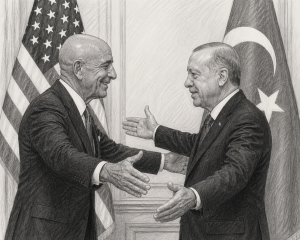 Ambassador Tom Barrack and President Recep Erdogan. Image via AI
U.S. Ambassador to Turkey Tom Barrack raised eyebrows last weekend at the Antalya Diplomacy Forum when he stated, “Turkey is not a country to be messed with,” — a remark intended to blame Israel for heightened tensions between Ankara and Jerusalem. Blood pressures rose further after Barrack equated Hezbollah and Israel, remarking that both were “equally untrustworthy.”
Never mind that Turkey is an overt and unabashed supporter of the Hamas terrorist organization that kicked off the regional war in the Middle East on October 7, 2023. Never mind that the Turkish government laundered billions of dollars on behalf of the Iranian regime in years past. Never mind that it continues to launder Iranian funds, even as America is engaged in hostilities with the regime.
Why is the American ambassador encouraging bad behavior? His job is to represent the interests of the United States.
The Erdogan government still rolls out the red carpet for Hamas terrorists. The group continues to enjoy safe haven and impunity in Turkey. Istanbul is the key financial hub for the group, even after the slaughter of October 7. Remarkably, the Turkish government continues to act as Hamas’s patron, even after joining Donald Trump’s board of peace — a body designed to remove Hamas from power in the Gaza Strip.
Instead of pressuring Turkey to cut its ties with the terrorist entity, Barrack has advised Israel to allow Turkey to position troops in Gaza, following the October 2025 ceasefire, arguing that because Ankara has “a dialogue with Hamas … that would be beneficial … to cool the temperature.”
As regional tensions between the United States and the regime in Iran continue to soar, Erdogan has clarified his position: support the continuity of the mullahs’ regime and ensure its survival. Following the wave of popular protests that spread across Iran in late 2025, Erdogan called his Iranian counterpart and congratulated him for his “handling” of the protests. Worse, to warn Tehran of impending airstrikes, Ankara installed and activated a sophisticated radar system in Damascus airport that could give Iran advanced warning of fighter aircraft flying over Syrian airspace. In years past, the Turks were caught red-handed, laundering an estimated $20 billion in cash and gold for the regime in Tehran. New Treasury Department sanctions issued last week revealed that Turkey is at it again, laundering money on behalf of the criminal ayatollah regime. Ambassador Barrack has been silent.
There are some who might argue that Barrack’s second job, U.S. envoy to Syria, is where he has the most value. With Turkey’s decisive backing, the new Syrian government, led by Ahmad al-Sharaa, toppled the Bashar al-Assad regime in December 2024. Trump is now working to forge a stable, unified Syria. And he believes that Turkey can help him achieve this aim.
But reports suggest that the Turks are using the weak and fledgling Syrian government to create a platform for possible aggression against Israel. In 2025, the Ankara government transferred advanced missiles and air defense systems to Syria. Tensions boiled over last year, prompting Israel to conduct limited military operations in Syria. Instead of chastising the Turks for transferring these weapons in the first place, Barrack criticized Israel’s military intervention in Syria as “poorly timed” and suggested Israel would prefer to see Syria “fragmented and divided rather than a strong central state.”
Since then, Turkey has been accused of financially supporting Hezbollah in Lebanon while establishing military outposts across East Africa and harassing Greek and Cypriot positions across the Eastern Mediterranean. There has not been a word from Barrack about these aggressive actions.
If anything, he seems to be encouraging them. Barrack declared earlier this year that it’s time to “take a bold step and give Erdogan what he needs,” which is not “weapons or trade” but “legitimacy.”
Lest one believe that the problem is contained to the Middle East, it’s not. Ankara’s deep ties to Russia’s defense industry remain a major concern after Erdogan purchased Russia’s S-400 air defense system in 2019 — a move that resulted in Turkey’s expulsion from the F-35 program. The Turks now have the dubious distinction of becoming the first NATO member sanctioned by the United States for buying weapons from an adversary. This was not a misunderstanding; it was a deliberate choice to privilege strategic cooperation with Moscow over alliance obligations.
Curiously, our ambassador to Ankara is working overtime to overturn those sanctions. And he is actively working to find ways to help Turkey acquire the F-35. At the Antalya Diplomacy Forum, he predicted his efforts would soon bear fruit: “you’ll soon see that the S-400 issue has been resolved. From my boss’s perspective, getting [Turkey] accepted into the F-35 program is no problem.”
Despite his overt pro-Turkey stance, even some parts of the Turkish political establishment want him gone — especially the main opposition Republican People’s Party (CHP), which demanded his expulsion as ambassador, for suggesting that the best systems for governance in the Middle East are authoritarian regimes.
Granting the Turks access to the F-35 program right now would be downright dangerous. Tensions between Turkey and Israel are now at an all-time high. Erdogan’s rhetoric is vitriolic. Should that spill over into unwanted conflict, the region could once again be set aflame. That is the last thing President Trump needs. A tough conversation between the president and his ambassador is long overdue.
The message to Tom Barrack is simple. The job of the American ambassador to Turkey is not to make Ankara feel validated; it is to defend U.S. interests, uphold alliances, and confront a partner whose policies have repeatedly empowered America’s adversaries.
If the president can deliver that message, he will do what his predecessors have failed to do for years: rein in Turkish aggression and set an important alliance on a new course.
Sinan Ciddi is a senior fellow on Turkey at the Foundation for Defense of Democracies (FDD), where Jonathan Schanzer is the executive director.


Why is this hapening??
The US has a number of compliant half-wits running around the world making :”useful” friendships.