
Peloni: As we are once again hearing talk about Iran preferring to hand its enriched uranium to a third party such as Russia, it should occur that they are simply trying to return to the failed JPCOA agreement of 2015 while pretending that we don’t know where this story might end, when in fact, we have been down this road once before. Iran must be made to relinquish its enriched uranium, or the responsible parties must go in and seize it. As Pres. Trump has noted many times, Iran can not be allowed to become a nuclear armed nation, and by playing this game of charades
A. Savyon, Yigal Carmon | MEMRI | April 20, 2026
 Screengrab via Vimeo
According to the Wall Street Journal, in the Oman-mediated U.S.-Iran talks in Geneva today, February 17, 2026, Iranian officials signaled that they “might offer to pause uranium enrichment for up to three years” – that is, until the end of President Trump’s term of office – and that they might be willing to remove “some” of their enriched uranium stockpiles out of Iran to another country.
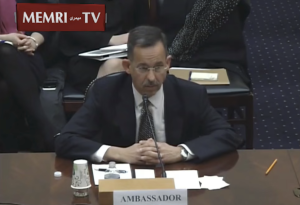
Below we are republishing a MEMRI report on what happened after Iran agreed to ship 8.5 tons of enriched uranium to Russia, under the Obama administration’s 2015 JCPOA Iran nuclear deal. The events are recounted by Amb. Stephen Mull, the administration’s State Department lead coordinator on Iran, at the February 11, 2016 hearing titled “Iran Nuclear Deal Oversight: Implementation And Its Consequences” before the House Committee on Foreign Affairs.
Introduction
While the U.S. protests Iran’s minor breach, announced this week, of the 300 kg limit on its stockpile of low-enriched uranium set in the 2015 JCPOA nuclear deal,[1] the location of 8.5 tons of Iranian-enriched uranium that Iran ostensibly shipped to its ally Russia that year remains completely unknown. It could well be back in Iran.
Seven months after the JCPOA was concluded, and two months after the ostensible shipment, Amb. Stephen Mull, the Obama administration’s State Department lead coordinator on Iran, declared that “it has not yet been decided where exactly Russia will put this” and added: “I believe, if it has not arrived yet, it will very soon.”[2]
On the other hand, what is certain is that in December 2015, according to the Russian Tass news agency,[3] Russia provided Iran with 200 tons of yellowcake.
The U.S. Has No Clue Where Iran’s 8.5 Tons Of Enriched Uranium Are
At a February 11, 2016 hearing before the U.S. House Foreign Affairs Committee, Amb. Mull acknowledged that Washington had lost track of the enriched uranium, which, he said, was now “on a Russian ship, in Russian custody, under Russian control” – that is, no longer under IAEA oversight.
Indeed, in response to Rep. Chris Smith’s (R-NJ) question at the hearing, “Do we have any on site accountability? Can we go and verify ourselves, or?” Amb. Mull replied: “We cannot.” Rep. Smith said: “We cannot. Who does?” to which Amb. Mull replied: “…Russia is responsible for maintaining access and controls.”
Rep. Smith then asked, “Where has it been put?” and Amb. Mull answered: “It has not been fully, according to our information it has not yet been decided where exactly Russia will put this.”
To Rep. Smith’s question “But where did it go? I mean it has to be somewhere,” Amb. Mull replied: “…I believe, if it has not arrived yet, it will very soon.”
In reply to Rep. Smith’s comment that “we are then trusting the Russians to say that they have it under their purview, that they are watching it? I mean they are so close to Iran, they have doubledealed us and especially the Middle East, the Syrians, I don’t know why we would trust them. Could you tell us where it is going?” Amb. Mull replied: “That is a Russian Government responsibility to decide where it goes. We do not have concerns about Russian custody of this material. What is important in this deal is will it go back to Iran? And I can guarantee there are sufficient controls in place that if one piece of dust of that material goes back into Iran we are going to be aware of it.”
Rep. Smith then asked, “But again, can the IAEA go to that ship and verify that it is there and follow it as it goes to its final resting place?” To this, Amb. Mull responded: “IAEA has different monitoring arrangements with each, each country in the world.” (As noted, Mull had stated that the uranium was now in “Russian custody, under Russian control” – that is, not under IAEA oversight.)
To Rep. Smith’s statement that “… it is not even in a place, it is not in any city that you say. It is not in any, it is not somewhere in Russia that we could say there it is. We don’t even know where it is,” Amb. Mull replied: “The IAEA verified the loading of all of this material…”
In response to Rep. Smith’s pointing out that “loading and where does it end up is very important,” Amb. Mull said, “That is the Russian Government’s responsibility to decide where it goes.”
Rep. Smith concluded, “That is a flaw, in my opinion.”
To view Amb. Mull’s testimony, click here.
Appendix: Amb. Mull’s Testimony
The following is Amb. Stephen Mull’s testimony at the February 11, 2016 hearing.[4]
IRAN NUCLEAR DEAL OVERSIGHT: IMPLEMENTATION AND ITS CONSEQUENCES
HEARING BEFORE THE COMMITTEE ON FOREIGN AFFAIRS HOUSE OF REPRESENTATIVES ONE HUNDRED FOURTEENTH CONGRESS SECOND SESSION FEBRUARY 11, 2016
Ambassador MULL. The material that Iran shipped out, that 25,000 pounds of nuclear, enriched nuclear material, Russia took that under its control. We obviously have many differences over many years with Russia, but one of the features of our relationship is pretty close cooperation on protection of nuclear material. We do not have concerns that that material —
Mr. SMITH OF NEW JERSEY. Do we have any on site accountability? Can we go and verify ourselves or?
Ambassador MULL. We cannot.
Mr. SMITH OF NEW JERSEY. We cannot. Who does?
Ambassador MULL. Well, we – I mean Russia has tons of nuclear material and has for many years. Russia is responsible for maintaining access and controls.
Mr. SMITH OF NEW JERSEY. What town is it actually being – where is the repository for it?
Ambassador MULL. I’m sorry?
Mr. SMITH OF NEW JERSEY. Where has it been put?
Ambassador MULL. It has not been fully, according to our information it has not yet been decided where exactly Russia will put this.
Mr. SMITH OF NEW JERSEY. Because if it has been shipped out it has gone somewhere. It’s not —
Ambassador MULL. It is still in the process of being delivered in its entirety.
Mr. SMITH OF NEW JERSEY. So it is not all shipped out yet?
Ambassador MULL. It is all shipped out. It all left Iran on a ship.
Mr. SMITH OF NEW JERSEY. But where did it go? I mean it has to be somewhere. Ambassador MULL. It is on a Russian ship, in Russian custody, under Russian control. Mr. SMITH OF NEW JERSEY. Actually on the ship right now?
Ambassador MULL. I believe, if it has not arrived yet, it will very soon. And it will be kept within control of Russian facilities.
Mr. SMITH OF NEW JERSEY. But again, we are then trusting the Russians to say that they have it under their purview, that they are watching it? I mean they are so close to Iran, they have doubledealed us and especially the Middle East, the Syrians, I don’t know why we would trust them. Could you tell us where it is going? I mean that is important. And then I will —
Ambassador MULL. That is a Russian Government responsibility to decide where it goes. We do not have concerns about Russian custody of this material. What is important in this deal is will it go back to Iran? And I can guarantee there are sufficient controls in place that if one piece of dust of that material goes back into Iran we are going to be aware of it
Mr. SMITH OF NEW JERSEY. But again, can the IAEA go to that ship and verify that it is there and follow it as it goes to its final resting place?
Ambassador MULL. IAEA has different monitoring arrangements with each, each country in the world.
Mr. SMITH OF NEW JERSEY. I would not have confidence that – I mean it is not even in a place, it is not in any city that you say. It is not in any, it is not somewhere in Russia that we could say there it is. We don’t even know where it is.
Ambassador MULL. The IAEA verified the loading of all of this material onto the — Mr. SMITH OF NEW JERSEY. But loading and where does it end up is very important. Ambassador MULL. That is the Russian Government’s responsibility to decide where it goes.
Mr. SMITH OF NEW JERSEY. That is a flaw, in my opinion.
[1] Fars (Iran), July 1, 2019.
[2] Docs.house.gov/meetings/FA/FA00/20160211/104456/HHRG-114-FA00-Transcript-20160211.pdf, pp. 30-31, February 11, 2016.
[3] Tass.com/world/847733, December 29, 2015; Tass.com/politics/929618, February 8, 2017; Commentarymagazine.com/foreign-policy/middle-east/iran/iran-yellowcake-nuclear-deal-ernest-moniz, March 21, 2017.
[4] Docs.house.gov/meetings/FA/FA00/20160211/104456/HHRG-114-FA00-Transcript-20160211.pdf, pp. 30-31, February 11, 2016.
Israpundit is entirely dependent on readers support. Please help me continue educating people with the truth about what is going on in Israel and around the world.


Perhaps the world has forgotten that during HILLARY CLINTON’S stint as Obama’s Secretary of State 2009-2013 Rosatom (Russia’s state nuclear agency) bought controlling interests and then acquired full ownership in Uranium One, the Canadian company with uranium interests/rights in the U.S. The seditious Democrat Russia Russia Russia narrative accusing President Trump of helping Russia is a lie and political “projection” to deflect attention away from the factual Obama/Hillary Clinton acts that approved the sale through CFIUS, the U.S. Committee on Foreign Investment in the United States, in 2010.
Russia/Rosatom built and helps operate Iran’s only commercial nuclear power reactor at Bushehr. Iran has its own independent uranium enrichment program at Natanz and Fordow where it produced low-enrichment uranium up to 60% and at Isfahan. All were targeted by the U.S. in June 2025 during Operation Midnight Hammer.
Political projection has been honed to an art form by the radical leftist anti-American Democrat party. Everything they accuse President Trump of doing is precisely what the Democrats are doing or did themselves. Politics is a very dirty business. The tactical use of political projection is foundational to fake news and is an ongoing threat to America and why Space Is No Longer the Final Frontier––Reality Is!
This method of double speak by the Russians is common knowledge. Indeed, their usual approach to “high level meetings” is to send representatives who are not empowered to agree to anything. The Iranians and Arabs are well trained in this approach. They call for a deal, get concessions, but then claim they cannot confirm their own. In the next round if discussions, they then brush previous achieved concessions aside as “given” and go to work on the next series of concessions while pocketing the earlier ones.
Israel has been there so often already that they recognize the approach from afar. The problem is then resolved by bringing on “friendly” diplomats such as US to coerce some new concession out of us. When we disagree with this new agreement, there are a bunch of ways to convince us to cooperate, such as reconsidering arms agreements or embargoing the transfer of arms or munitions to Israel.
With the disadvantage of always fighting with at least one arm tied behind your back and multiple fronts to deal with, this reconsidering of signed agreements leaves very little space for trust, and since the number of signed agreements with Russia is at best in the single digits, there can be no trust that they still have the enriched Iranian uranium under their purview.
The US needs to dig up the hot stuff buried there and spread it around the Iranian countryside in such a way that the country becomes ungovernable due to access cutoff to various regions combined with the high cancer death rate.
The deaths will not be in the US hands, but the Iranians for deceiving the IAEC.