
However, as the US seeks to put on a positive face regarding the incoming prime minister, the US is also announcing new rewards for information on several key Iraqi militia leaders.
By SETH J. FRANTZMAN | APRIL 30, 2026
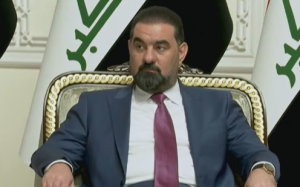 Iraq’s President Nizar Amedi named Ali al-Zaidi as prime minister-designate, tasking him with forming a government. Screengrab via Youtube
The US mission in Iraq “extends its best wishes to Prime Minister-designate Ali Al-Zaydi in his efforts to form a government capable of achieving the aspirations of all Iraqis for a brighter and more peaceful future,” the US Embassy & Consulate in Iraq said Wednesday.
As the US seeks to put on a positive face regarding the incoming prime minister, however, it is also offering new rewards for information on several key Iraqi militia leaders.
Those militias are linked to Iran, and they carried out attacks against US forces and diplomats. They also attacked the autonomous Kurdistan Region in northern Iraq.
“We express our solidarity with the Iraqi people in their pursuit of shared goals, including safeguarding Iraq’s sovereignty, enhancing security to combat terrorism, and building a prosperous future that delivers tangible benefits for both Americans and Iraqis,” the US Embassy & Consulate in Iraq said.
US funding in Iraq
Questions remain about US funding for the Kurdish Peshmerga in northern Iraq and also for continued work with Iraq. Ostensibly, the US has been supporting anti-ISIS operations in Iraq, even though those operations largely ended in 2018.
Nevertheless, the US sees a reason to continue to have good ties with Iraq. The US has invested large sums of money in a new consulate in the Kurdistan Region, for instance.
“The United States’ Fiscal Year 2027 defense budget outlines a significant restructuring of its counter-ISIS campaign, including changes to financial assistance for Kurdish Peshmerga forces and Iraq,” Kurdistan Region-based news channel Rudaw Media Network reported. “The Counter-ISIS Train and Equip Fund (CTEF) request totals $303.1 million, aimed at supporting vetted partner forces across Iraq, Jordan, Lebanon, and Syria in ongoing operations against Islamic State (ISIS) remnants and networks.”
In Iraq, it appears $118m. will go toward existing partner forces.
“However, the Peshmerga Ministry – the Kurdistan Region’s equivalent of a defense ministry – is slated to receive $0 in direct funding in the proposed 2027 budget, marking a notable shift in the structure of CTEF support,” the Rudaw report said.
“Asked about the issue, Republican Congressman Joe Wilson [South Carolina] underlined to Rudaw the importance of ties with Erbil and Kurdish allies,” Rudaw reported. Wilson said, “personally, I’ll be working with the administration [on this matter]… the Kurdistan Regional Government and the Kurdish people are very important. We want their sovereignty to be maintained within Syria and Iraq. This will be considered.”
US Democratic Congressman Seth Moulton said that the US “must support our allies,” the report said.
US Rep. Abe Hamadeh (R-Arizona) asked US Secretary of War Pete Hegseth on Thursday: “Given Iraq’s close ties to Iran and the growing challenges we’re facing with their government, does [the secretary of war] believe the $118 million we’re providing them for counter-ISIS operations is a wise use of American taxpayer dollars?”
In response, Hegseth said the US was paying close attention to the new government in Iraq. Some of Iraq’s efforts have been successful, and some have not, he said.
The US has left bases in Syria over the past year. Now it will face a major test about what comes next in Iraq.


Leave a Reply
You must be logged in to post a comment.