
Peloni: This is an insightful essay by Memri’s Yigal Carmon on the real reason which might have led Trump to cast aside his Muslim Brotherhood affiliated ‘negotiating’ partners while dealing with the Iranians. It isn’t so much that they have been dishonest with him, but that they are honestly dedicated towards their Jihadist credo, and perhaps Trump has finally come to be aware of this, by one means or another.
Yigal Carmon | MEMRI | April 29, 2026
 Screengrab via Youtube
Amid the Iran War, the behavior of those whom President Trump believed to be his allies and who have sought to position themselves as mediators – Qatar, Pakistan, and Oman – has been a rude awakening for him. In the moment of truth, they have stood by Iran. Qatar has been pushed away from negotiations, and its status with President Trump is not clear. Pakistan sought to maintain the pretense of acting as a mediator in the U.S.-Iran conflict but, as has been the case with Qatar in mediating between Hamas and Israel, it is clear that Pakistan, too, is on the side of Iran. Having realized that Pakistan, like Qatar, is playing a double game, President Trump cancelled meetings in Pakistan, saying the Iranians “can call us anytime they want.”
The Qatar-Iran Alliance In Recent Weeks: Halting LNG Production, Hosting Iranian Bank In Doha
The first to be revealed in this rude awakening was Qatar, which sought to create an energy crisis. At the beginning of the war, Qatar immediately stopped LNG production, saying on March 2: “Due to military attacks on QatarEnergy’s operating facilities in Ras Laffan Industrial City and Mesaieed Industrial City in the State of Qatar, QatarEnergy has ceased production of LNG and associated products.” Iranian strikes on Ras Laffan and Mesaieed were not reported until March 18, more than two weeks after Qatar stopped LNG production.
In stopping the production at the start of the war, the Qataris sought to further two goals: the first was to undermine the American war effort by pressuring the American economy; the second was to appear to have been attacked by Iran and thereby conceal its alliance with Iran. In service of this alliance, Qatar has been doing everything that it can to stop the war since it began, in particular through its channel Al-Jazeera, which it uses as a mouthpiece for Iran, actively promoting pro-Iranian figures and anti-American incitement to a degree exaggeration of which is impossible, all to run cover for Iran.
This alliance reveals itself more clearly every day in various manifestations as, for instance, while the U.S. pressures Iran and its economy with its blockade of Iranian ports in the Strait of Hormuz, Qatar maintains an economic lifeline for the regime by enabling Bank Saderat Iran (BSI), which is among the largest state-owned banks in Iran, to continue to operate from Doha. Qatar has demonstrated its alliance with Iran for decades, justifying it by saying that, in sharing the South Pars/North Dome oilfield with Iran, it is compelled to collaborate with the ayatollahs.[1]
In stark contradiction to all this, America has committed itself to the defense of Qatar with a September 2025 executive order stating “it is the policy of the United States to guarantee the security and territorial integrity of the State of Qatar against external attack.”[2] Since then, President Trump has apparently seen Qatar’s true face, as Qatar was the first to be removed from playing any part in the negotiations. Then came Turkey. In their place Pakistan was chosen.
The Pakistan-Iran Alliance: Bartering, Importing Resources And Electricity, Getting Military Assurances, Striking Mutual Enemies, And Recruiting Pakistani Fighters For Iranian Militias
Indeed, Pakistan has repeatedly demonstrated its alliance with Iran. On April 26, as the U.S. blockades Iranian ports to squeeze the Iranian regime economically and amid reports that over 3,000 containers bound for Iran have been stuck at Karachi ports for days, Pakistan has opened six land routes for moving goods to Iran. The following day, Pakistan introduced a framework allowing goods bound for Iran from other countries to move through Pakistan, essentially circumventing the blockade on Iran.
This kind of support for Iran from Pakistan is in no way unique to the current conflict. In May 2023, the Pakistan Petroleum Dealers Association complained that up to 35 percent of the diesel sold in Pakistan had been smuggled from Iran. That was before the announcement of a June 2023 Pakistan-Iran agreement that has allowed bartering between the two countries, assisting Iran in circumventing the sanctions against it. The agreement explicitly allows the import into Pakistan from Iran of coal and coal products, petroleum crude oil, liquefied natural gas (LNG), and liquefied petroleum gas.
Also in May 2023, Pakistan and Iran opened the Polan-Gabd Electricity Transmission Line, using which Pakistan has been has been buying from Iran about 100 megawatts of energy in addition to the approximately 100 megawatts it had already been buying from the country, bringing the total to about 200 megawatts. In the same month the Pakistani finance minister announced a five-year trade deal to increase the annual trade between the two countries from $2 billion to $5 billion. Pakistan is also seeking to build a gas pipeline from Iran into Pakistan, which the U.S. has said that it does not support and which risks provoking sanctions.
The cooperation may have taken on a military as well as an economic dimension. In early March 2026 it was reported that Pakistani Deputy Prime Minister and Foreign Minister Ishaq Dar said that “[Iran] asked for some assurances” that Saudi “soil should not be used” against Iran. “I got them the assurances,” he said. Earlier, on January 16, 2024, Iran fired missiles at targets in Pakistan’s Balochistan province belonging to Jaish Al-Adl, a Sunni jihadist organization seeking political independence for Iran’s Sistan and Balochestan province. On January 17, Pakistan fired missiles at targets in Iran’s Sistan and Balochestan province belonging to the Balochistan Liberation Army (BLA) and Balochistan Liberation Front (BLF), which seek the political independence of Pakistan’s Balochistan province. By January 19, Iran and Pakistan had “agreed to de-escalate,” the entire incident beginning and concluding cleanly in four days. While this incident is reported as a brief moment of tension between the two countries, it is more likely that this was simply a thinly veiled Iran-Pakistan joint military operation against their shared Balochi enemies.
Alongside that incident is the Zainabiyoun Brigade, which the Islamic Revolution Guard Corps (IRGC) founded in 2014-2015 amid the Syrian Civil War and whose fighters comprise Pakistani Shi’ites recruited primarily from Pakistan’s northwestern Kurram district. Pakistan nominally banned the organization in 2024 after a decade of allowing the IRGC to actively recruit Pakistanis to fight in Iran’s proxy armies abroad. Even that ban has done little to dismantle the organization’s functional recruiting pipelines in Pakistan. Now the brigade is reportedly being used to suppress protests and enforce order on Iranian streets.
“Long Live Pak-Iran Friendship And Brotherhood” – Large Poster Displayed Prominently On Main Road In Islamabad
Pakistan’s rhetoric is also strongly in support of Iran, and its anti-Western position became even more pronounced during the June 2025 12-Day War – a direct confrontation between Iran and a coalition of Israel and the United States – when Islamabad expressed its support for Iran. The visit of Iranian President Masoud Pezeshkian to Islamabad on August 2-3, 2025, was marked by highly visible displays of solidarity. For that occasion, the streets of Islamabad were extensively decorated with Pakistani and Iranian national flags, along with large posters celebrating the friendship between the two nations. Prominent displays featured portraits of Pakistani President Asif Ali Zardari, Prime Minister Shehbaz Sharif, Iranian President Masoud Pezeshkian, and then Supreme Leader Ayatollah Ali Khamenei. One notable poster on a main road carried the slogan: “Long live Pak-Iran friendship and brotherhood.” Along the highway from the airport to the capital, banners welcomed the Iranian president, while images of Pezeshkian and Khamenei – alongside Pakistan’s leaders – filled the cityscape.
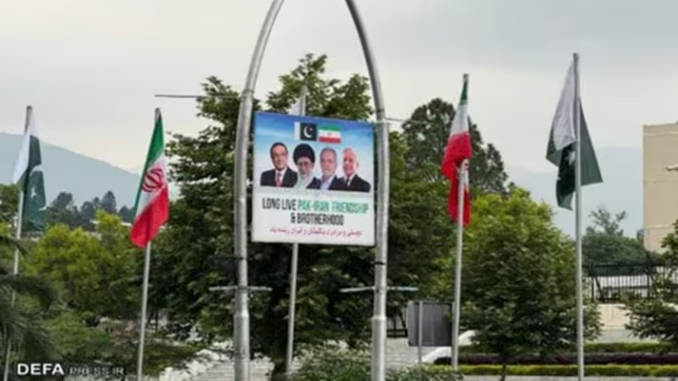 In Islamabad, during Iranian President Masoud Pezeshkian’s visit to Pakistan. (Source: Memri.org, Defapress.ir)
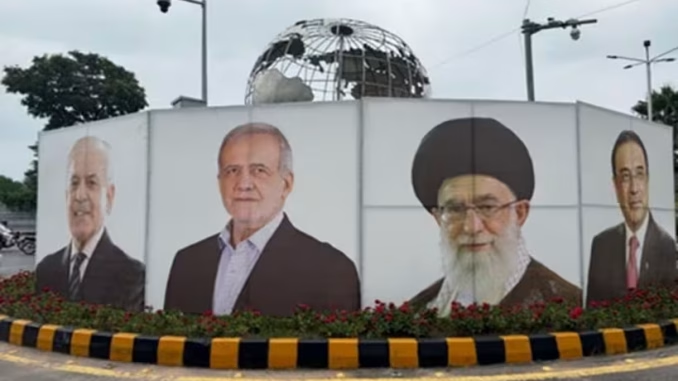 (Source: Memri.org, Defapress.ir)
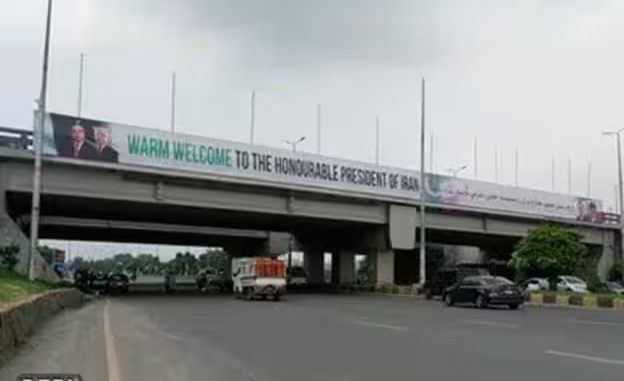 (Source: Memri.org, Defapress.ir)
During his visit, Pezeshkian repeatedly thanked Pakistan for its “firm,” “heartening,” and “unwavering” support throughout the conflict. Pakistani President Zardari lauded the “bravery” of Iran during the 12-Day War, while Pakistani Commerce Minister Jam Kamal described Iran’s performance in the war as a “triumph” over Israel and the United States, declaring that Iran stood as the “crown of the Islamic Ummah” and that its actions were a source of immense pride for Muslims worldwide. Furthermore, during the 12-Day War, former IRGC Commander-In-Chief Mohsen Rezaee claimed that Pakistan had told Tehran it would retaliate with nuclear weapons against Israel if Israel were to use nuclear weapons against Iran. Rezaee said: “Pakistan has stated that if Israel drops a nuclear bomb on Iran, it will drop a nuclear bomb of its own on Israel.” Pakistan denied the Iranian commander’s claim; however, its very articulation reflects how closely Iranian officials portrayed their relationship with Pakistan during the conflict.
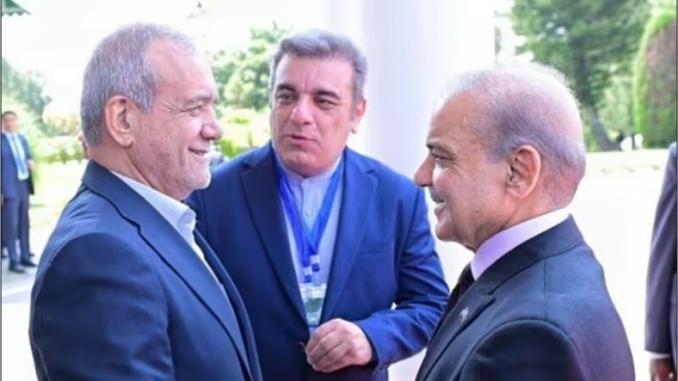 Iranian President Masoud Pezeshkian (left) was received by Pakistani Prime Minister Shehbaz Sharif at the prime minister’s house in Islamabad on August 3 (Source: @GovtofPakistan)
This pattern continued into 2026. Amid reports of mass killings of civilians by the Islamic Republic, Pakistan’s Defense Minister Khawaja Muhammad Asif reiterated support for Iran. On January 13, 2026, he emphasized that Iran has always been a dear neighbor and brother, and that its security and sovereignty are close to Pakistan’s heart. On January 20, the Pakistani Defense Minister in a meeting with Iranian Ambassador to Islamabad Reza Amiri Moghadam said that Pakistan stands firmly by Iran in all circumstances. Furthermore, on January 24, Iranian Foreign Minister Abbas Araghchi thanked Pakistan for its support at the UN Human Rights Council after Islamabad voted against a resolution expanding an international investigation into Iran’s violent crackdown on protests. In March 2026, following the killing of Iran’s Supreme Leader Ali Khamenei in U.S.-Israeli strikes, Pakistani PM Sharif even expressed condolences, describing Khamenei’s death as a “martyrdom” and emphasizing solidarity with the Iranian people “in their hour of grief and sorrow.”
Oman: Declaring Iranian Victory, Calling For Realignment Away From U.S. And Toward Iran
Then there is Oman. The Omani press has made excuses in recent weeks for Iranian attacks on the Gulf states and said that Oman “should reassess the relations with the U.S… The U.S. has neither friends nor allies… balancing [our] ties with the various superpowers and diversifying [our] sources of munitions in order to deter aggression is a central tenet in the strategy for the desired security in the Gulf.” It has crowed that Iran “bravely defended itself” and declared Iran the victor in the war, saying “the one who dictated the terms for stopping the war is the only victor, and we were certainly happy to see that, after 40 days [of fighting], Iran was the one who exclusively set these terms.” It has called to reassess Oman’s relations not only with the U.S. but with this “powerful Muslim neighbor” because it is “better to gain [the friendship] of a strong neighbor than that of an imperialist [country] that abandons [its allies].” The Omani Foreign Ministry also congratulated Mojtaba Khamenei on his election as Iran’s Supreme Leader.
Turkish-Iranian Relations: Turkish Threats To Invade North Iraq If Kurdish Militia In Iran Plays Active Role Against Iran; Billions In Trade And In “Halkbank” Laundering
The rudest awakening of all will be when President Trump finally realizes that his “friend” Turkish President Recep Tayyip Erdo?an, is more of an ally to Iran than he is to America. In late March of this year, Turkish officials stated that if PJAK, an Iran-based Kurdish armed group aligned with the PKK, is active in fighting Iran, Turkey would invade Northern Iraq, where it already has a military presence, saying: “We will intervene as we did in Syria.”
Since December 2001, Turkey has been importing gas from Iran via the Tabriz-Ankara pipeline, despite sanctions against Iran. In 2025, Turkey imported about 7.81 billion cubic meters of natural gas from Iran, constituting 13.5 percent of Turkey’s total natural gas imports. Earlier this month, Turkish Energy Minister Alparslan Bayraktar signaled a readiness to extend the 25-year agreement, which is set to expire in July.
Turkey and Iran do about $5.5 billion in trade annually and just three days ago, on April 25, amid the war, in a ceremony on Turkish soil attended by Turkish Trade Minister Ömer Bolat as well as other Turkish and Iranian officials, a new customs facility was opened in Gürbulak in Turkey to facilitate trade between the two countries. The facility is located across from the Bazargan terminal on the Iranian side, which, with 200,000 trucks passing through it annually, is one of the most important commerce crossings for Iran.
Overt trade is only part of this financial relationship. In 2019, the Department of Justice charged Turkey’s Halkbank “in a six-count indictment with fraud, money laundering, and sanctions offenses related to the bank’s participation in a multibillion-dollar scheme to evade U.S. sanctions on Iran.” The elaborate scheme involved the laundering of $20 billion in Iranian funds, essentially exchanging Iranian energy resources for Turkish gold that could then be used internationally. The case was quietly resolved without the expected billions in fines against Halkbank after Turkey helped to broker a ceasefire with Hamas, with which it has had strong relations for over two decades, hosting offices in Istanbul and its leadership on many occasions. Then Hamas leader Ismail Haniyeh was reportedly in Istanbul on October 7, when, upon seeing footage on Al-Jazeera of the attacks, he led a “prostration of victory.”
The recognition of President Erdo?an’s true position will be the biggest disappointment for President Trump because his trust in Erdo?an originates in the latter’s facilitation of the 2019 killing of then ISIS leader Abu Bakr Al-Baghdadi in Barisha, a Syrian village located less than five miles from the Turkish border in Idlib, an area which at that time was controlled by Turkish-backed fighters. The next day, the Turkish Defense Ministry stated: “Prior to the U.S. Operation in Idlib Province of Syria last night, information exchange and coordination between the military authorities of both countries took place.” Within a week Turkey had rounded up Al-Baghdadi’s wife and sister. For President Erdo?an, however, the killing of Al-Baghdadi was not an anti-jihadist action, nor was it an act of support to President Trump. Erdo?an was simply allowing the Americans to finish off a competitor for the throne of caliph, to which Erdo?an believes himself to be entitled.
The betrayal of Qatar, Pakistan, and Oman will be the second rude awakening of President Trump; it was preceded by the betrayal of European members of NATO, who should have helped the United States for the sake of their own security against the threat of Iranian missiles that can already reach Europe long before they can reach America.[3] Europe behaves as though they are indifferent to living under such an Iranian threat. This is the bitter role of a world leader: to save Western Civilization against its own will.
*Yigal Carmon is founder and president of MEMRI.
[1] Qatar’s enmity of America does not begin with its alliance with Iran, however: MEMRI has published many reports detailing Qatar’s anti-American activities, including its sponsorship of terrorists like Khalid Sheikh Mohammed, the mastermind of 9/11.
[2] Qatar may have thought that by granting President Trump a 747 aircraft, and by its investments in Boeing and in other companies, they would be able to impact his policy. Little did they know that he has his own considerations not easily impacted by money.
[3] See MEMRI Inquiry and Analysis No. 1880, Iranian Regime Claims President Trump’s Statements About Iran’s ICBM Program Are False – But Statements By Senior Iranian Regime Officials Prove The Regime Is Again Lying, February 25, 2026; Special Dispatch No. 12336, Iranian Expert Prof. Mehdi Seif Tabrizi: Iran Has Conducted Its First Test Of An ICBM With A 10,000 Km Range; The Missile Was Launched Towards Siberia, With Russia’s Approval, January 20, 2026; MEMRI TV Clip No. 11502, Retired IRGC General Esmaeil Kowsari: Iran’s Missile Program Founder Hassan Tehrani Moghaddam Was Working On An ICBM When He Was Killed, October 14, 2024.


Leave a Reply
You must be logged in to post a comment.