
By Pamela Geller |
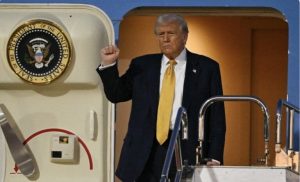 President Trump upon landing in China. Screenshot via Youtube
It will be Trump’s second meeting with President Xi in the US president’s second term. The first was on October 30 last year at the APEC summit in South Korea. This is the first state visit to China by a U.S. president since Trump’s 2017 meeting (White House).
He arrives at a time when the US and China are competing for dominance in trade and technology as well as global influence.
Last October, Xi and Trump met in South Korea and agreed to a truce in their trade war, with the US unwinding tariffs that had hit 145 per cent after Beijing squeezed the supply to the US of critical minerals needed to manufacture high-tech products.… Some US officials say both sides are now pursuing “strategic stability” to buy time to work on their weak spots — including rare earths for the US and semiconductors for China. But others have disparagingly dubbed it “strategic deference” on the part of the US, and worry that Washington is abrogating its role in securing the world order against growing authoritarianism led by Xi and Russia’s Vladimir Putin. American allies in Asia are especially anxious that Trump — who at that encounter with Xi in October described the Chinese president as “a friend of mine, really for a long time now” — might concede ground on regional security, especially on Taiwan, which Beijing regards as its territory. Trump has at times seemed ambivalent about Taiwan despite its importance to the US and its allies as a strategic bulwark in the western Pacific and its dominance of the advanced semiconductor industry (Financial Times).
President Donald Trump is traveling to China alongside a CEO lineup that reads almost like a list of the most powerful companies in America.
The president is expected to pressure the Chinese president on Iran.
Financial Times: President Donald Trump will urge President Xi Jinping to curb China’s support for Iran when the leaders meet in Beijing this week. “I would expect the president to apply pressure,” a US official told reporters in a briefing. He said Trump would resume previous discussions with Xi about China’s support for Iran and Russia, including providing them with dual-use components and potential arms exports. “I expect that conversation to continue. I think you’ve seen some actions, meaning sanctions, coming out from the US side just in the last few days that I’m sure will be part of that conversation,” the official added. The state department on Friday imposed sanctions on three Chinese satellite companies for providing imagery and other services to Iran that helped it conduct military strikes against US forces in the Middle East. The Treasury also sanctioned Yushita Shanghai International Trade for helping Iran import man-portable air-defensive systems [Manpads] from China…. Trump and Xi are meeting six months after reaching a one-year trade war truce at their summit in South Korea. The second official said it was unclear if they would extend the ceasefire in Beijing, or later. “I’m confident that we’ll announce any potential extension at the appropriate time,” he said (Financial Times).
Entourage of Tech Leaders to Join Trump on China Trip
Including, notably, Elon Musk.
President Trump and Elon Musk … reunited again. The president has personally invited the Tesla CEO, along with a powerful delegation of top American business leaders, including Apple’s Tim Cook and BlackRock’s Larry Fink, to join him on a high-stakes trip to China this week…. After months of distance following the 2024 election cycle, the high-profile reunion signals a renewed alliance as the Trump-Musk power duo prepares to negotiate major business deals and push for American interests. The band is back together again, albeit in a less dramatic capacity (RedState).
Joining the delegation are Tim Cook of Apple, Elon Musk of Tesla, Larry Fink, David Solomon, Jane Fraser, Stephen Schwarzman, Chuck Robbins, Cristiano Amon, and executives representing companies such as Boeing, Micron Technology, Visa, Mastercard, GE Aerospace, Cargill, and Meta Platforms.
The delegation spans nearly every major sector tied to the U.S.-China economic relationship, including semiconductors, AI infrastructure, consumer tech, banking, aerospace, payments, biotech, manufacturing, and agriculture.
The fact that so many CEOs are personally making the trip shows just how high the stakes remain for both sides.
NY Post: Despite the hype surrounding China’s artificial intelligence capabilities, progress remains heavily dependent on theft and smuggling. The Chinese Communist Party, meanwhile, is determined to maintain tight control. That has become increasingly clear ahead of this week’s Beijing summit between Donald Trump and Xi Jinping.
The Chinese leader wants to lead the world in what he terms an “epoch-defining technology.” He appears confident that Trump, preoccupied by his war against Iran, has limited options to counter Beijing’s increasingly brazen activities.
Last month, the White House accused Beijing of “industrial-scale” theft of know-how from American AI labs. Meanwhile, US prosecutors claim to have busted an international smuggling ring that funneled advanced chips worth billions of dollars to China in defiance of sanctions.
The CCP is also stepping up efforts to protect China’s own AI innovation, blocking a $2 billion takeover by Meta of a Chinese AI start-up called Manus. For good measure, the authorities prevented Manus’ two founders from leaving the country.
Cheaper & faster
The accusations of theft refer to a process called “distillation,” whereby China is accused of illicitly training its smaller AI models on the output of larger (and expensively developed) US models.
A leaked internal memo written by Michael Kratsios, director of the White House Office of Science and Technology Policy, said: “The US government has information indicating that foreign entities, principally based in China, are engaged in deliberate, industrial-scale campaigns to distill US frontier AI systems.”
Distillation involves the creation of thousands of fake accounts for the targeted AI chatbot or tool, with the accounts working together to extract information.
The US AI company Anthropic said it had detected 24,000 fraudulent accounts, which had generated more than 16 million exchanges with its powerful Claude chatbot. It accused leading Chinese labs of being behind the campaign in order to acquire powerful capabilities “in a fraction of the time, and at a fraction of the cost.”
The company also warned that “distilled” apps would carry none of the safeguards of the original against using AI for such activities as developing bioweapons or carrying out destructive cyberattacks and thereby “creating significant national security risks.”
Beijing also appears to have established an extensive and lavishly funded smuggling network to get around US restrictions on the sale of the top-end Nvidia chips used for training AI models.
In a series of indictments against Chinese nationals, federal prosecutors describe how servers containing “billions of dollars” of restricted chips were shipped to front companies in Southeast Asia before being repackaged and diverted to Hong Kong and mainland China.


“ Xi ORDERED his ORCHESTRA to play the YMCA 😀
Jesse Waters: ? WOW! Trump just walked through China’s “TEMPLE OF HEAVEN” like an EMPEROR ?
Body Language Experts say POTUS projected “DOMINANCE… LIKE A LION” ? ?
Xi ORDERED his ORCHESTRA to play the YMCA ?
China is “OPEN FOR BUSINESS”… they just BOUGHT 200 BOEING JETS, BEANS, AND ENERGY ??
Trump’s message to China? America’s DONE being the SUCKER ???
https://www.facebook.com/share/v/1EV7jEbTZS/?mibextid=wwXIfr
In college, for a Music History class for the Master of Music degree I never completed. 20 years ago, I wrote an essay comparing and contrasting two operas, “Nixon in China” by John Adams and “Marco Polo in China” by Tan Dun. Will someone write “Trump in China?”