
Update: Amit Segal reports the US agrees with strikes on Beirut’s southern suburbs if Hezbollah continues to targets Israeli towns and villages. Addionally, Segal reports that the White House has denied the derogatory comments reportedly made by Trump regarding Netanyahu and Israel.
Peloni: Prof. Kobi Michael, Senior Researcher at the Institute of National Security Studies and the Misgav institute, reviews the actions taken by the US to countermand Israel’s announced attack on Beirut. Trump’s preference to reaffirm his linkage of the war in Lebanon to his negotiations with Iran diminishes Israel’s position in the region, reinforces the subjugation of Lebanon under Iran’s suzerainty, and strengthens Iran’s regional and international outlook rather than diminishing it. While the nature between the US and Israel is not that of equal powers, it is not in Washington’s interest to treat Israel with the lack of respect and influence which is inherently due to its partner in this war.
Furthermore, while Washington announced a ceasefire, this ceasefire was no more accurately termed as such than was the original ceasefire Trump imposed upon Israel on April 16, stating “Israel will not be bombing Lebanon any longer. They are PROHIBITED from doing so by the U.S.A. Enough is enough!!!”
What is important to grasp in both the manner and actions being taken by Trump in these non-ceasefire ceasefires is that he recognizes his ability to have Israel act as he instructs, while he has no such leverage over Iran or its minions. Accordingly, he is subjugating Israel’s interests to the whims of the Iranians, even as Iran’s proxy will not submit to the demands of a ceasefire. Instead, as I noted back on April 16, it was entirely predictable that Hezbollah would react to Trump’s restraint of Israel by doing just as it has done over the past nearing two months by harrying the IDF forces, knowing that their central command was safe from any direct attack due to Trump’s interceding, in effect, on behalf of Hezbollah. The consequence of all of this is that the protection of Hezbollah’s command centers will continue, even as Hezbollah’s attacks will not, leaving the IDF to react and respond rather than to preempt attacks, at the cost of precious lives, political capital, and the possibility of any victory.
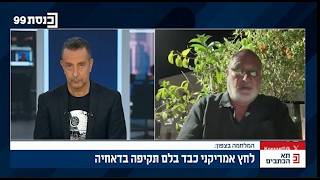 Video Loads at Bottom
Overview of Prof. Kobi Michael’s remarks
– Premature announcement of Dahieh attack:
Prof. Kobi Michael said it was “not a good event” that Israel publicized an intended strike on Dahieh before carrying it out. He argued this embarrassment undermined the element of surprise that the attack would have had.
– U.S. pressure and ceasefire:
Michael noted that President Trump was effectively “imposing a kind of ceasefire” on Israel. Meanwhile, Israel wanted to move past the existing “equations” with Hezbollah and set new rules of engagement, since Hezbollah had long been provoking Israel and felt emboldened by U.S. restraint.
– Iran’s influence and proxy link:
Michael insisted that Iran must not be allowed to claim a victory by linking conflicts in different arenas. He warned that this connection serves Iranian interests, encourages other Iranian proxies, boosts Iran’s regional position, and strengthens Hezbollah in Lebanon.
– U.S.–Israel power asymmetry:
He emphasized that the U.S. is a superpower and Israel only a regional power, so their interests sometimes diverge. He argued that on the Lebanon issue, Israel must vigilantly protect its own interests, try to persuade the Americans, and possibly act even if Washington disagrees.
– Hezbollah’s ceasefire response:
He recalled that when Israel threatened to bomb Dahieh, Hezbollah (via Speaker Nabih Berri) immediately offered a ceasefire “here and now.” This, Michael said, showed that Hezbollah understood the risk to its centers of gravity.
– Impact of a ceasefire on Israel:
Michael warned that if Hezbollah holds fire and a ceasefire takes hold, it would be “not good” for Israel. Such a pause would limit reconstruction and relief in northern Israel and leave everyone expecting a ceasefire violation. He noted this is likely since U.S.–Iran negotiations may eventually break down.


CNN, a conduit for the enemies of America!
Destroying the IRGC, an absolute necesssity.