
Janatan Sayeh | June 17, 2026
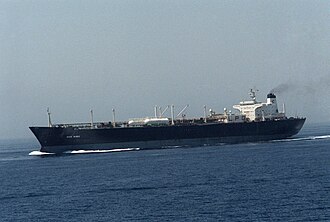 A port view of the reflagged Kuwaiti supertanker GAS KING underway. Photo by Department of Defense. American Forces Information Service. Defense Visual Information Center. 1994 -Public Domain, Wikipedia
The U.S. has reportedly granted Iran sanction waivers for selling oil, with one Iranian supertanker transporting crude oil having already crossed the U.S. naval blockade.
This development came one day after Vice President JD Vance said that Tehran would be given access to a $300 billion fund financed by the “Gulf Coast Coalition so long as they honor their end of the obligation.”
Providing the regime with financial incentives before securing any concessions would squander the unprecedented leverage Washington has built through its military campaign and blockade. More importantly, it rests on the flawed assumption that incentives produce cooperation. Yet Tehran perceives such concessions as victory in the recent conflict, reducing any incentive to make meaningful compromises on the nuclear file.
U.S. Blockade Established Unprecedented Leverage
Iran’s crude oil exports fell to zero in May, while total seaborne petroleum exports averaged just 64,000 barrels per day. This marked a sharp decline from 981,850 bpd in April, 1.15 million bpd in March, and 2.1 million bpd in February. Monthly inflation reached 8.8 percent in May, up from roughly 3-4 percent five months earlier, while year-over-year inflation surged from 52.6 percent to 83.9 percent over the same period. Even regime authorities feared the economic situation could ignite renewed protests, increasingly regarding the capsizing economy as a greater threat than the war itself.
Yet if reports that an Iranian supertanker has already crossed the blockade are accurate, this period of pressure may already be coming to an end.
Tehran Wants Relief To Rearm Without Nuclear Concessions
The U.S. goal is that an initial agreement over the Strait of Hormuz will pave the way for negotiations over Iran’s buried stockpile of highly enriched uranium (HEU). Instead, Iran has spent the negotiation period sealing off its cache of near weapons-grade uranium, collapsing tunnels and laying explosive mines at key access points.
Media affiliated with Mohammad Bagher Ghalibaf — Iran’s parliament speaker who is leading negotiations on Tehran’s behalf — asserted that any potential agreement is merely an “opportunity” for Iran “to rebuild its offensive and defensive military capabilities, and “prepare for a large-scale battle.” IRGC Quds Force Commander Esmail Qaani declared that “Hamas will soon be rebuilt” while threatening to use Tehran’s Houthi proxies to close the Bab al-Mandab Strait in the Red Sea.
Washington’s Silence Hands Tehran a Narrative Victory
Regime hardliners have turned on one another over the deal, while some staged protests against Foreign Minister Abbas Araghchi and Ghalibaf for negotiating with Washington. The same factions resisted the 2015 nuclear deal and have long rejected engagement with the United States.
With Washington withholding details of the agreement, state outlets openly described the postwar disinformation campaign as an effort to win the narrative. Some asserted that Tehran had “imposed its will” on Washington, while others claimed the Islamic Republic forced last-minute U.S. concessions.
A Limited Deal Should Not End Maximum Pressure
The agreement already appears to be taking effect, with Iranian tankers moving through the blockade. Over the next 60 days, Washington should continue maximum pressure and be prepared to respond if Tehran fails to follow through on its commitments.
First, mine-clearing should be conducted by an international mission rather than the Islamic Republic, with any attempt by Tehran to obstruct the effort triggering a U.S. retaliation.
Second, revenues from renewed oil sales should remain locked in escrow accounts, with no access to frozen assets or side deals that allow Tehran to repatriate the funds.
Third, permitting Iran to resume oil sales is far more consequential than a narrow General License, as broadening authorization for financial transactions would surrender the strongest leverage of the sanctions architecture established by President Donald Trump.
Finally, the text of any agreement with Tehran should be made public both for transparency and to prevent the Islamic Republic from winning the narrative battle.
Janatan Sayeh is a research analyst at the Foundation for Defense of Democracies (FDD), where he focuses on Iranian domestic affairs and the Islamic Republic’s regional malign influence. For more analysis from the Foundation for Defense of Democracies (FDD), please subscribe HERE. Follow FDD on X @FDD and @FDD_Iran. Follow Janatan on X @JanatanSayeh. FDD is a Washington, DC-based, nonpartisan research institute focusing on national security and foreign policy.


Leave a Reply
You must be logged in to post a comment.