
Orde Kittrie & Miad Maleki | June 30, 2026
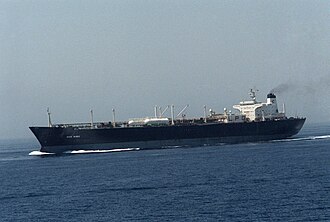 A port view of the reflagged Kuwaiti supertanker GAS KING underway. Photo by Department of Defense. American Forces Information Service. Defense Visual Information Center. 1994 -Public Domain, Wikipedia
The Treasury Department’s issuance on June 22 of a license pausing Iranian petroleum sanctions appears to be inconsistent with the Iran Nuclear Agreement Review Act (INARA), which prohibits such relief for 30 days after a U.S. nuclear agreement with Iran is submitted to Congress. The U.S.-Iran Memorandum of Understanding (MOU) was submitted to Congress on June 18. The 30-day period was designed to provide Congress time to review a nuclear agreement with Iran — and potentially reject it — prior to implementation.
The license provides Iran with billions of dollars in unprecedented relief from congressionally mandated sanctions, thereby enabling Iran to rebuild its armed forces, nuclear program, and terrorist proxies before — and thus perhaps ultimately without — making meaningful concessions on any of those threats to U.S. national security.
The Justice Department has reportedly provided the White House with an opinion, shared with neither the public nor Congress, that INARA’s requirements somehow do not apply to the MOU. Congress should insist on being fully briefed on the rationale for this seemingly inexplicable view so it can judge its validity for itself. In addition, congressional action to block the license, using INARA or another legislative vehicle, would help ensure that the current nuclear negotiations with Iran result in a final agreement that advances, rather than undermines, U.S. national security.
The stakes are enormous. The license frees roughly 67 million barrels of stranded Iranian oil worth an estimated $8 to $9 billion, clears the way for restored exports worth as much as $120 million to $135 million per day, and reopens a $10 to $15 billion annual petrochemical revenue stream, all before a single Iranian nuclear concession has been verified.
The applicable INARA provision specifies that during the 30-day period following transmittal to Congress of any nuclear agreement with Iran, “the President may not waive, suspend, reduce, provide relief from, or otherwise limit the application of statutory sanctions with respect to Iran … or refrain from applying any such sanctions pursuant to an agreement” covered by INARA. INARA’s prohibition of “refrain[ing] from applying” statutory sanctions bars the administration’s nonenforcement posture on the Iran Sanctions Act and on §1245 of the FY2012 National Defense Authorization Act, neither of which has been formally suspended through any statutory mechanism.
The June 22 license pausing petroleum sanctions on Iran was clearly issued pursuant to the MOU’s paragraph 10, which specifies that “immediately upon the signing of this MOU … Treasury will issue waivers for the export of Iranian crude oil, petroleum products and derivatives, and all associated services.”
Former top attorneys from both the George W. Bush and Barack Obama administrations were quick to warn that INARA prohibited such waivers for the first 30 days following the MOU’s transmittal to Congress.
INARA was passed to strengthen Congress’s role in overseeing President Barack Obama’s 2015 Joint Comprehensive Plan of Action (JCPOA). But INARA does not have a sunset date and is as applicable to President Donald Trump’s MOU with Iran as it was to Obama’s JCPOA.
The license’s broad scope compounds its damage to U.S. national security. The license does not merely authorize Iranian petroleum transactions — it explicitly allows involvement by entities sanctioned under the Global Terrorism Sanctions Regulations, the authority under which Treasury designated Iran’s Central Bank and Ministry of Petroleum for financing the Islamic Revolutionary Guard Corps-Qods Force and Hezbollah. The licensing of transactions with U.S.-designated terrorist-financing entities is not incidental to the sanctions relief — it is the relief.
The license also authorizes Iranian petroleum transactions previously prohibited by the Weapons of Mass Destruction Proliferators Sanctions Regulations, thereby allowing transactions with — and thus facilitating revenues for — entities sanctioned for supporting Iran’s ballistic missile program and the IRGC’s economic conglomerates.
Most consequentially, the license authorizes U.S. dollar-denominated payments to the government of Iran — including the Central Bank of Iran — and blocked persons, for oil purchases. This provision, unprecedented in recent Iran sanctions relief, gives foreign financial institutions the correspondent-banking comfort to process Iranian oil proceeds through the international financial system, effectively neutralizing the dollar as a sanctions-enforcement tool for these transactions.
The MOU trades vast U.S. leverage for relatively minor Iranian concessions. Just as troubling, the final deal outlined in the MOU will not verifiably and sustainably prevent Iran from acquiring a nuclear weapon. It will also not constrain — but rather financially fuel — Iran’s missile program, terrorism sponsorship, human rights violations, and malign regional activity.
By increasing its involvement, Congress will strengthen the administration’s incentives and capacity to strike a better deal with Iran. Congressional buy-in is essential to an agreement’s implementation and sustainability. Several provisions of any final agreement will be dependent on statutory changes that Congress is far more likely to support if is involved in the process.
The MOU, and its implementing license pausing sanctions on Iranian petroleum, raise numerous troubling questions. Congress should use its INARA and other legislative authorities to demand answers, block the license, and consider blocking the MOU before it is too late. By acting now — and insisting on full INARA compliance — Congress can help steer these negotiations toward a stronger, more durable agreement that genuinely protects U.S. national security.
Orde F. Kittrie is a law professor at Arizona State University, senior fellow at the Foundation for Defense of Democracies (FDD), and former lead State Department attorney for nuclear affairs. Miad Maleki is a senior fellow at FDD and a former senior executive at the U.S. Treasury Department where he led sanctions targeting at the Office of Foreign Assets Control. For more analysis from Orde, Miad, and FDD, please subscribe HERE. Follow FDD on X @FDD. Follow Orde on X @ordefk. Follow Miad @miadmaleki. FDD is a Washington, DC-based, nonpartisan research institute focused on national security and foreign policy.


Leave a Reply
You must be logged in to post a comment.