
Peloni
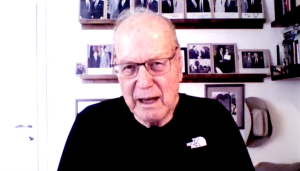
In an important interview on TOV Channel, Ambassador (ret.) Yoram Ettinger reflects upon VP J.D. Vance and his current approach to Israel, Iran, and US foreign policy, with the host asking whether Israel should be concerned by Vance’s recent statements and whether Vance might represent the future direction of the Republican Party. While the host expresses unease over Vance’s rhetoric – particularly comments suggesting that American taxpayers effectively sustain Israel and questioning whether some of his remarks reflect hostility toward Jews – Ettinger counters that the more accurate depiction to what we are witnessing from Vance is not based on antisemitism but, rather, that it is related to Vance’s inexperience and a lack of understanding.
Ettinger repeatedly emphasizes that Vance entered national office with virtually no background in foreign policy or national security. Also, his two years in the Senate did not include service on the principal foreign affairs or defense committees, and he therefore depends heavily on advisers, especially former State Department official Andy Baker. Ettinger argues that Baker represents the traditional viewpoint of the State Department establishment, which historically opposed any support for the creation of Israel in 1948 and has consistently remained critical of pro-Israeli policies in Washington ever since. Ettinger goes on to also describe Baker as an isolationist who opposes extensive American military involvement overseas in general. Ettinger notes that these influences sway Vance towards adopting a worldview which is distinctly disconnected from Middle Eastern realities. He notes that the reliance on experienced advisers by Washington leaders is not unusual, and he shares similar comparisons which took place under Presidents Biden and Carter, both of whom also relied heavily upon trusted foreign policy advisers due to their also having entered office without extensive international experience. He goes on to remind viewers that American presidents and members of Congress are generally elected for domestic rather than foreign policy expertise.
Responding to the suggestion that Vance’s comments about Israel may carry antisemitic overtones, Ettinger rejects that interpretation. He characterizes the remarks as provocative and irritating but insists they are better explained by ignorance than by prejudice. In his view, Vance is expressing a misconception shared by many Americans, including both supporters and critics of Israel: namely, that the United States simply gives Israel foreign aid as though it were charity to a needy country. Ettinger notes that employing the phrase “foreign aid” to describe Washington’s investment in supporting Israel’s defenses creates the false impression that Israel belongs in the same category as developing countries dependent on American assistance. He maintains that this misunderstanding is relatable to Israel’s having failed to explain the true nature of the relationship, something which Ettinger and others have highlighted over the years.
Ettinger emphasizes throughout the interview that American assistance to Israel is not charity but an investment that generates exceptional returns for the United States. He highlights the fact that Israel serves as a strategic US asset by testing American military technology under combat conditions, improving U.S. defense systems, strengthening the American defense industry, and projecting American power across the Middle East. By doing so, the annual $3.8 billion in US security assistance package has been repaid many times over, producing returns for the US taxpayer which vastly exceed the cost of this investment.
Ettinger notes further that Vance himself appeared to recognize this distinction during the 2024 election campaign. He recalls that Vance questioned the strategic benefit of providing roughly $150 billion in military assistance to Ukraine while explicitly stating that aid to Israel clearly produces benefits for the United States. Although Ettinger believes Vance fails to fully appreciate the extent of those benefits which should be understood to be well above a 1000% return on that investment, nonetheless Vance did acknowledge at the time that support for Israel served American interests. Based on this understanding, Ettinger highlights that the distinctions which now mark Vance’s current rhetoric represents a noticeable shift from those earlier statements.
The conversation next addresses Iran, where Ettinger expresses his strongest criticism of Vance. He argues that Vance has been overly impressed by conversations with Iranian and Pakistani representatives and has come to believe that the Iranian regime can be moderated through negotiation. Ettinger warns that this is a serious misunderstanding of the ideological and religious character of the Islamic Republic. He also argues that anyone who fails to appreciate the role of revolutionary ideology, religion, and authoritarian political culture in the Middle East becomes vulnerable not only in dealings with Iran but also with such nations as Russia and China. Consequently, he concludes that Vance’s willingness to promote negotiations as possibly leading to a viable solution with the Iranians reflects a lack of familiarity with the region rather than being based on strategic realism.
Despite these concerns, Ettinger does not believe Vance currently commands sufficient support within the Republican Party to become its next presidential nominee. He argues that Vance’s present influence stems largely from President Trump’s decision to select him as vice president rather than from an independent political base within the party. Drawing on his own conversations with Republican lawmakers, Ettinger notes that most Republican senators and members of the House oppose negotiations with Iran and favor a much tougher approach, with many believing that the regime itself should ultimately be replaced. He points to Republican congressional leaders and committee chairmen who have expressed skepticism or outright opposition to the emerging negotiations with Iran, arguing that these positions differ sharply from those voiced by Vance, himself.
When the host asks whether Israel should prefer Vance or another potential Republican nominee, Ettinger wisely reframes the question by addressing the fact that Israel’s preferred candidate should simply be the one who is best for the United States while correctly asserting that whatever benefits America will ultimately benefit its allies in turn. Nonetheless, Ettinger notes that figures such as Marco Rubio, Florida Governor Ron DeSantis, Senator Ted Cruz, and several other Republicans would be preferable to Vance both from the standpoint of American interests as well as Israel’s security. At the same time, he emphasizes that Israelis often underestimate the importance of Congress. Ettinger notes that Republican members of Congress represent a more authentic reflection of the views of their constituents than do many national leaders. He emphasizes that the vast majority of Republican lawmakers oppose negotiations with Iran, and instead prefer regime change, strongly contrasting with the views being expressed by Vance, and that Israel should focus a greater effort in cultivating and strengthening its relationships with those lawmakers.
Toward the end of the interview, the host asks about Vance’s personal background. Ettinger notes that Vance has undergone significant religious and political changes, moving through several churches before eventually becoming an Evangelical Christian and evolving politically from a critic of Donald Trump into one of his supporters. While Ettinger explicitly says he is not accusing Vance of opportunism, he argues that these shifts suggest a political figure whose worldview is still developing. Consequently, he does not rule out the possibility that Vance’s political outlook might continue to evolve, including as regards to Israel.
The interview concludes with Ettinger returning to what he sees as Israel’s own responsibility for the misconceptions surrounding the bilateral relationship expressed by Vance. He argues that Israel has failed to adequately communicate to American leaders or the broader American public that it is not a recipient of charity but is instead a strategic partner whose contributions to American power and interests uniquely outweighs the financial investment it receives. The host agrees, observing that if even the Vice President of the United States repeats the narrative that American taxpayers sustain Israel, it is hardly surprising that ordinary Americans might draw a similar conclusion. He concludes that Israel must become far more proactive in explaining its strategic value to the United States and in clarifying that the US-Israeli relationship is one based on mutual benefits rather than one-sided assistance.
Click here to see full interview [auto-dubbed]:



https://youtu.be/Fdl5ctdrV28?is=ivxBy4JOe7vITRQt
https://www.cbsnews.com/news/vance-israel-insulted-west-bank-annexation-knesset-vote/
@Peloni
https://www.theguardian.com/us-news/2026/jul/05/atlantic-republishes-jd-vance-trump-essay
Seems me Vance has gone through a lot of sudden conversions, a couple of them quite recently. All other things being equal, that’s not exactly confidence-building in choosing a President. And he was brought up as an Evangelical, was a self-described “angry atheist” in college, and converted to Catholicism 7 years ago.
“A foolish consistency is the hobgoblin of little minds, adored by little statesmen and philosophers and divines. With consistency a great soul has simply nothing to do. He may as well concern himself with his shadow on the wall. Speak what you think now in hard words, and to-morrow speak what to-morrow thinks in hard words again, though it contradict every thing you said to-day. — ‘Ah, so you shall be sure to be misunderstood.’ — Is it so bad, then, to be misunderstood? Pythagoras was misunderstood, and Socrates, and Jesus, and Luther, and Copernicus, and Galileo, and Newton, and every pure and wise spirit that ever took flesh. To be great is to be misunderstood.”
– Ralph Waldo Emerson, “Self-Reliance” (1841).
And what about his having worked for Peter Thiel? When did he convert from Globalist to MAGA?
Correction: Peloni, I seem to recall that you wrote that Thiel is a globalist.
AI Overview says: “peter thiel globalism +7 Peter Thiel views globalism as a deeply flawed and unsustainable force, warning that it leads to a stagnant, one-world state and stifles the radical technological innovation needed to avert resource depletion. He has famously stated that “globalization without new technology is unsustainable”, arguing that it has simply copied and spread existing ideas rather than creating true progress.Key Themes in Thiel’s ViewsGlobalization vs. Technology: In his book Zero to One, Thiel distinguishes between “globalization” (horizontal progress—taking things that work and expanding them everywhere, like copying the 19th century to build a modern Chinese city) and “technology” (vertical progress—doing something completely new, like going from zero to one). He favors technology-driven progress over the mere geographic expansion of existing models.The Threat of a “One-World State”: Thiel has expressed strong opposition to supranational organizations and the Brussels bureaucracy. In recent years, his rhetoric has taken a theological turn, warning that the push for global integration and a centralized world government is comparable to the apocalyptic rise of the Antichrist.National Conservatism: Thiel is a self-described conservative libertarian. Over the last decade, he has drifted away from open-market globalism in favor of national conservatism, arguing that globalization has undermined Western economies, concentrated wealth in unaccountable global elites, and created a dangerous dependency on countries like China.To explore Thiel’s detailed thoughts on these topics, check out his interview on the Hoover Institution or listen to his broader economic breakdowns on Conversations with Bill Kristol.”
Am I misremembering something? Please clarify.
By contrast:
https://www.timesofisrael.com/huckabee-israels-claim-to-judea-and-samaria-stronger-than-us-tie-to-manhattan/
Call me conservative but that’s what I call stable.
This is the article that made me switch from independent to Republican if only for the 2016 primary. Plan to do that again next year for 2028.( In NY state, party registration changes only take effect after the November general election. The rest of the time, it’s just symbolic here so there’s no point.)
I have much respect for ambassador Ettinger. I love how he always tries to explain how the US benefits from the ‘aid’ it sends to Israel. I totally agree of course.
But on his interpretation of Vance vis a vis Israel and Jews – I disagree, though not entirely. He’s right about Vance’s lack of foreign policy knowledge and worse, his ignorance regarding the Muslim mind set. If in fact he is taking his cues from the old State Department’s anti-Israel foreign policy, then we are in trouble.
But how does Ettinger explain Vance’s comments some months ago at a Turning Point USA event when a young Tucker Carlson fan asked: Why are we supporting Israel anyways? His nonsensical response was telling. He went into an unhinged diatribe about how Jews and Christians differ, sighting how one group believes in Jesus and the other does not. Have you noticed that he never uses the term Judeo-Christian values but instead only uses the term Christian values. He took a page directly from Obama’s presidency. Divide the public. Obama was a master deceiver at this. He did it with Blacks vs Whites, Jews vs Christians, rich vs poor, etc.
Most important, we all know that it was thanks to his ‘good friend’ Tucker who got him the job as VP. When asked about Tucker’s obscene Jew/Israel hatred he replied that although they might disagree on certain issues, Tucker remains a very good, close friend! That would be like saying that although I disagree with some of Hitler’s policies (like murdering 6 million Jews in the most horrific way), we share a love of German shepherd’s so we remain good friends.
The fact that he refuses to condemn his ‘friend’ for his blatant, overt antisemitism is the most disturbing issue and it has nothing to do with foreign policy or ignorance thereof.
I compare him to his friend Tucker, Kanye West, Candace Owens, Megan Kelly and others on the right who slowly but surely turned on us. We all had hopes and wishes at the beginning that they are our friends who just needed more explaining. Believe me, I held the same hopes for Vance. But as I predicted in my blog post: https://leonupsidedown.blogspot.com/2025/12/antisemitism-from-right-jd-vance.html
that unless Vance is confronted both publicly by members of the Republican party (Congress, cabinet members and citizens) and privately by his boss (Trump), his subliminal Jew hatred will become more overt and obvious.
I also want to note that I think Vance is viewed as the best contender for the Republican nomination. He is very articulate and checks all the boxes for your average conservative citizen to choose. The fact that many Republicans in Congress oppose his foreign policy is near moot.
If someone asked me what I thought about him as the next US president I would respond simply with: G-d forbid!
I’m a conservative, and a Republican, but there is something about J.D. Vance that I just don’t trust. He’s not showing all his cards, and I don’t think we would like some of them very much.
… and lack of knowledge.