
Peloni: We live in an age in which information is more easily weaponized than munitions, and in the war of words, we are losing. David Bedein of the Center for Near East Policy Research explains some of the battlefields on which this war is currently being lost, and how to change the dynamics so that victory on these battlefronts might also be achieved.
Israel faces not only military threats but also an increasingly sophisticated campaign of delegitimization that demands a far stronger response.
By: David Bedein | TheJ.ca | June 28, 2026
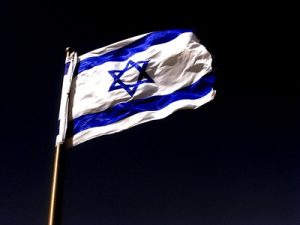 Israeli Flag. “Israel National Flag” by momo, CC BY 2.0
Israel today faces a war on multiple fronts. While much attention is understandably focused on military threats, another battle is being waged every day in the media, in academia, in international institutions, and on social media platforms around the world.
This is a war of words.
And unless Israel begins to fight back with the same determination that it brings to the battlefield, we risk losing ground in the court of international opinion.
The Genocide Lie
Joseph Goebbels, Hitler’s Minister for Public Enlightenment and Propaganda, operated on the principle that if a lie is repeated often enough, it eventually gains credibility.
That lesson has not been forgotten.
Today, a vast network of organizations, many operating under the banner of human rights, has invested enormous resources in promoting the false narrative that Israel is conducting a war of genocide.
The accusation is not merely wrong. It is a deliberate inversion of history and a modern blood libel directed against the Jewish state.
Israel is fighting a defensive war against terrorist organizations that openly seek its destruction. Yet much of the international discourse has shifted from examining Hamas atrocities to placing Israel itself in the dock.
This campaign cannot be countered simply by producing another fact sheet or issuing another diplomatic statement.
Israel must begin imposing consequences on those who knowingly spread defamatory falsehoods while benefiting from access to the country. Israel should carefully examine whether individuals who repeatedly accuse the Jewish state of genocide, without evidence and in bad faith, should continue to enjoy unrestricted professional access within Israel.
The Palestinian Authority Curriculum
Another dangerous front in this conflict is Palestinian education.
When Israel and the United States agreed to engage with the Palestine Liberation Organization, a central assumption was that the PLO would abandon its commitment to Israel’s destruction and move toward coexistence.
That transformation never occurred.
My organization, the Center for Near East Policy Research, has monitored the Palestinian Authority curriculum since August 1, 2000, when the Palestinian educational system introduced its first independent curriculum.
Over the past quarter-century, we have collected and archived more than 1,000 Palestinian Authority textbooks.
The findings are deeply troubling.
The curriculum does not teach peace, reconciliation, compromise, or mutual recognition. Instead, students are exposed to messages that glorify martyrdom, reject Jewish historical ties to the land, and promote an ethos of continued struggle.
The Palestinian Authority once promised that its curriculum would receive UNESCO endorsement. That promise was never fulfilled.
Education shapes future generations. No peace process can succeed while children are educated for conflict.
Israel must therefore seriously reconsider its current policies toward educational institutions that systematically promote incitement.
Pay for Slay Continues
For years, Palestinian Authority officials have promised reforms to the system commonly known as “Pay for Slay.”
Those promises have not materialized.
Instead, the Palestinian Authority continues to provide financial payments to convicted terrorists and to the families of attackers.
No democratic society can accept a system in which acts of terrorism are rewarded with lifelong financial support.
The international community has repeatedly condemned this policy. Yet the program remains in place.
The time has come for Israel to move beyond diplomatic protests.
Anyone who knowingly facilitates, transfers, administers, or distributes funds that reward terrorism should face legal consequences.
Foreign Funding Networks
Another issue demanding urgent attention is the extensive network of non-governmental organizations operating in Judea and Samaria, as well as elsewhere, under the sponsorship of foreign governments and private donors.
Many of these organizations openly work against Israeli interests while receiving substantial foreign funding.
Particular scrutiny must be directed toward Qatar, which has emerged as a major financial player throughout the region.
Qatar has simultaneously positioned itself as a diplomatic intermediary while continuing to provide support and legitimacy to actors fundamentally opposed to Israel’s existence.
Israel must reassess its relationship with Qatar and closely examine the activities of Qatari-funded entities operating within the country.
Likewise, Israel’s allies should carefully evaluate their own relationships with Doha.
Time for a New Strategy
Israel has repeatedly demonstrated that it can defend itself militarily.
The challenge before us now is whether we possess the same determination in the diplomatic, educational, and informational arenas.
Wars are no longer fought solely with tanks and aircraft.
They are also fought through narratives, classrooms, international institutions, and media campaigns.
Israel cannot afford to remain passive while others define its story.
The Jewish state must fight back in the war of words with clarity, confidence, and resolve.
Because if we do not tell our story, others will tell it for us.


I just had a horrible thought. Could Yahyah Sinwar, the architect of the Oct 7, 2023 invasion and massacre – who, ironically, was himself released from prison – where he had been able to attend college* – in the 2011 Gilad Shalit exchange and even more ironically, whose life and intelligence had been saved by Israeli surgeons who successfully removed a brain tumor. –
Could Sinwar have gotten the idea for Hamas’ use of Go Pro cameras and social media during and after from this satirical video?
I had already been wondering if he got the idea for the use of hang gliders to breach the border from this global hit Kdrama:
“Crash Landing on You” 2019-2020.
“A paragliding mishap drops a South Korean heiress in North Korea — and into the life of an army officer, who decides he will help her hide.”
It’s on Netflix. I just checked.
“ These are results for did yahya sinwar get a college degree in prison:
AI Overview: Yahya Sinwar did not earn a new college degree while in prison. However, during his 22 years in Israeli custody, he pursued academic studies through Israel’s Open University. He funded his classes himself**, completed 15 courses in humanities and social sciences, and maintained high grades, but ultimately did not complete a degree.Before his imprisonment, Sinwar had already earned a bachelor’s degree in Arabic language and literature from the Islamic University of Gaza.”
** How, through pay for slay stipends?
“Compassion for the cruel leads to cruelty to the compassionate.” “Guide for the Perplexed. “”Maimonides (Rambam). 1138-1204 C.E.
Enter Ben Gvir.
For starters the entire Moslem Sharia system of Dhimmi and Jizya protection racket of non-Moslems otherwise derogatorily classed as Kaffirs/kufr which translates as perfidious is apartheid – as is their treatment of women.
Wahtever else MAhommed was he was an aggressive and successfu warlord who ethnically cleansed Jews and Christians from Arabia and his followers in the Moslem Bros /Ikwan intend to do likewise to the World.