
CENTCOM carries out additional round of strikes on Iranian coastal cities over the weekend
All Israel News Staff | Published: July 12, 2026
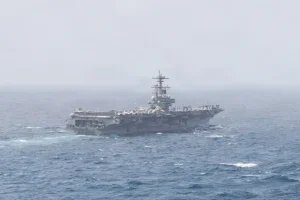 U.S. Navy warships and air assets continue to patrol regional waters enforcing the blockade against Iran, June 12, 2026. (Photo: US Centcom)
Shipping traffic through the Strait of Hormuz remains an area of contention between the United States and Iran, as the Memorandum of Understanding and the ceasefire between the two countries appears to be collapsing.
On Friday, U.S. officials claimed that the administration of President Donald Trump was demanding Iran make a public statement saying the Strait of Hormuz is open for all traffic and that there would be no more attacks on vessels transiting the critical waterway.
This came after President Trump posted to social media that “the Cease Fire is OVER!”
On Saturday, Oman, which holds territory across from Iran at the narrowest point of the strait, announced it had presented a proposal to Iran for joint management of the waterway, using two separate routes.
The Islamic Republic regime has previously stated that the strait should only be managed by those two countries, as it falls within their sovereign territory. However, Iran has also tried to force all sea traffic through a course along its coastal territory, frequently charging protection fees for doing so.
However, with another attack on a vessel transiting the strait outside the Iran-approved route on Saturday, and after the Islamic Revolutionary Guard Corps announced the closing of the waterway, the U.S. military launched additional strikes on Iranian coastal targets later that night.
U.S. Central Command (CENTCOM) said it “completed a third round of strikes this week against Iran, July 11, holding Iranian forces accountable for attacking another commercial ship in the Strait of Hormuz.”
CENTCOM claimed to have hit “approximately 140 Iranian military targets,” including “Iranian missile and drone sites, naval capabilities, ammunition storage facilities, communication networks, and coastal surveillance locations.”
According to open-source intelligence accounts online, most of the confirmed targets lie along Iran’s Persian Gulf coast, as the U.S. apparently seeks to degrade the regime’s ability to threaten traffic in the waterway.
So far all targets (that we know about) have been on Irans southern coast
Bandar Abbas
Sirik
Qeshm Island
Asaluyeh
Bushehr Province
Jask
Konarak
Chabahar
Mahshahr, Khuzestan Province pic.twitter.com/eH7GlR7cNQ— Open Source Intel (@Osint613) July 12, 2026
Over the past week, CENTCOM said it has struck “more than 300 targets at the direction of the Commander in Chief to degrade Iran’s ability to attack civilian mariners and commercial vessels freely transiting the strait. Commercial vessel transits through the vital international maritime corridor continue.”
Following the U.S. strikes, Secretary of War Pete Hegseth said, “Iran made a poor choice. Now they pay.”
Iran made a poor choice. Now they pay. https://t.co/8m4fEfgrXv
— Pete Hegseth (@PeteHegseth) July 11, 2026
CENTCOM further stated that its forces “have helped facilitate the successful transit of more than 800 commercial vessels and 400 million barrels of crude oil through the Strait of Hormuz.”
The IRGC launched retaliatory attacks against U.S. forces and facilities across the region. Attacks were reported in Kuwait, Oman, Qatar, and Jordan.
The IRGC claimed to have targeted critical support and refueling platforms in the port of Duqm, used by the U.S. carrier support group in the Persian Gulf.
Ebrahim Rezaei, spokesperson for the Iranian parliament’s National Security Committee, later declared that Iran had taken over the strait “by force.”
While Israeli forces have yet to participate in the strikes on Iranian sites, security officials have said the nation stands ready to join the fight against Iran, if its territory or forces are targeted by the Islamic Republic.
Israpundit is entirely dependent on readers support. Please help me continue educating people with the truth about what is going on in Israel and around the world.


Leave a Reply
You must be logged in to post a comment.