
Bridget Toomey & Behnam Ben Taleblu | July 27, 2026
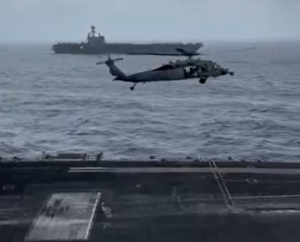 Screengrab via Social Media.
Yemen’s Houthis have brought the Red Sea and the Bab al-Mandeb Strait into the conflict between the United States and the Islamic Republic of Iran — blocking millions more barrels of oil from easily reaching the global market.
On July 22, the Iran-backed Yemeni terror group claimed drone and missile attacks on two Saudi vessels transiting the Red Sea, enforcing a maritime blockade of the kingdom. Saudi Arabia confirmed one of the ships was set ablaze and responded by striking sites in Yemen’s Houthi-controlled west coast. The Houthis then attacked oil infrastructure on Saudi Arabia’s Red Sea coast.
To support Houthi aggression in the Red Sea, the Islamic Republic reopened direct flights between Tehran and Sanaa in early July. On July 3, Iran sent a plane to retrieve the Houthi delegation that attended Supreme Leader Ali Khamenei’s multiday funeral — the first flight between the two capitals in roughly a decade. The delegation’s July 13 return flight carried Iran’s Islamic Revolutionary Guard Corps (IRGC) advisors and weapons, according to Reuters.
Saudi Arabia has maintained an air blockade of Houthi territory to deny Tehran direct access to arm its proxy. As Iran explores new avenues to expand the conflict with the United States, it is increasingly looking to the Houthis.
Tehran Has Been Preparing for Two Different Maritime Conflicts
In the summer of 2018, the late IRGC Quds Force Commander Qassem Soleimani said “the Red Sea, which was once safe, is no longer safe for the presence of Americans.” The speech followed several Iranian declarations threatening oil exports and even the closing of the Strait of Hormuz following the U.S. exit from the 2015 Iran nuclear deal. Iran sought maximum economic impact by threatening maritime trade in two critical waterways.
Prior to Houthi attacks in the Red Sea during the war in Gaza that began October 7, 2023, the Red Sea and the Strait of Hormuz carried around 30 percent of the global oil supply. While Red Sea shipping declined following the Houthi campaign, the closure of Hormuz, at the mouth of the Persian Gulf, forced a resurgence of oil transport through the Red Sea. In June, roughly 7 percent of global oil supply transited the waterway, which amounted to 7.4 million barrels per day (bpd) up from 4.2 million bpd in 2025.
In 2025, the United States conducted Operation Rough Rider, an air campaign against the Houthis that struck more than 1,000 targets to restore freedom of navigation in the Red Sea. Subsequent attacks by the Houthis on Israel, Saudi Arabia, and commercial shipping demonstrate it was not a lasting victory.
Houthis Rely on Iranian Weapons
Despite the various arms embargoes against the group, Iran has been able to provide the Houthis with weapons since 2015, according to the U.S. Defense Intelligence Agency, if not earlier. These transfers also took place following the UN-brokered truce in 2022 which effectively ended fighting between the group and Saudi Arabia.
A Reuters source said that aboard the July 13 flight were “?components related to short- and medium-range missiles and drones.” Much of the Houthi long-range firepower comes from near carbon copies of Iranian surface-to-surface missiles or anti-ship platforms. These even include single-stage solid-fuel ballistic missiles that Tehran and the Houthis claim are hypersonic, as well as medium-range ballistic missiles. The Houthis are the only non-state actors on the planet with these capabilities.
U.S. Doesn’t Need To Go It Alone in the Red Sea
Preventing Houthi resupply must be an American and global priority. President Donald Trump hoped to obtain international participation in American efforts to secure Hormuz. News of a U.S.-UK-led international conference on protecting maritime trade through the strait is a necessary but insufficient step forward.
The United States should lead a re-tasking of the Combined Maritime Forces — an international coalition that counters non-state bad actors on the high seas — to prioritize weapons interdiction. The European Union should also enhance its missions in the region and prioritize stopping the flow of weapons to the Houthis.
When it comes to emerging air supply routes, Washington can support requests from the internationally recognized government of Yemen that Riyadh target Houthi-controlled airstrips.
Bridget Toomey is a research analyst at the Foundation for Defense of Democracies (FDD), where she focuses on Iranian proxy groups. Behnam Ben Taleblu is senior director of FDD’s Iran Program and a senior fellow. For more analysis from the authors and FDD, please subscribe HERE. Follow FDD on X @FDD and @FDD_Iran. Follow Bridget on X @BridgetKToomey and Behnam @therealBehnamBT. FDD is a Washington, DC-based, nonpartisan research institute focusing on national security and foreign policy.
Israpundit is entirely dependent on readers support. Please help me continue educating people with the truth about what is going on in Israel and around the world.


It’s wonderful that Arab nations are finally getting involved in caring for their own business. It cannot be that the USA has to solve this problem on its own.
In fact, it doesn’t even make sense:
The USA are drilling for oil and gas are are essentially self-sufficient. If the Arab countries are unable to export oil and gas, that will tilt the market towards those that have the products to sell. On the other hand, countries like China that are very dependent on Arabian oil and gas have to search for other sources on the world market.
To me, that sounds like good news for the USA.