
Peloni: We are given to believe that the US is out of option, but the truth is that the options available to Trump are quite numerous in fact, as detailed by John Spencer in his recent article: What Options Does the United States Have Left in Iran? Actually, Many. The question of options is not the issue, the question of political will is what will distinguish which if any of these options are employed. There are significant political and geopolitical ramifications for both acting and failing to act, and this is no doubt the basis on which Trump is basing his preference for delaying decisive actions after announcing imminent strikes. Unfortunately, this too is having an effect, which is undermining confidence in American resolve by many, such as is being voiced by Maj.-Gen. (res.), Eitan Ben Eliyahu below.
Trump says Hormuz Strait is ‘sort of open,’ promises agreement ‘soon’
| Published: August 7, 2026
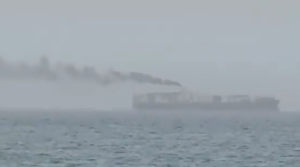 Smoke rising from a damaged tanker after being attacked this week. Is this a casualty of failing or successful negotiations? Screengrab via X
Israel’s former commander of the Air Force warned that the U.S. military leverage is slowly eroding amid the repeated threats by President Donald Trump, followed by assurances that an agreement between the United States and the Iranian regime is imminent.
Speaking to Israel’s Radio 103FM on Thursday, former Israel Air Force (IAF) commander, Maj.-Gen. (res.), Eitan Ben Eliyahu said, “How many times can you cry wolf when it does no good, and how many times can you attack and achieve a result?”
He warned “The Iranians are reaching a point where they are prepared to sacrifice themselves, to hold out to the death and to the last soldier. When you reach that point, the use of force loses its leverage.”
“Then you ask the most important question: When is the right moment? The other side has an almost unlimited capacity for attrition. So where is the point at which you stop? Where do you begin to make concessions?”
His comments came as President Trump continued to insist that a deal to reopen the Strait of Hormuz was imminent on Thursday after saying on Tuesday that an agreement would be signed by then.
Speaking to reporters, Trump said the strait is “sort of open right now,” describing the situation. “We control it, but they can always shoot something, they always have something, or drop a mine, and if you have one mine out there you sort of mess things up, because people don’t want to take their billion-dollar boats and accidentally get hit by a mine, but I think we’re doing very well.”
“I’m involved in the negotiation. I think we’re doing fine. It could be. It could be soon,” he vowed.
Also on Thursday, Trump reiterated that the U.S. is not running low on munitions, contradicting several reports in recent days.
“We have certain types of munitions that are very powerful, yeah, that we have unlimited, virtual unlimited supply,” the president said. “We have others where it’s a little bit tighter, and we’re getting them in on a daily basis.”
“But with that being said, we always want more,” he added. “We have to have more… Hopefully, nothing else does come up. But we’re in very good shape. We have literally massive amounts of ammunition.”
Iran’s Parliament Speaker and chief negotiator, Mohammad-Bagher Ghalibaf, mocked Trump’s repeating cycle of threats and promises of an agreement in a post on ?: “’Massive attack coming… wait, never mind, they want to negotiate.’ That’s theater diplomacy on loop,” he wrote.
“Using bullying + broken promises + fake news as leverage is a failed strategy. Acknowledge the facts and fulfill your commitments. We don’t need more theater.”
Meanwhile, Iran’s deputy foreign minister said negotiations with Oman over reopening the Strait of Hormuz by splitting control of transit routes are “on the verge of being finalized.”
Ben Eliyahu explained, “There is more or less an understanding that Iran will control entry into the strait, but regarding the exit from the Gulf, it is still unclear whether it will have control or not.”
“The second issue is that Iran is demanding a certain commission, while Oman is demanding less,” he added. “One side is demanding around 7%, while the other is asking for only 3%, and the United States is demanding that there be no payment at all.”
The former general warned, “The Iranians operate in a way that the American president does not understand… In my opinion, he does not understand this mentality. We barely understand it either. Perhaps we understand it a little better, but we do not respond as we should.”
According to Ben Eliyahu, the negotiations with Iran could be aimed at creating a loophole “in international law.”
“It is not exactly ‘deception.’ They raised an idea that, from their perspective, is a good one. It says: ‘Leave the Americans out of it. This is our business with the Omanis, and in this way, we will overcome the restrictions of international law, because if it is only us, then it is an absolute problem.”
“I do not know whether Trump will go along with it, and I do not know what power he has not to go along with it. His military leverage is gradually weakening, and I would say that he is almost losing it.”


USA has options but Trump does not appear to want to win militarily and arm Iranians for regime change. He somehow still believes you can make a deal with Islamic terrorist regime run by the IRGC.