
Peloni: John Spencer provides a LONG list of actionable targets and strategies which have been left untapped while focusing on negotiation strategy with an enemy whose strategic strength has always been in negotiating its survival while evading all terms and commitments forced on it.
John Spencer | Jul 15, 2026
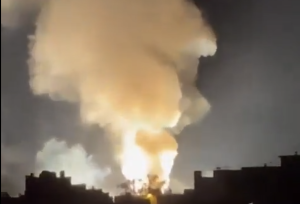 Bushehr, Iran, under attack on July 8, 2026. Screengrab via Youtube.
The war against Iran that began on February 28 was never designed as a regime-change campaign. Had the United States intended to overthrow the Islamic Republic, it would have applied vastly different forces and pursued Tehran’s political collapse from the opening hours. Operation Epic Fury, a regime-behavior change campaign, began with limited objectives:
- Eliminate Iran’s nuclear weapons threat
- Destroy its offensive missile capability
- Destroy its navy
- Sever its support for terrorist proxy organizations.
Those objectives were publicly stated at the beginning of the campaign and have remained consistent. Iran must abandon its nuclear weapons program, surrender or remove its enriched uranium, and accept a robust and intrusive inspection regime. It must end its coercion of commercial shipping in the Strait of Hormuz, accept full freedom of navigation, limit the missile and drone programs that protect its aggression, and pay continuing costs for supporting terrorist armies across the region.
The endgame remains regime behavior change. Iran’s remaining leaders must decide that preserving the Islamic Republic requires abandoning the programs and actions that brought the country into war. They do not have to become friends of the United States, embrace Western democracy, or surrender control of the Iranian state. They must accept that continuing their current behavior will place their military power, governing institutions, personal security, and ultimately the survival of the regime in greater danger.
Yes, capitulation is the goal. That word may make some people uncomfortable, but it accurately describes the desired outcome. The United States wants Iran to accept conditions it has resisted for decades because American military power has made further resistance unbearable. George Shultz captured that relationship between diplomacy and force when he said, “Negotiations are a euphemism for capitulation if the shadow of power is not cast across the bargaining table.” His point was not that negotiations are meaningless. His point was that negotiations produce little when one side believes time, delay, and continued resistance will improve its position.
Operation Epic Fury destroyed much of Iran’s military capability. American forces flew more than 10,200 sorties and struck more than 13,000 targets, while Israel conducted thousands of additional sorties, including more than 2,100 over Tehran. Together, the two campaigns targeted senior leadership, command-and-control systems, military industrial facilities, missile infrastructure, air defenses, naval forces, and key elements of Iran’s nuclear enterprise. They demonstrated the ability to penetrate Iranian airspace at will, locate protected military assets, eliminate senior commanders, and dismantle capabilities the regime had spent decades developing.
The campaign imposed enormous costs, although those costs have not yet compelled the regime to accept American terms. Iran has continued to resist demands concerning its nuclear program and freedom of navigation. Iran’s conventional means have been badly damaged. Its will has survived. That is the problem the next phase must solve.
The next phase should place the regime under simultaneous military, economic, diplomatic, informational, and psychological isolation. Compellence is cumulative. Military action, economic pressure, diplomacy, intelligence, cyber operations, information operations, and support to internal resistance should reinforce one another until the regime concludes that continued resistance threatens what it values most: its power and survival. Iranian leaders should lose the ability to communicate securely, gather safely, move military forces freely, protect the coastline, observe the strait, generate military revenue, or assume that they can outlast American attention. Every day of resistance should leave the regime weaker, more divided, and less confident about its own survival.
There is no single operation that guarantees this result. The United States could select any of the following measures, combine several of them, employ nearly all of them over time, or reject those that do not fit the political and military circumstances. Their value lies in giving the president options and forcing Iran to defend against possibilities it cannot confidently exclude.
Possible actions against the regime’s wartime leadership include:
- Continue targeting senior regime and IRGC leaders. Military, intelligence, missile, naval, drone, nuclear, and command officials who direct or enable ongoing hostilities.
- Strike command posts, emergency headquarters, communications centers, and protected meeting locations used to direct the war.
- Force commanders to disperse, relocate constantly, restrict their communications, and abandon established headquarters.
- Use cyber, intelligence, information, and covert action to make senior leaders feel exposed wherever they operate.
- Publicize defections, internal disputes, corruption, failed operations, and leadership losses to deepen mistrust within the government.
- Make continued participation in the war personally costly for those directing attacks against American forces, regional partners, and international shipping.
The senior political and military leadership should not enjoy sanctuary while Iranian forces attack American personnel and attempt to control the Strait of Hormuz. Those directing the war should be hunted, isolated, and prevented from exercising effective command. Their military headquarters, communications systems, protective organizations, and operational networks should remain under constant pressure.
Possible actions against Iran’s communications and transportation systems include:
- Sever military communications linking Tehran with regional headquarters, missile forces, naval commands, air defenses, and proxy organizations.
- Disable government television and radio systems used for military mobilization, operational messaging, and regime command.
- Disrupt military internet networks, secure communications, satellite links, and emergency command channels.
- Preserve or expand outside communications that allow ordinary Iranians to receive information beyond regime control.
- Destroy transportation nodes used to move missiles, drones, weapons, commanders, and military reinforcements.
- Interdict military rail lines, bridges, tunnels, highway junctions, and logistics corridors connecting production sites with operating forces.
- Isolate major military installations from reinforcement and resupply.
- Prevent military units outside Tehran from moving quickly to defend the capital or suppress organized resistance.
- Expand efforts to disrupt/halt military resupply into Iran by air, land, and sea.
- Interdict the movement of weapons, missile components, drone parts, dual-use technology, industrial equipment, and other military materiel supplied by foreign partners.
- Increase diplomatic and economic pressure on neighboring states, airlines, shipping companies, and commercial networks that facilitate military resupply.
Information operations should accompany the physical isolation of the regime. Tehran relies on television, radio, internet restrictions, censorship, and official messaging to preserve the appearance of control and convince the population that continued resistance is both necessary and sustainable. The United States could challenge that monopoly by speaking directly to the Iranian people, the armed forces, government officials, and regime supporters.
Possible informational actions include:
- Disrupt regime television and radio broadcasts used for military mobilization, propaganda, and internal control.
- Broadcast directly to the Iranian people through radio, satellite television, digital platforms, and any communications channels that bypass regime censorship.
- Publicize regime losses, leadership failures, corruption, internal disputes, and the destruction of military capabilities Tehran attempts to conceal.
- Provide instructions for accessing uncensored information and bypassing internet restrictions.
- Encourage defections and refusal of orders by offering clear assurances to personnel who abandon the regime’s military campaign.
- Reassure the Iranian population that the campaign’s objectives remain limited to ending the nuclear threat, restoring freedom of navigation, reducing Iran’s offensive military capabilities, and terminating support for terrorist proxy organizations.
- Make clear that continued destruction is the result of the regime’s refusal to accept terms that would end the conflict.
Israpundit is entirely dependent on readers support. Please help me continue educating people with the truth about what is going on in Israel and around the world.


Very interesting article about the options to dealing with Iran. I am left with the impression that the USA will not really follow up on any of them until forced to by the Iranian regime. We will continue to suffer until they make a nuclear device and only then will the real method be employed. We could have avoided their nuclear device… The big remaining question is who will be on the receiving end?
Continue Reading Article link is fixed and working now.