
Peloni: Peace is something of a mirage which seems to vanish with every step taken in pursuit of it. Indeed, if we are truly interested in finding peace, it would be best if we ignored it altogether in preference of seeking promoting the highest state of preparation with which to respond as the mirage of peace might disappear. Indeed, the conditions under which peace might be achievable requires a sort of oxymoronic twist of our focus, ie peace could only be made possible when defense preparations are maintained and maximized and the topic of peace is entirely isolated from our dialogue and our diplomatic entreaties. By doing so, when or if the underlying Hudna is finally revealed, the state of national preparation will not fail Israel as it failed the Quraysh tribe in Mecca so long ago. Indeed, if the Arabs want peace, let them act accordingly, and it is noteworthy, and revealing, that far too few of them actually do so. Focusing on outmatching the capabilities of neighboring nations, rather than on any sweet and enticing promises which they might speak as it might suit their weaknesses, is how falling afoul of the fate of the Quraysh tribe will be avoided. Take note that with regards to the situation with Iran today, the best way to secure peace with a irascible nation is to see it defeated utterly, and failing this, well, we would simply have to maintain a posture and state of readiness such that, at a moment’s notice, such a defeat can be delivered in any event as needs require it. In the years which follow, should no such need come to fruition, the visage of peace might develop should the hostile intentions of the nation in question finally recede into acceptance. Indeed, this is very similar to the premise of the Iron Wall which Jabotinsky spoke about over a century ago, where the Arabs would grasp that our national resolve was so great that they would finally submit to the reality of our vigilance and capabilities. Yet, for this to come to fruition, we must maintain the reality of our vigilance and capabilities, both to keep the peace, and if necessary, to win the war which might surprise us as it did the Quraysh tribe just before they found themselves vanquished.
Jonathan Feldstein
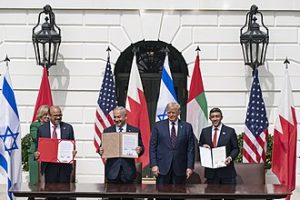 Signing of the Abraham Accords Tuesday, Sept. 15, 2020, on the South Lawn of the White House. Photo bBy The White House from Washington, DC – President Trump and The First Lady Participate in an Abraham Accords Signing Ceremony, Public Domain, Wikipedia
In the good old days, Arabs would just rant with wild unabashed rhetoric about destroying Israel outright and driving Israelis into the sea. They would threaten Israel openly, blockade shipping, eject UN “peacekeeping troops,” launch a variety of terrorist attacks, initiate global boycotts of Israel and the companies that do business with Israel, etc. Today, while the chants of freeing “Palestine” “from the river to the sea” still mean driving Israel into the same sea and eliminating the Jewish state, their tactics have changed from outright hostility and threats to something even more nefarious but not new.
Israelis want peace. We are lured by the idea of peace. Each generation prays that it will be the last generation to serve in combat to defend ourselves from ongoing threats. Even after the Hamas attack and massacre of October 7, 2023, even though the reality vis a vis our Arab neighbors is clear, some still fantasize about peace and believe it is somehow achievable.
Israel has peace with Egypt and Jordan, and the UAE, Bahrain, and Morocco thanks to the Abraham Accords. While three years ago Saudi Crown Prince Mohammed Bin Salman said peace with Israel has never been closer, the Saudis remain unwilling to pull the trigger so to speak.
Qatar still threatens Israel, is an epicenter of radical Islam, and brainwashing the world as such through media and buying influence.
Turkey, while not Arab, has become one of the biggest regional threats with its Islamist leader threatening to reconquer Jerusalem (and his fantasies about restoring the Ottoman Caliphate which was resoundingly defeated in WWI). Its influence in Syria has increased, bringing the threat of a land attack – though they also seek American F35s – closer than ever before. Turkey also openly supports and harbors Hamas terrorists, making no secret of its ill intent, despite being a member of NATO.
While no less alarming, Turkey’s tactics are old-school: overtly threatening, delegitimizing, and seeking alliances and weapons upon which it can realize its threats vis a vis Israel.
Recently reports were revealed marking a shift in the tactic but no less threatening to Israel’s existence.
While the countries involved have not yet been named, what’s been revealed is that one or more Arab countries are being encouraged to make peace with Israel in order to normalize relations, as if being part of the Abraham Accords, but to use this to “lull” Israelis to think that peace is real, and at the same time to build up their military preparedness to attack Israel.
This is a new tactic in the past 100 years of the broader “Arab-Israel Conflict,” but it is indeed a tactic that is as old as Islam.
This week’s headlines could have come from headlines of the year 628 with Mohammed’s “Treaty of Hudaybiyyah.” What happened 1398 years ago was that Mohammed signed a truce with the stronger Quraysh tribe at Hudaybiyyah. Many of Mohammed’s followers found this humiliating. However, Mohammed had a bigger scheme planned. As the Quraysh tribe lived through the intoxication of their “peace in our time” fantasy, the pause in fighting allowed Mohammed time to rearm and grow stronger. Two years later, he broke the treaty, attacked Mecca with a much larger force, and conquered it from the Quraysh tribe. Mecca was never the same, and Islam continued this path until today of using the model of the Treaty of Hudaybiyyah to conquer other tribes, cultures, and countries.
What’s evident in this week’s headline is that as much as Israelis strive for peace agreements with our Arab and Moslem neighbors, what’s been proven time and again throughout history, is that we cannot trust them, we cannot let our guard down, and we must maintain our military and intelligence capabilities because every treaty has the potential of being Hudaybiyya.
Countless ceasefires with Hamas and Hezbollah were not made from positions of strength or genuine desire for peace, or the well-being of their own communities. They are made from weakness in order to regroup, rearm, and return to war when the time is right. That’s what this week’s headline is about.
While Israel has peace with Egypt and Jordan, we have never seen these become a warm peace. We have continued to see threats and military buildup, and the frequent undermining and delegitimizing of Israel, as well as publicly bashing Israel in many forums. Since the Hamas massacre of October 7, rather than standing with Israel against the Islamists who also threaten them, these two nations at peace with Israel, have only increased their rhetoric and threats about Israel.
In Lebanon, we see hopeful signs of some sort of agreement with our northern neighbor which has largely been plagued by war since 1975. Civil war among competing sectors of Lebanese society, the overt threat of Palestinian Arab terrorists, and the rise of and hijacking of most of the country by the Islamist Hezbollah continue to plague Lebanon. They should want peace, and signing a piece of paper might be nice. But as long as Hezbollah remains dominant and a threat to Israel as well as Lebanon itself, Israelis will never truly be able to trust a peace agreement with them either.
Which Arab countries are involved in this attempt at a modern Treaty of Hudaybiyyah? I don’t know yet but have my guesses. In the bigger picture it almost doesn’t matter because it’s the simple reality of the threat of peace with any Arab or Islamic neighbor is the same. In 1979 we were intoxicated by the idea of peace with Egypt and indeed there have been many advantages of that. The same with making peace with Jordan in 1994, theoretically freeing up the risk of threats along our longest border. Some never trusted these from the outset, and recent rhetoric and threats may prove them right.
The Abraham Accords brought normalization with Arab countries that were never in open conflict with Israel, and with which Israel does not share a border. These have been fruitful in just a few years. But just because we’re paranoid about the long-term threats as a result of making peace does not mean we’re wrong about the potential for these threats. Time will tell.
Israelis fantasize about eating humus in Damascus. From the early years of the state. After the Arabs’ resounding loss in the 1967 Six-Day War, we believed that they would eventually come to understand that Israel is not going anywhere, and if it were a conflict about land, using the failed “land for peace” model which the rejected anyway, if we “gave back” land to the vanquished Arab states, they would become rational and make peace with us.
As we maintain the need for readiness for anything, and as has been revealed this week we cannot let our guard down, we also must continue to look in the rear-view mirror. As much as we want peace Mohammed’s model then is our reality today.
Jonathan Feldstein is president of the Genesis 123 Foundation (www,genesis123.co) whose mission is to build bridges between Jews and Christians and Christians with Israel. He was born and educated in the U.S. and immigrated to Israel in 2004. He is married and the father of six, and grandfather of four (so far).
Two sons and a son in law are currently serving in the IDF and have been involved in combat in Gaza and Lebanon since the October 7, 2023 Hamas massacre in Israel.
Jonathan is a leader working with and among Christian supporters of Israel, and shares experiences of living as an Orthodox Jew in Israel through his work, writing, and as host of the Inspiration from Zion podcast. Since the war began, he has authored more than 150 articles, and participated in a similar number of interviews, briefings, prayer events, and more.
Jonathan is working with Christian leaders all over the world to realize a true peace in Gaza, details of which can be found at www.SolutionforPeaceinGaza.com.
In 2023 he published the highly acclaimed book, Israel the Miracle (www.israelthemiracle.com), which makes a great gift for Chanukah and Christmas, and year round.


The Obscene Misuse of the Term Genocide
https://lel817.substack.com/p/the-obscene-misuse-of-the-term-genocide?r=1q2uiq&utm_campaign=post-expanded-share&utm_medium=post%20viewer