
Peloni: Avi Abelow draws attention to the paradigm shift which has taken place under Netanyahu during the last three years, and warns of the move back to October 6 would be the consequence of voting Eisenkott, Bennett or others into office simply to choose someone other than Netanyahu in the coming election. Abelow goes further by adding that while the diplomatic shift is not yet where it needs to be to secure Israel’s security, things have significantly changed more closely to doing so than ever before.
Avi Abelow
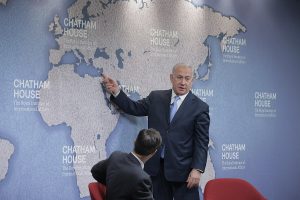 Benjamin Netanyahu, Prime Minister, State of Israel. Photo by Chatham House – Benjamin Netanyahu, Prime Minister, State of Israel, CC BY 2.0, Wikipedia
As fighting with Hezbollah returns, let’s talk about the latest in Lebanon….
What gets little attention, especially as we begin election season her in Israel, is how Netanyahu totally changed the rules of the Middle East.
For nearly eight decades, Israel has fought the same diplomatic war after every military victory.
We defeat the enemy on the battlefield. The world pressures Israel to withdraw. We relinquish strategic territory. Our enemies rebuild. They attack us again.
That cycle defined Israel’s history after 1948. After 1967. After Lebanon. After Gaza.
This time, something fundamentally different is happening.
First, Hezbollah continues to prove exactly why Israel cannot leave southern Lebanon. Overnight, three IDF soldiers were seriously wounded by an explosive Hezbollah drone launched at Israeli forces operating in southern Lebanon. The IDF responded decisively, striking Hezbollah targets in Ansar and Deir al-Zahrani, eliminating senior Radwan Force commanders. Hezbollah immediately responded with its familiar threats, declaring that Israel’s actions would receive “an appropriate response.”
Nothing about Hezbollah has changed. And the Lebanese army is not demilitarizing Hezbollah as promised in the Trump administration deal.
What has changed is America’s response.
Listen carefully to what the U.S. State Department is now saying:
“Hezbollah alone bears responsibility for the Israeli presence on Lebanese territory.”
Read that sentence again.
Not Israel.
Not “both sides.”
Hezbollah.
The spokesperson went even further:
“Hezbollah must be disarmed and the organization dismantled.”
For the first time in Israel’s history, the international diplomatic framework is not demanding that Israel withdraw first and hope the enemy behaves afterward. They tried, but Netanyahu did not allow for such a deal.
Instead, Netanyahu ensured that the international demand is directed at our enemy, Hezbollah.
No IDF withdrawal until Hezbollah is dismantled and until southern Lebanon is demilitarized.
Think about how revolutionary that is.
For decades Israel was told to trust international guarantees and international forces, like UNIFIL.
We withdrew from southern Lebanon in 2000. International forces under UNIFIL filled the vacuum to prevent Hezbollah from rearming.
Instead, Hezbollah became exponentially stronger, right under the eyes of the international forces.
Israel then uprooted close to 10,000 Jews in Gaza, destroying all 21 Jewish communities, promising to respect the 1948 armistice line as an international border, to give peace a chance with Gaza, understanding that the international community would support us if rockets would ever be shot at us from Gaza.
Instead, Hamas built a terrorist state on Israel’s border, spending nearly twenty years attacking our civilians with rockets, tunnels, and ultimately the October 7 invasion, while the international community’s primary concern was repeatedly pressuring Israel to halt its military operations to stop Hamas. The Gaza disengagement proved that relinquishing strategic territory and trusting international guarantees is not a path to peace, it is an invitation to greater war.
Again and again, Israel gave up strategic depth while the world promised security.
Again and again, those promises collapsed.
Today, even if imperfectly, the diplomatic language has changed.
This is one of the greatest diplomatic achievements any Israeli Prime Minister has secured in the state’s 78-year history.
Is it enough?
No.
Not even close.
Ultimately, the jihadi Muslim Middle East speaks only one language: decisive victory.
The war is not over until the jihadi enemy is permanently incapable of threatening Israel again. History teaches that temporary ceasefires and partial disarmament do not end jihadist movements. Lasting security requires a strategic reality in which the enemy loses the territory from which it launched its attacks and is no longer able to rebuild its military infrastructure.
True victory over Hezbollah ultimately means permanent Israeli control of southern Lebanon, the Biblical tribal lands of Dan and Naftali. The Lebanese state has repeatedly demonstrated that it is both unwilling and incapable of preventing Hezbollah from turning its Southern territory into a launching pad for war against Israel. Talks with the Lebanese government are futile. They are powerless.
Just as history has shown throughout the world, military control is strongest when backed by a permanent civilian presence. Only when Israel permanently secures southern Lebanon with military presence and civilian resettlement, ensuring Hezbollah can never again threaten our northern communities from that territory, will we have achieved the kind of decisive victory over a jihadi enemy that brings lasting security to the people of Israel.
While Netanyahu has not pushed for that yet, we still must be thankful for the huge diplomatic paradigm shift that he has achieved.
Prime Minister Netanyahu and this government have achieved something that no previous Israeli government succeeded in achieving: shifting international pressure away from Israel and toward the aggressor.
Contrast that with the approach advocated by Gadi Eisenkot and much of Israel’s political left.
Even after October 7, they continue advocating policies that would ultimately lead Israel back to the failed pre-October 7 paradigm. Gadi Eisenkot has publicly supported the idea of ending the war in Gaza by having the Palestinian Authority return to govern Gaza and has suggested allowing over 100,000 jihadi Gazans back into Israel to work under future arrangements.
He has also supported eventual Israeli withdrawal from southern Lebanon and southern Syria as part of diplomatic frameworks once security conditions permit. This diplomatic approach repeats the same assumptions that failed us for decades: restraint instead of decisive victory, concessions instead of deterrence, and faith in international guarantees instead of permanent Israeli security control. October 7 taught us the devastating cost of those illusions. Israel cannot afford to repeat them.
We have already lived that experiment.
It failed in Lebanon.
It failed in Gaza.
It failed catastrophically on October 7.
Today, the United States itself is publicly saying what Israel has argued for years: Hezbollah, not Israel, is the obstacle to peace on our Northern border.
That is no small accomplishment.
It reflects a profound shift in international thinking.
Is it the final victory we seek?
No.
But it is a major step in the right direction.
History is rarely transformed in a single battle. More often, it changes because a series of strategic victories gradually reshape what the world considers normal.
For the first time, the normal expectation is no longer that Israel must leave while terrorists remain armed.
The expectation is that the terrorists must be disarmed before Israel leaves.
That is a historic achievement.
There is still much work ahead. Hezbollah has not surrendered. Hamas has not disappeared. Iran continues to orchestrate terror across the region.
But for the first time in generations, Israel is negotiating from a position in which the burden is falling on the aggressor, not on the victim.
That is progress worth recognizing.
Our future remains bright, provided we continue learning the lessons of October 7, remain steadfast in our mission, and never forget that true peace in the Middle East comes through strength, deterrence, and ultimately, victory.
The real political danger is that Israel could abandon this historic diplomatic momentum. If Gadi Eisenkot and the parties aligned with him come to power, they would return to the pre-October 7 doctrine of restraint, concessions, and deterrence through appeasement rather than peace through strength.
For the first time, the international community is demanding that Hezbollah, not Israel, take the first step by disarming before Israel withdraws. That is a strategic breakthrough worth preserving.
Israelis face a historic responsibility in the upcoming elections. We must vote to preserve and build upon this remarkable diplomatic paradigm shift that Prime Minister Netanyahu and his government have achieved. Yes, many of us are frustrated that nearly three years after October 7 the war is still not over. But a significant reason for that has been the national commitment to bringing every hostage home, a mission that required painful political, diplomatic, and military compromises, both at home and abroad.
When we step back and look at the full picture, what has happened is nothing short of miraculous.
On October 7, our enemies believed they had begun the destruction of the Jewish state. Instead, the exact opposite has happened. Israel stands stronger than ever. Hamas has been shattered. Hezbollah has suffered devastating blows. Iran has been weakened on all its fronts. For the first time in our history, the international community is increasingly demanding that our enemies disarm before expecting Israel to relinquish strategically vital territory. We are stronger militarily, diplomatically, and spiritually than we were before the war.
So let’s not throw the baby out with the bathwater.
There is still much to accomplish. The war is not yet won. But we dare not hand the reins of the country back to the military and political leaders whose strategic worldview helped produce the failures that allowed October 7 to happen, and who now advocate returning to many of the very assumptions that proved so catastrophically wrong.
The Jewish people have overcome challenges far greater than these throughout our history. We are witnessing the greatest comeback of all time, the continued return of the Jewish people to our God-given, indigenous, ancestral homeland and the restoration of Jewish sovereignty after nearly two thousand years.
Strengthen your faith.
Stay united.
Keep moving forward.
The best chapters of our national story are still ahead of us.
Am Yisrael Chai!!!


Leave a Reply
You must be logged in to post a comment.