
Another antisemitic attack on American Jews at prayer. This one happened inside the most politically connected Reform synagogue in the country, a place where Israel has been condemned.
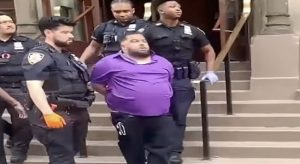 Screengrab via Youtube. [Resized]
Friday night. Shabbat services. More than 500 congregants inside Central Synagogue – Lexington Avenue and 55th Street, Midtown Manhattan. Just after 6 p.m., a man barreled down the center aisle, screaming.
Larry Montes, 46, from the Bronx. He struck a 63-year-old woman in the face, causing a split lip, forearm injuries. Smashed synagogue property. When security grabbed him, he spat on a guard and headbutted him. Congregants scrambled. The synagogue’s own livestream captured the panic. One witness told CBS she heard a loud pop and thought it was a gun.
An NYPD sergeant working a paid detail at the synagogue took Montes into custody. He was charged with two counts of assault as a hate crime and one count of criminal mischief as a hate crime. In Mamdani’s New York, he will almost certainly face a very minimal punishment.
Another antisemitic attack on American Jews at prayer. This one happened inside the most politically connected Reform synagogue in the country – led by a member of the Reform clergy who has chosen to stand with Palestine and against Israel again and again, but who, when it came time to stand up for Jews in her own city, decided her institutional voice had limits.
The Tisch-Speyer-Lauder Synagogue
Central Synagogue is not just any synagogue. Built in 1872. National Historic Landmark. Moorish Revival architecture – twin onion-domed towers, brownstone facade, 1,400-seat sanctuary. The oldest continuously used synagogue in New York City. Approximately 2,600 member households. On Yom Kippur, the congregation rents Avery Fisher Hall at Lincoln Center for overflow – more than 7,000 members attend High Holiday services. The Wall Street Journal called it New York’s first “mega-shul.”
NYPD Commissioner Jessica Tisch grew up at Central Synagogue. She was married there. Her father blows the shofar on Rosh Hashanah. She is a member of the Tisch family – heirs to Loews Corporation, whose relatives include Jonathan Tisch, chairman of Loews Hotels; Laurie Tisch, philanthropist; and Steve Tisch, co-owner of the New York Giants and Academy Award-winning film producer.
The Wall Street Journal reported that the congregation includes Jerry Speyer – chairman of Tishman Speyer, owner of Rockefeller Center – and Ronald Lauder, heir to the Estée Lauder fortune and president of the World Jewish Congress. This is where elite Reform Judaism worships – and where its most prominent spiritual leader chose silence when silence had consequences.
The Most Powerful Congregational Leader in Reform Judaism
Angela Buchdahl. Born in Seoul to a Jewish American father and a Korean Buddhist mother. First Asian American ordained as both Reform spiritual leader and cantor anywhere in the world. First woman to lead Central Synagogue in its 175-year history. Yale graduate. Invited by President Obama to light Hanukkah candles at the White House. Named by the Jerusalem Post to its Top 50 Most Influential Jews list.
Buchdahl is not a bystander. She is the most visible spiritual leader in American Reform Judaism. When she speaks, the movement listens. When she signs, the community notices. When she stays silent, the silence is heard.
And she has used her voice – selectively.
Here is the record.
2019: Buchdahl Signed a Letter Defending the Right to Boycott Israel
July 2019. Buchdahl put her name on a clergy letter organized by J Street and T’ruah opposing anti-BDS legislation at the federal and state level. The letter urged lawmakers to oppose any legislation penalizing supporters of the Boycott, Divestment, and Sanctions movement – arguing that such laws “do nothing to protect the State of Israel” and threaten free speech. The letter explicitly stated that anti-BDS legislation “blurs the distinction between Israel within its internationally recognized borders and the occupied Palestinian territories” and “deliberately extend[s] U.S. legal protection to Israeli settlements.”
Signed: “Rabbi Angela Buchdahl – New York, NY.”
2022: Buchdahl Signed a Letter Accusing Israeli Settlers of “Pogroms”
Buchdahl signed T’ruah’s 2022 letter to the Israeli ambassador – “250+ Rabbis and Cantors to the Israeli Ambassador: Stop Settler Violence.” The letter accused Israeli settlers of “frequent and violent attacks on Palestinians” and described certain incidents as “a pogrom.“
Signed: “Rabbi Angela Buchdahl – New York, NY.”
2024: Buchdahl Platformed Palestinian Activists at Central Synagogue
Central Synagogue hosted “Standing Together: Israelis and Palestinians Pursuing Peace,” featuring Sally Abed – a Palestinian citizen of Israel – and Alon-Lee Green. Central’s own event page described Standing Together as a coalition of “progressive Jewish and Palestinian citizens of Israel” organizing for “equality, peace, and justice.” The page highlighted Abed’s advocacy for “an end to the occupation.”
Standing Together sits on the far left of Israeli politics – a fringe movement in a country where the political center moved decisively rightward after October 7. Abed describes herself as “Palestinian, feminist, socialist.” The organization’s U.S. tour was funded by the New Israel Fund – that funds groups supporting boycotts of Israel and has been condemned by Israeli government officials for undermining the state. In Israel, where the vast majority of the public backed the military operation in Gaza, Standing Together called for an immediate ceasefire and “an end to the occupation” – a position shared by a single-digit percentage of the Israeli population.
Central chose the speakers. Central wrote the description. Central provided the platform.
September 2025: 120,000 People Watched Buchdahl Criticize Israel from the Bimah
Erev Rosh Hashanah. September 22, 2025. From the bimah at Central Synagogue, Buchdahl opened with a confession: “I have been a rabbi for 25 years, 20 of them at Central Synagogue, and I have never been so afraid to talk about Israel.”
Then she talked about Israel. She condemned Israel’s supposed spring food blockade of Gaza. She denounced “settler violence” in the Judea and Samaria. She defended humanitarian aid to Gaza. She framed Palestinian Arab suffering as a Jewish moral obligation: “Our tradition reveals that the real danger we face is not that we might have too much empathy. It’s that we might not have enough. We can feel brokenhearted for the suffering of the children of Isaac and Ishmael. Indeed, we must.”
The sermon drew over 120,000 views on YouTube.
October 2025: 1,100 Rabbis Opposed Mamdani. Buchdahl Refused.
More than 1,100 rabbis and cantors signed a letter denouncing mayoral candidate Zohran Mamdani and the “normalization of anti-Zionism.” Mamdani had accused Israel of “genocide,” labeled it an “apartheid state,” refused to condemn the slogan “Globalize the Intifada,” and declared he would arrest Prime Minister Netanyahu if he entered New York City.
Buchdahl refused to sign.
She wrote to her congregation: “Central Synagogue is a Jewish spiritual home and we want to keep it that way. It remains our conviction that political endorsements of candidates are not in the best interest of our congregation, community, or country.” She added: “It is up to each of us to vote our conscience.”
Under pressure from her own congregants, Buchdahl returned to the pulpit and called Mamdani a contributor to “a mainstreaming of some of the most abhorrent antisemitism.” But she still refused to endorse against him. No signature. No institutional opposition. The policy held.
Mamdani won.
The record is clear. Buchdahl signed a political letter when the target was Israeli anti-BDS legislation. She signed another when the target was Israeli settlers. She hosted an event platforming Palestinian activists calling for an end to the occupation. She delivered a globally broadcast sermon criticizing Israeli government policy. In every case, Central’s institutional voice was deployed.
When the question was whether to oppose a candidate who endorsed BDS, called Israel an apartheid state, and refused to condemn “Globalize the Intifada” – Central decided that its institutional voice had limits.
The policy was not neutral. It protected interventions that targeted Israel – and blocked the one intervention that might have protected Jews.
August 14, 2026
Seven months after Mamdani took office, a man walked into Central Synagogue during Shabbat services and attacked Jews.
Commissioner Tisch – who grew up in that sanctuary, who was married at that bimah – posted on X: “A place of worship should never be a crime scene.”
Mayor Mamdani – the candidate 1,100 rabbis warned about, the one Buchdahl chose not to oppose – said he was “horrified.”
Central Synagogue posted on Facebook that it was grateful for the outpouring of support, and vowed: “We will keep on gathering for joyful, meaningful Judaism with our Central family every week.”
The attack came two weeks after a man was stabbed with a screwdriver outside a Modern Orthodox synagogue on the Upper West Side while wearing a kippah. It came five months after a Hezbollah-inspired terrorist drove a truck into Temple Israel in West Bloomfield, Michigan, and opened fire – injuring 64 people. It came during the worst year for antisemitic assaults in America on record.
Like so many American Jewish “leaders,” Buchdahl is surprised that a synagogue was attacked – and this time it was hers.
Liberal Diaspora Jews who choose Palestine over their own people, who platform Israel’s enemies from their own podiums, who do not find their institutional voice for Jewish safety – may be posing a danger to Jews.


Leave a Reply
You must be logged in to post a comment.