
How Childhood Conditioning, Institutional Failure and Leadership Shaped the Experience of Jewish Students and Staff
Michel Benchimol | Aug 22, 2026
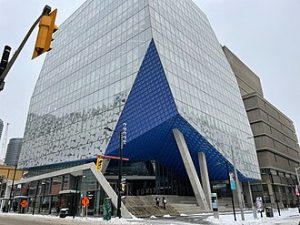 Toronto Metropolitan University Student Learning Centre. Photo by Onekoolcat – Own work, CC BY-SA 4.0, Wikipedia
Mohamed Lachemi is an educated man. He is also a Muslim.
He is an engineer, professor and academic administrator who rose to become president of Toronto Metropolitan University.
He was born and raised in Algeria, a Muslim-majority Arab country whose post-independence political culture was profoundly hostile to Israel and Zionism. Religion and that political environment were part of the culture surrounding him during his formative years.
I mention these two sides of Lachemi—the accomplished academic and the man shaped by a very different childhood environment—because both matter when examining what later happened at TMU.
Education gives us knowledge.
It does not automatically erase what was planted in us when we were young.
The lessons absorbed in childhood are among the most powerful influences we carry into adulthood. Culture, religion, family, schools and politics begin shaping our view of other people long before we are old enough to challenge what we are being taught.
A university degree does not magically wipe that slate clean.
A doctorate does not do it.
Becoming a professor does not do it.
Becoming the president of a university does not do it.
Prejudice learned in childhood disappears only when it is consciously recognized, challenged and rejected.
That principle matters here because Islamic tradition contains material capable of reinforcing hostility toward Jews.
The Qur’an describes Jews among those “strongest in hostility” toward believers in 5:82 and contains severe condemnations directed at particular Jewish communities. In 2:65 it recounts Sabbath-breakers being transformed into “apes.”
Sahih Muslim 2922 goes considerably further. It contains an end-times tradition in which Muslims fight Jews and stones and trees reveal where Jews are hiding.
These passages exist. They have existed for centuries. The same texts have also been used to provide religious justification for hostility toward Jews.
Combine religious texts capable of such interpretations with a political culture intensely hostile to Israel, and the attitudes a child absorbs do not simply evaporate because that child eventually becomes a highly educated adult.
That is the central point.
Education is not an antidote to childhood conditioning.
To believe that intelligence, academic achievement or professional status automatically cleanses anyone of prejudices absorbed while growing up is naïve, and that is a mistake many westerners make.
And that brings us directly to Lachemi’s record at TMU.
Under his presidency, Jewish employees and students told TMU’s own external review that they experienced fear, isolation, pain and powerlessness.
Some became reluctant to wear a kippah or Star of David.
Some worked remotely because they felt unsafe on campus.
At a major Canadian university dedicated to inclusion, Jews became afraid to look Jewish.
Had Muslim employees become frightened to wear hijabs, it would immediately have been recognized as an institutional disgrace.
Had Black employees become frightened to come to campus because they were Black, nobody would have searched for political explanations.
But Jews were treated differently.
Anti-Jewish hostility had acquired a convenient disguise.
It could call itself anti-Zionism.
Call someone a Jew while attacking him and everyone recognizes the prejudice.
Call the same person a Zionist and suddenly hostility becomes political discourse.
That distinction has become one of the great intellectual frauds of modern academia.
Criticism of an Israeli government is political speech.
Criticism of Israeli policy is political speech.
But treating a Jewish student as morally contaminated because he believes the Jewish people have a right to their own country is something entirely different.
A Muslim wearing a hijab deserves protection.
A Jew wearing a Star of David deserves exactly the same protection.
A Muslim does not have to repudiate Islam before qualifying for protection from racism.
A Jew should not have to repudiate Israel or Zionism either.
Either equality applies equally or the word is meaningless.
And that is where Mohamed Lachemi’s presidency must ultimately be judged.
His engineering degree does not excuse his record.
His academic accomplishments do not excuse his record.
His titles do not excuse his record.
His fluency in the language of diversity does not excuse his record.
What matters is what happened to the minority entrusted to his protection.
Jewish members of the university he led became afraid to display their Jewish identity.
That happened under his presidency.
That is part of his record.
And it demonstrates the central point more powerfully than another diversity statement ever could:
Hatred Is Learned Young
The most disturbing form of prejudice is not the hatred that suddenly appears in adulthood. It is the hatred that is taught to a child before that child is old enough to question it.
That is why any serious discussion about relations between Muslims and Jews has to confront an uncomfortable issue: anti-Jewish teachings that exist within the Muslim world and within interpretations of Islamic religious tradition.
There are passages in Islamic scripture and later religious traditions that have portrayed Jews as treacherous, corrupt, cursed or enemies of believers.
When those passages are taught—especially to children—they can become something much more powerful than ancient religious argument.
They can become an explanation of who the enemy is. And once a child is taught that lesson, education later in life does not necessarily erase it.
That is precisely why education matters so much. UNESCO has repeatedly emphasized that schools and educational materials can either challenge prejudice or perpetuate it, and that combating anti-Jewish hatred requires confronting stereotypes before they become deeply embedded.
In Mohamed Lachemi’s case, I can judge the results. When Jewish staff and students needed their university leadership to make their safety and dignity an unmistakable priority, I do not believe they received the protection they deserved.
Whether that failure was conscious or subconscious is ultimately secondary. Something shaped his priorities, and in my view, protecting Jewish members of the TMU community was not high among them.
That is precisely why childhood education matters. The attitudes we absorb when we are young can remain with us long after we become educated, accomplished adults.
They may not announce themselves openly as prejudice. They can appear instead in what we excuse, what we minimize, whose fears we take seriously, and whose protection we fail to make urgent.
I cannot prove that this explains Lachemi’s conduct. But I believe his record raises the legitimate question of whether attitudes learned much earlier in life affected, consciously or subconsciously, the priority he gave to protecting Jewish staff and students.
My Hope for the New Administration
The only thing I can hope for now is that the new administration will be better.
In January 2027, Dr. Roberta Iannacito-Provenzano, currently TMU’s Provost and Vice-President, Academic, will replace Mohamed Lachemi as President and Vice-Chancellor. She has been part of TMU’s senior administration since 2020 and has served as provost since 2023.
That gives me both hope and concern.
My hope is that she will recognize that Jewish students, professors and staff are entitled to precisely the same protection, dignity and sense of belonging that TMU promises every other minority community.
My concern is that she is not arriving as an outsider being brought in to change the culture. She comes from the existing senior administration. She worked alongside Lachemi during precisely the period in which many of the controversies that concern me occurred.
In announcing her appointment, she publicly thanked Lachemi for his leadership and spoke of continuing TMU’s existing momentum. Lachemi, in turn, praised her as a leader who had been integral to the university’s recent accomplishments.
That does not mean she will govern as he did.
But neither should anyone assume that changing the name on the president’s door automatically changes the culture underneath it.
And the president is not the only person who matters.
The current senior administration also includes Tanya (Toni) De Mello, Vice-President, Equity and Community Inclusion; Saeed Zolfaghari, Vice-President, Administration and Operations; Steven Liss, Vice-President, Research and Innovation; Sean Kheraj, Vice-Provost, Academic; and Jen Gonzales, Interim Vice-Provost, Students. These are among the people occupying positions that influence university policy, student life, academic administration, equity and institutional responses to campus problems.
My concern therefore extends beyond one president.
When Jewish students say they are frightened, intimidated or unwelcome, will the administration act immediately—or study the matter until the moment has passed?
When anti-Jewish racism is disguised as political activism, will the university recognize the difference between legitimate criticism of Israel and hostility directed at Jews?
Will a Jewish student wearing a Star of David receive the same institutional protection as any other minority student displaying an expression of identity?
Will Jewish professors and employees be expected to tolerate behaviour that would never be accepted if directed toward another racial, religious or ethnic minority?
Will rules governing demonstrations, intimidation, disruption and harassment be enforced consistently, regardless of the political cause of those violating them?
Those are the questions by which I will judge the new administration.
Roberta Iannacito-Provenzano deserves the opportunity to demonstrate what kind of president she will be.
I hope she succeeds.
But because she comes from the same senior administration, I do not believe that her appointment alone constitutes change.
Change will have to be demonstrated through decisions.
If the next administration wants Jewish members of the TMU community to believe that a new chapter has begun, it will have to show them—not with another statement about inclusion, but through its actions—that anti-Jewish racism will be treated with the same urgency, seriousness and moral clarity as racism directed against anyone else.
That is not asking for special treatment.
It is asking for equal treatment.


There are passages in the Koran that say Israel belongs to the Jews. Here’s why they don’t matter to most Muslims:
“ Do most Muslims believe in abrogation as an immutable tenet of their faith?”
“ +9 Yes, the majority of traditional Sunni and Shia legal scholars accept the concept of abrogation—known in Arabic as naskh—as a valid mechanism within classical jurisprudence to explain how later divine revelations superseded earlier legal rulings. However, it is not viewed as an all-encompassing “immutable tenet” of personal faith, and its application is heavily debated.Scope and LimitationsStrictly Legal: Naskh applies exclusively to practical legal commands (ahkam) and never to core beliefs, core theology, the attributes of God, or universal moral truths like justice.Divine Authority Only: Rulings could only be abrogated by God during the revelation period via a subsequent text, not by human jurists or changing cultural norms.Divergent ViewsClassical Consensus: Most traditional schools of jurisprudence accepted that naskh occurred, though they fiercely disagreed on which specific verses were actually abrogated, with estimates ranging from a handful to dozens of verses.Modernist and Reformist Rejection: Many contemporary and 19th/20th-century thinkers reject naskh entirely, arguing that it was a construct of early commentators struggling to harmonize contextual verses. They prefer to view apparent differences as contextual or complementary rather than canceled.Denominational Rejection: Specific groups, such as the Ahmadiyya community, completely reject the doctrine, asserting that no part of the Quran’s legal or textual guidance was ever cancelled or invalidated.Would you like to explore specific examples of verses often debated under the theory of abrogation, such as the transition in directives regarding alcohol or rules of engagement?”
In other words, after all the equivocation, yes.
See:
https://jihadwatch.org/2006/10/the-islamic-doctrine-of-abrogation
https://www.algemeiner.com/2026/08/20/there-were-centuries-of-jewish-christian-coexistence-in-the-holy-land/