
October 7 Was Not Simply an Intelligence Failure. It Was a Failure of Leadership.
PELONI
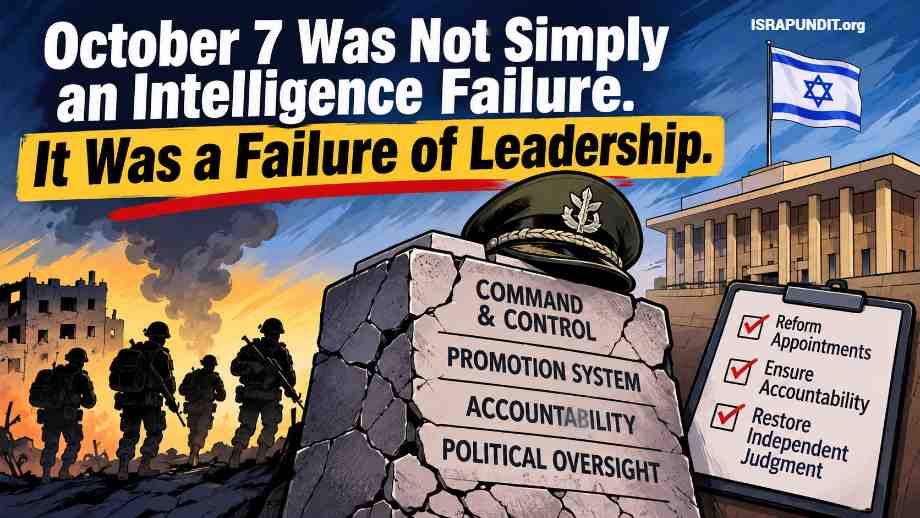 Click Image to Enlarge. Image created via AI.
In an important interview with journalist Lior Levy, Brig. Gen. Oren Solomon addresses, among other matters, three subjects of grave and enduring consequence: the comprehensive breakdown of Israel’s military and security establishment on October 7, the further failures which came in the hours before the attack and the corrosive internal logic of the senior-command appointment system which has long served to entrench conformity over competence. The interview raises important questions which go well beyond the military failures of October 7, but it also delves into a perspective on those failures which have thus far failed to be expressed or considered. His account describes an IDF senior command failed to recognize the scale of an unfolding attack, failed to act on information already available to it, failed to prepare adequately the night before, and then failed to exercise effective command and control when the attack began. Yet, perhaps the most consequential part of his testimony concerns what happened after years of leadership decisions had shaped the military establishment: who gets promoted, who gets pushed aside, and who is ultimately held accountable.
These are not merely internal military matters. They go directly to the question of who should be trusted with responsibility for Israel’s security and national leadership.
And there is one political implication which cannot be ignored: Solomon specifically identifies Gadi Eisenkot among the senior figures associated with the earlier period in which existing intelligence, operational plans, and military preparedness were not adequately addressed. That fact should give Israelis considerable pause when considering the prospect of an Eisenkot-led government.
The Catastrophe of October 7 Was Centered on a Breakdown at the Top of the Chain of Command
Solomon’s investigation concentrated on the first six hours of the October 7 attack, beginning at 6:29 a.m. His central finding is devastating: the senior command did not understand what was happening.
This was not simply a matter of being surprised by the scale of Hamas’s assault. According to Solomon, the information needed to understand the situation was already being transmitted through the IDF’s operational and digital systems. The commanders on the ground were reporting what they were seeing. The information was available. Yet the senior command absorbed only approximately 30 percent of the operational picture and effectively discarded the remaining 70 percent.
This failure was compounded by the most basic requirements of military command. Commanders did not make the necessary telephone calls. They were not positioned in the appropriate command centers, where they could receive information, communicate with subordinate units, and understand the developing battlefield picture. Instead, senior officers remained in remote offices or locations which failed to provide them with the necessary command-and-control capabilities.
The result was paralysis and chaos. The General Staff treated the attack as a series of separate security incidents rather than recognizing that Israel was facing a massive, coordinated assault. Orders were contradictory. Forces were sent in the wrong directions. The Air Force was directed to strike locations inside Gaza which were actually empty, while the actual emergency demanded a coordinated response to the invasion.
Solomon is particularly direct in describing where the greatest failures were evident. Although there were problems at several levels, he says most of the failures were concentrated at the highest levels of command: the Southern Command, the Operations Directorate, and the General Staff.
That distinction matters. The soldiers and local commanders who found themselves confronting an unprecedented assault fought courageously under extraordinarily difficult circumstances. Solomon credits them with preventing an even greater catastrophe. The failure, therefore, cannot simply be laid at the feet of those who were fighting for their lives and trying to defend the communities under attack. The central responsibility lies with those whose duty was to understand the situation, direct the response, and ensure that the military was prepared.
This is the first lesson of Solomon’s testimony: October 7 was not simply a failure to anticipate an enemy’s intentions. It was a failure of command, judgment, and professional responsibility at the very top of the military establishment.
Examination of the Hours Prior to October 7 Attack Exposed the Warning Signs Were Evident
If the breakdown during the attack was appalling, Solomon’s account of the preceding night is equally troubling.
He explains that he devoted hundreds of hours to examining what happened before the assault. He also prepared an entirely separate investigation into that night, and he sharply rejects the account produced under then-Chief of Staff Herzi Halevi, describing it as false and explaining that it was rejected for good reason.
Solomon identifies serious negligence involving Halevi, the head of the Operations Directorate and its staff, Air Force command and staff, Military Intelligence, and other officials. His criticism is not that every piece of intelligence should automatically have triggered a full military mobilization. He acknowledges that military professionals must evaluate information and distinguish between indications of danger and an actual warning of imminent attack.
Yet that is precisely the reason which should have called for the responsible officials to have assembled in person.
The Operations Directorate, Southern Command, Air Force, Military Intelligence, and the other relevant bodies should have convened, shared the information available to them, and coordinated a comprehensive assessment. Instead, according to Solomon, the necessary process did not take place.
He offers a simple but powerful analogy. Imagine a patient arriving at a doctor’s office reporting that he has been coughing blood, has collapsed twice, and has lost consciousness. The doctor performs a superficial examination and tells him to return the following morning. When the patient suffers a stroke that night, the doctor cannot excuse himself by saying that he did not know precisely what was going to happen. The symptoms demanded further examination and action.
That, Solomon challenges, is exactly what took shape in the hours preceding October 7. The warning signs required a serious professional assessment. The military should have brought the relevant officials together, examined the information, and prepared accordingly.
Had that happened, Israel could have recognized that Hamas was preparing for war. Additional forces could have been positioned. The Air Force could have been prepared. The communities’ security squads could have been readied. Solomon also refers to intelligence indicating that Mohammed Deif wanted to preserve the element of surprise and might not have launched the attack had he seen tanks or other visible military preparations along the border.
This directly challenges the familiar argument that the catastrophe was unavoidable because Israel had too few soldiers in the area. Solomon distinguishes between the forces available once the attack began and the forces which could have been positioned beforehand had the military fulfilled its responsibilities. He does not, however, make the claim that there would have been no casualties. Instead, he suggests that the scale of the disaster could have been far more limited in nature.
He also makes an important point about political accountability, ie that the discussion should not be diverted into whether the prime minister or defense minister ought to have been awakened during the night. Solomon says that defending Israel’s citizens and protecting its borders is the IDF’s responsibility.
That is a fundamental point of distinction. The military cannot shift responsibility for its own professional failures onto the political leadership by arguing that elected officials should have intervened. The IDF had the information, the responsibilities, and the professional obligation to act.
The Failures of the Promotion System Exposes an Establishment Which Selectively Rewards Conformity over leadership skills
Perhaps the most disturbing part of Solomon’s testimony is his description of how the military establishment selects its future leaders.
He rejects the assumption that senior officers who eventually leave the military and enter public life simply become politically aligned after their careers are over. His explanation is almost the reverse: the system identifies and advances people who already fit its prevailing institutional outlook.
According to Solomon, the process begins well before an officer reaches the rank of major general. By the time an officer is a colonel and begins moving toward positions which could lead to the General Staff, the system has already begun distinguishing between those who are considered “with the system” and those who would fail to be a good fit.
This is not necessarily a question of professional competence or command ability. It is a question of whether an officer fits within the establishment, whether he challenges its assumptions, and whether his approach is acceptable to those already in positions of authority.
Officers who question established thinking or propose different operational approaches can find themselves pushed aside. Solomon mentions himself and officers such as Ofer Winter and others as examples of people whose approaches did not conform to the prevailing outlook. The result, in his account, is a leadership structure in which those who challenge the system are less likely to reach its highest ranks, while those who accommodate it are advanced.
He also addresses the treatment of religious officers. The issue, he explains, is not simply whether an officer wears a knitted kippah. It is what the establishment believes that kippah represents: a more hawkish outlook, a belief that Israel’s enemies are genuine enemies rather than partners with whom conflict can be managed, and a rejection of the assumption that containment and negotiations are sufficient answers to the threats Israel faces.
In Solomon’s assessment, the establishment has favored officers whose outlook is compatible with its own approach, while those who question that approach are placed at a disadvantage.
This is a serious institutional problem. A military cannot afford to become a closed system in which advancement depends on agreeing with the prevailing assumptions of senior commanders. It needs officers who challenge conventional wisdom, identify dangers others overlook, and are prepared to argue for different courses of action.
The consequences of a promotion system which discourages independent thinking are not theoretical. Solomon’s account of October 7 describes what can happen when senior commanders fail to question assumptions, fail to absorb information, and fail to recognize that the situation has changed.
And yet this is where the political implications become unavoidable. If the same establishment which produced these failures continues to determine its own future leadership, changing a few names will not necessarily change the underlying problem. Israel needs a military leadership capable of independent judgment, not merely a different generation of officers trained to implement the same rote inherited institutional thinking.
Political Responsibility – The Military Cannot Be Allowed to Govern Itself
Solomon is equally critical of the political leadership which allowed this system to continue.
He makes clear that responsibility does not end with the military. The government had been in office for years before October 7. It had sufficient time to recognize that the appointment process and the concentration of authority within the military establishment required reform, and yet it failed to do so.
As Solomon describes it, the chief of staff effectively controls the promotion of senior officers, while the defense minister’s approval often amounts to little more than a rubber stamp. That arrangement gives the military establishment enormous power to select the people who will succeed its current leaders, without meaningful oversight from the elected officials ultimately responsible for the country’s security.
His proposed remedy is straightforward: meaningful political involvement in senior appointments, external committees to provide oversight, and the authority for elected officials to remove generals who have failed. The government should not have to wait for the chief of staff to decide that one of his own subordinates must go.
Solomon describes the existing arrangement as a system in which senior officers protect one another. They have served together, advanced together, and developed relationships that make it difficult for them to hold one another accountable. He characterizes this as a form of mutual protection and silence.
His point is that the IDF is not an independent political authority. The military must be subordinate to the elected government, and the government must exercise the authority and responsibility entrusted to it. The political echelon cannot simply defer to the military establishment and then claim that it had no influence over the decisions which ultimately shaped it.
This criticism also exposes the failure of the political right during its years in power. It is not enough to complain that the military establishment does not reflect the electorate’s outlook. If a government has the authority to oversee appointments and reform the system, it must use that authority. Solomon’s criticism is that the political leadership had years to act and failed to do exactly this.
The Eisenkot Dimension: Implications of Leadership and Accountability
The political significance of this interview cannot be separated from Solomon’s specific reference to Gadi Eisenkot. When discussing the years of inadequate attention to intelligence, operational plans, and military preparedness, Solomon identifies Eisenkot as one of the senior figures associated with that earlier period, alongside other commanders and officials.
While Solomon does not offer a separate political assessment of Eisenkot’s suitability to serve as prime minister, nor does he explicitly discuss a future government led by him. That conclusion is a political inference, not a quotation from Solomon or the interview, but nonetheless the question raised by this inference is unavoidable.
If the failures which Solomon describes reach back to the period in which Eisenkot served as chief of staff, why should Israelis regard Eisenkot’s elevation to national leadership as the answer to the very institutional failures which must now be examined and remedied?
A country confronting the consequences of failed military assumptions, a closed promotion system, and inadequate accountability should be demanding answers from those who held senior responsibility during the relevant years. It should not automatically treat their military rank or public stature as proof of the leadership qualities the country now requires, even as this is a fairly routine reaction amid the Israeli electorate.
Israel does not need another leader whose credentials rest primarily on his membership in the same establishment whose assumptions and failures must be examined. It needs leaders willing to challenge that establishment, insist on accountability, and ensure that the military serves the country rather than protecting its own institutional interests.
October 7 exposed the cost of a system which failed to question itself. Solomon’s testimony suggests that the problem was not confined to one night or one group of commanders. It was embedded in the way the military understood its enemy, evaluated intelligence, prepared for war, selected its leaders, and exercised responsibility.
The political lesson is just as important as the military one. A government which fails to oversee the institutions responsible for national security cannot escape responsibility for their failures. And a political movement which presents figures from that establishment as the solution should be judged against their actual record, not simply their reputations.
Israel cannot afford to repeat the same mistakes under new political management. Before entrusting the country to anyone who emerged from the leadership structure Solomon describes, Israelis should demand a full accounting of that record. The consequences of failing to do so are simply too great.
Here is the full interview with Gen. Solomon. It is in Hebrew, but you change the audio tract to English for a dubbed English audio:
Israpundit is entirely dependent on readers support. Please help me continue educating people with the truth about what is going on in Israel and around the world.


Leave a Reply
You must be logged in to post a comment.