
Jalal Tagreeb
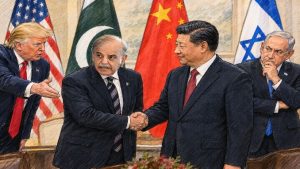 From Right to Left: Pres. Trump, PM Shehbaz Sharif, Pres. Xi, and PM Netanyahu. Image created via AI.
When American and Iranian negotiators finally sat down in the same room in Islamabad in April 2026, the choice of venue surprised almost everyone outside the region. Pakistan is not a traditional Middle East power broker. It has no seat at the Gulf Cooperation Council, no historic role in Arab-Israeli diplomacy, and a domestic political system so dominated by its military that most Western chancelleries treat it as an afterthought.
Yet over the course of the 2025-2026 Iran war, Field Marshal Asim Munir and Prime Minister Shehbaz Sharif turned Islamabad into the indispensable channel between Washington and Tehran. For those who care about Israel’s security, that development deserves more scrutiny than it has received. Pakistan is not a neutral bridge. It is a nuclear-armed state whose defense establishment has grown more dependent on Beijing with each passing year, whose senior officials have openly described Israel as a “common threat” to the Muslim world, and whose economic survival increasingly runs through Chinese, not American, capital. Understanding why Washington leaned so heavily on this particular partner requires understanding the two very different relationships pulling at Pakistan from opposite directions.
An Old and Deep Friendship
China’s relationship with Pakistan did not begin last year or even last decade. Formal ties date to 1951, and the partnership hardened through shared hostility toward India, first during the wars of 1965 and 1971 and then through the decades that followed. Beijing began transferring nuclear and missile technology to Pakistan in the 1970s and 1980s, and a 1986 nuclear cooperation agreement gave Islamabad much of the technical foundation for its 1998 weapons test. That history matters because it establishes a pattern that has never really broken. China has been Pakistan’s primary source of advanced weaponry for a generation, and current estimates put roughly seventy percent of Pakistan’s defense imports as Chinese in origin. The two countries co-produce the JF-17 fighter jet, and in May 2026 Pakistan commissioned the first of eight Hangor-class attack submarines built in Chinese shipyards, with several more slated for assembly at Karachi.
The economic dimension is even larger. The China-Pakistan Economic Corridor, a roughly sixty-five billion dollar package of roads, power plants, and port facilities anchored around Gwadar on the Arabian Sea, forms the backbone of China’s Belt and Road ambitions in South Asia and has left Pakistan holding something in the neighborhood of thirty billion dollars in sovereign debt to Beijing. When Sharif and Munir traveled to China together in May 2026, the symbolism was deliberate. A civilian prime minister and an army chief appearing side by side is rare in Pakistani diplomacy, and the trip produced a formal China-Pakistan Security Partnership meant to expand military coordination well beyond arms sales. China’s foreign minister called the friendship “rock-solid,” and Pakistani officials have taken to describing the arrangement as an “all-weather” alliance, a phrase Beijing uses for almost no other country on earth.
None of this makes Pakistan a Chinese puppet in any simple sense. Analysts who study the relationship closely note that Beijing has avoided a formal mutual-defense treaty, preferring what one recent assessment called a “threshold alliance” that keeps China’s options open. But the direction of travel is unmistakable. Pakistan’s military hardware, its infrastructure, its energy grid, and a growing share of its foreign debt now run through Beijing, and that dependency shapes how Islamabad calculates its interests on every regional question, including its posture toward Israel.
A New and Shallow Courtship
Set against seventy-five years of Chinese investment, the current warmth between Islamabad and Washington looks considerably thinner. The relationship soured badly during Donald Trump’s first term, when he accused Pakistan of years of “lies and deceit” over its handling of Afghan militants, and it did not meaningfully improve until his second term began. The turnaround has been built less on shared strategic vision than on a series of transactional wins. Munir showed Trump sample stones from Pakistan’s mineral deposits during a September 2025 White House visit, and within months a private American firm had signed a memorandum of understanding on rare earth extraction, backed by a five hundred million dollar investment. Trump floated cooperation on Pakistani oil reserves, praised Islamabad’s counterterrorism assistance in a speech to Congress, and hosted Munir at the White House twice in a matter of months, a level of access no Pakistani general had previously received. Pakistan, for its part, nominated Trump for a Nobel Peace Prize after he claimed credit for ending its brief 2025 conflict with India, and it rolled back a digital services tax as a goodwill gesture during trade talks. A bilateral trade agreement lowered American tariffs on Pakistani textiles and goods to nineteen percent, among the lowest in South Asia.
These are real developments, but they are also recent, personality-driven, and narrow in scope. They rest on Trump’s evident fondness for Munir and on Pakistan’s willingness to flatter him, not on the kind of institutionalized security architecture that anchors the China relationship. Compare the two tracks and the asymmetry is stark. China has spent decades building submarines, fighter jets, nuclear reactors, and a debt relationship that gives it leverage over Pakistani decision-making for years to come. The United States, by contrast, is negotiating over antimony shipments and crypto partnerships with a Trump-family-linked firm. One relationship is structural. The other, so far, is largely tactical.
Why Washington Called Islamabad
This asymmetry is precisely what made Pakistan useful as a mediator once the Iran war escalated. Islamabad had spent the prior two years repairing its relationship with Tehran, signing agreements to jointly counter Baloch militants along their shared border, and Iran returned the favor by publicly backing Pakistan during its May 2025 confrontation with India. At the same time, Munir had cultivated exactly the kind of personal rapport with Trump described above. Pakistan could talk to both capitals, and after the initial American and Israeli strikes on Iran at the end of February 2026, Islamabad began shuttling proposals between Washington and Tehran almost immediately. By April, senior delegations from both countries were meeting face to face in Islamabad for the first time since the 1979 revolution, a genuine diplomatic milestone even though that first round of talks broke up without an agreement.
Pakistan’s motives were not selfless. It imports the overwhelming majority of its oil and nearly all its liquefied natural gas, and an unresolved war on its western border threatened both its energy security and its recently signed defense pact with Saudi Arabia. Playing peacemaker also delivered exactly the kind of international prestige that a country written off as a pariah a decade earlier could use, elevating Pakistan from a state courted by no one to a partner courted by Washington, Beijing, Riyadh, and Tehran simultaneously.
The View From Jerusalem
This is where the story should concern anyone thinking about Israel’s position. The same week that Pakistan was being praised in Washington as an indispensable peace broker, its defense minister was publicly declaring that Israel poses a threat to the entire Muslim world and calling for a coordinated Islamic response, language that followed a defense pact Pakistan signed with Saudi Arabia and Turkey after Israel’s strike on Hamas leadership in Qatar. Israeli officials reacted with open alarm, describing that agreement as aimed at Israel rather than purely at Iran and urging Jerusalem to deepen its own counterbalancing ties with India, Greece, and Cyprus. Because Pakistan is the only nuclear-armed state in the Islamic world, the Saudi pact was widely read as extending an informal nuclear umbrella over Riyadh, a arrangement analysts say gives Saudi Arabia deterrence against Israel without technically violating nonproliferation rules. Whatever the precise military reality, the political signal was unmistakable, and it was aimed squarely at the region’s only Jewish state.
Layer the China relationship on top of that posture and the picture becomes more troubling still. A Pakistan that depends on Beijing for the bulk of its weapons, a large share of its infrastructure financing, and its submarine fleet has every incentive to align its regional messaging with an axis that includes China’s own tightening partnership with Iran. Elevating Islamabad into the role of essential Iran mediator does not simply solve a diplomatic puzzle for Washington. It hands additional legitimacy and leverage to a government whose military establishment has been willing to frame Israel as a civilizational adversary, whose nuclear arsenal has already been informally extended toward Saudi Arabia, and whose strategic center of gravity sits closer to Beijing than to Washington or Jerusalem on almost every measure that matters, from arms procurement to sovereign debt. Each round of talks that boosts Pakistan’s international standing also boosts the standing of a state increasingly comfortable positioning itself as part of an anti-Israel bloc.
There is also a proliferation dimension that Israeli strategists have worried about for decades, going back to reporting on Israel’s own failed effort in the 1980s to stop Pakistan’s weapons program before it succeeded. A more internationally legitimized, more diplomatically central Pakistan is also a Pakistan with greater room to expand its nuclear cooperation with Gulf partners and to resist the kind of outside pressure that might otherwise constrain that arsenal.
Other Perspectives Worth Weighing
A fair accounting has to note the counterarguments. Many regional specialists reject the idea that Pakistan’s China ties automatically translate into hostility toward Israel, pointing out that Islamabad has historically stayed out of conflicts that do not touch its immediate borders and that its Israel rhetoric is aimed primarily at domestic and pan-Islamic audiences rather than reflecting an operational commitment against Israeli interests. Some analysts argue China itself prefers a cautious, hedging posture on Gulf nuclear questions precisely so it does not provoke a public breach with Washington, which would cut against the idea of a unified anti-Israel axis. Others make the case that a Pakistan pulled toward American trade and mineral deals has real incentive to moderate its rhetoric over time, and that Washington’s growing economic footprint in Islamabad gives it fresh leverage it did not have a few years ago. And supporters of the mediation itself argue that any credible channel that reduces the odds of a wider war, including one that indirectly protects Israel from a broader regional conflagration, is worth the diplomatic cost of dealing with an imperfect partner. These are reasonable positions, and the debate over how much weight to give Pakistan’s China dependency versus its new American ties is far from settled among people who watch the region closely.
What is not in dispute is that Pakistan enters this moment as a state with one foot in a decades-old, deeply institutionalized partnership with Beijing and the other in a much newer, transactional courtship with Washington, all while some of its most senior officials speak of Israel in the language of confrontation. That combination deserves a clear-eyed look from anyone who wants to understand what Pakistan’s expanded diplomatic role in the Iran file actually means for Israel’s long-term position in the region.
Jalal Tagreeb is an East Jordanian freelance researcher and translator who works in the United Kingdom and abroad, specializing in Islamic Studies and History. Formerly rooted in conservative Sunni Islam, he was once an active Muslim apologist who frequently debated secularists. Following a series of decisive intellectual defeats, he undertook a profound re-evaluation of his beliefs, ultimately culminating in his public renunciation of Islam.
He now focuses on analyzing cultural and ideological contrasts between the West and the Middle East. Through his writings and translations, he aims to foster meaningful dialogue, encourage critical engagement with Islamic tradition, and promote intellectual honesty. His writings, debates, and a selection of his previously refuted Islamic arguments can be found here: Jalal Tagreeb, Author at The Freethinker.
He can be contacted at servantjiff@gmail.com.
Israpundit is entirely dependent on readers support. Please help me continue educating people with the truth about what is going on in Israel and around the world.


Leave a Reply
You must be logged in to post a comment.