
Ambassador (ret.) Yoram Ettinger | “Second Thought: a US-Israel Initiative” | September 7, 2026
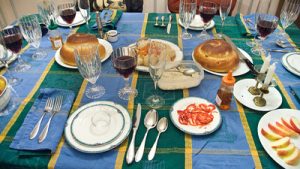 “Rosh Hashanah 5769 – The Table” by Edsel Little, CC BY-SA 2.0
More on Jewish holidays: Smashwords, Amazon
*Rosh Hashanah, the Jewish New Year of 5787, will be launched on the evening of September 11, 2026 – at a time of severe social polarization – underscoring personal accountability andadditional critical values:
^Family and community bonding;
^Roots commemoration and strengthening;
^Accountability (assume responsibility), moral stock-taking and recalibration;
^Renewal (desisting from autopilot behavior);
^Relationships-mending;
^Modesty and humility enhancement;
^Repentance;
^Fending off complacency and instant-gratification;
^On a national level: the centrality of the Land of Israel and Jerusalem.
*Rosh Hashanah initiates a wake-up call of ten days of self-examination and repentance, which are concluded on Yom Kippur (the Day of Atonement). This self-examination is guided by morality-driven tenacity, humility and faith, re-studying moral values and avoiding past errors.
The root of the Hebrew word Shanah is “repeat” (every year) and “change.” Rosh Hashanah is an annual reminder that morality should be the central value of our life, which should guide – not transcended by – success, fame, power and monetary wealth.
*Rosh Hashanah commemorates the 6th day of Creation, when the first human-being, Adam, was created. Adam is the Hebrew word for a human-being (???), which is the root of the Hebrew word for “soil” (????) – a metaphor for humility. Adam is also a derivative of the Hebrew word for blood (??) – the body’s primary transport and immune system, delivering essential oxygen and nutrients while removing waste. Adam is, also, a Hebrew acronym of Abraham, David and Moses, who were role model of humility.
*The Hebrew word Rosh (???) means first/head/beginning and Hashanah (????) means the year. Rosh (???) is the root of the Hebrew word for Genesis (??????), which is the first Hebrew word in the Book of Genesis.
*Rosh Hashanah is celebrated on the first day of the Jewish month of Tishrei – “The Month of The Strong Ones” (Book of Kings A, 8:2) – when the three Jewish Patriarchs (Abraham, Isaac and Jacob) and the Prophet Samuel were born. Tishrei means beginning/Genesis in ancient Acadian. The Hebrew letters of Tishrei (????) are included in the Hebrew spelling of Genesis (??????), that includes the first two letters in the Hebrew alphabet (??), a middle letter (?) and the last three letters (???) – representing the totality of the Creation.
*The late Rabbi Adin Steinsaltz, the iconic Talmudic scholar, compared the calendar year to a human body, consisting of the head/brain, the heart and the liver. Thus, on Rosh Hashanah (head/brain) one contemplates the vision of the coming year, while the rest of the year facilitates the implementation of the vision in a balanced coordination between the head/brain, heart and the liver of the year.
*Rosh Hashanah is announced and celebrated by the blowing of the (bent/humble) Shofar, which is the horn of the humble and determined non-predator ram. The initial blowing of the Shofar is indicated in Leviticus 23:23-25 and Numbers 29:1-6: “a day of blowing the shofar.”
The Hebrew spelling for Shofar ????)) is a derivative of the verb to enhance and improve ???)).
The sound of the Shofar was used to alert people to physical challenges (e.g., military challenges). On Rosh Hashanah, the Shofar alarms people to spiritual challenges – a wakeup call for enhancing one’s behavior.
The Shofar represents “peace-through-strength,” as demonstrated by the peaceful ram, which is equipped with powerful and deterring horns.
In ancient times, the blowing of the Shofar was employed to announce the (50th) year of the Jubilee – a Biblical role model of liberty: “Proclaim liberty throughout all the land and unto all the inhabitants thereof (Leviticus 25:10).” The Jubilee inspired the US Founding Fathers’ concept of liberty, as inscribed on the Liberty Bell. It also inspired the US Abolitionist movement.
The English word Jubilee is derived from the Hebrew word Yovel, which is a synonym for horn-Shofar.
*The 100 blows of the Shofar commemorate the creation of Adam, the first human-being; the almost-sacrifice of Isaac, which was prevented by a ram; the receipt of the Ten Commandments on Mount Sinai; the tumbling of the walls of Jericho upon re-entering the Land of Israel, which was facilitated by the blowing of the Shofar; Judge Gideon’s war against the Midianites, which featured the blowing of the Shofar; and the reaffirmation of faith in God, the Creator (“In God We Trust“). The blowing of the Shofar underscores the transformation from despondency (the destruction of the two Temples in Jerusalem and the ensuing exiles) to fulfilled optimism (the ingathering to – and the reconstruction of the Land of Israel).
The 100 blows of the Shofar are divided into three series, honoring the three Patriarchs (Abraham, Isaac and Jacob), the three parts of the Old Testament (the Torah, Prophets, Writings) and the three types of human beings (pious, mediocre, evil).
*Pomegranate. On Rosh Hashanah, it is customary to eat seeds of pomegranate, which is one of the seven Biblical species of the Land of Israel (wheat, barley, grapes, dates, figs, olives and pomegranates), representing health (high in iron, anti-oxidants, anti-cancer, enhances cardiac and digestion systems), righteousness, fruitfulness, fertility, longevity, learning and wisdom.
*Honey. Rosh Hashanah meals include honey, sweetening the coming year. The bee is the only insect which produces essential food. It is a community-oriented, constructive and a diligent creature. The Hebrew spelling of bee (?????) is identical to “the word of God” (????-?’), and Deborah ?????)) who was one of the seven Jewish prophetesses, as well as a distinguished military and political leader.
Wishing you a New Year top heavy on enhanced mutually-beneficial US-Israel cooperation and low on US and Israeli casualties.
Israpundit is entirely dependent on readers support. Please help me continue educating people with the truth about what is going on in Israel and around the world.

Leave a Reply
You must be logged in to post a comment.