
Peloni
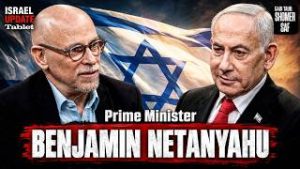 Video Loads Below
See Highlights Below Video [Hebrew with English subtitles]
Highlights:
The course and objectives of the war after October 7
- Netanyahu’s describes the war against Hamas, Hezbollah, Syria, and Iran as having fundamentally changed the Middle East.
- He concludes that Israel has achieved major strategic gains yet the war campaign is not yet completed.
Iran and the Iranian nuclear threat
- Netanyahu examines his long-standing emphasis on Iran and its nuclear program.
- The decision to strike Iran directly.
- The relationship between Iran and its regional proxies.
- The weakening of Iran and the possibility of further weakening its regime.
Hamas and Gaza’s future
- The disagreement over whether the war in Gaza should have been ended at an earlier point.
- The need to dismantle and disarm Hamas before Gaza can be rebuilt.
- The new security zones and buffers and Gaza’s future, including reconstruction and the support for Gazan emigration.
Hezbollah, Lebanon, and Syria
- The destruction of Hezbollah’s leadership and decimation of its missile capabilities.
- The situation in Syria and its jihadi and other hostile forces.
- The need to prevent threats from developing along Israel’s borders and the use of buffer zones for this.
The relationship with the United States Trump
- Israel’s cooperation and challenges with Washington and specifically Netanyahu’s relationship with Trump.
- Various approaches used with Iran including negotiations, continued sanctions/blockade, or military action.
- The importance of maintaining the US-Israeli alliance while still developing greater Israeli independence.
Israeli military doctrine and the role of military force
- The import of coordinating conventional military power and special operations alongside the employment of technological advancements.
- The importance of armor, ground forces, firepower, logistics, and control of territory.
- An emphasis on the moral courage and strength of the Israeli people in pursuing their own defense.
- The changing relationship rising between the political leadership and the military establishment.
The security establishment and political leadership
- Netanyahu’s conflicts with elements of the Israeli security establishment over Iran and other military policies.
- His criticism of leaks and opposition from security officials.
- Questions related to the relative authority of elected leaders exercised over military and security professionals when differences arise.
Israel’s international legitimacy and the battle over public opinion
- Israel’s struggle against what Netanyahu describes as an organized campaign of delegitimization including the libels portraying Israel as an “apartheid” or genocidal state.
- The influence which social media is having on the youth in the United States and elsewhere.
- The importance of Israel actively defending its position rather than apologizing for its actions.
Israel and the Western world
- Israel’s war as part of a broader struggle between Western civilization and its enemies.
- The connection between attacks on Israel and attacks on the US.
- The willingness of the West to act in its own defense and Israel’s role in this broader civilizational struggle.
Israeli alliances beyond the US
- The importance of diversifying Israel’s alliances while maintaining its relationship with America.
- The emphasis on Israel’s relationship with India and other states including those throughout the Middle East.
- The value of alliances with Arab and Muslim states which oppose radicalism.
Israeli military independence and defense industries
- The need to reduce Israel’s dependence on foreign weapons supplies.
- Increasing defense spending and developing domestic weapons industries.
- The ambitions for Israel to develop its own advanced fighter aircraft.
- The connection existing between military independence and national security.
The Abraham Accords and regional opportunities
- Israel’s developing relationships with Arab states.
- Abraham Accords emerged from a broader strategic process.
- The potential for an expansion in regional alliances.
The Israeli elections and the future government
- The upcoming elections and what is at stake.
- The preference for a broad national government.
- The principles Netanyahu requires for participation in such his government, including Israel as the nation-state of the Jewish people and opposition to a Palestinian state.
- Criticism of the opposition camp.
Judicial reform and the balance between the branches of government
- The importance of judicial reform in restore a balance between the branches of govt.
- The belief that this issue could have been addressed earlier with less difficulty.
- The possibility of reaching broader agreement on judicial reform following the elections. [Editor’s note: I think this is highly unlikely]
Haredi military enlistment
- The need for a law which will provide clear guidelines surrounding military service by the Haredim.
- A distinction drawn between genuine Torah scholars and those who are not studying Torah.
- Haredi enlistment has already substantially increased.
- This issue will be addressed by a broader national government following the election.
The political and media environment
- The role of advertising agencies, organized campaigns, and media outlets in manipulating and shaping public opinion.
- The decline of substantive political discourse and the growing legitimacy of political manipulation.
Personal attacks against the Netanyahu family
- The personal cost of Netanyahu’s political career on his family.
- The suffering and sacrifices experienced by his family.
Netanyahu’s personal experiences and worldview
- The influence which his father and Jewish history had on Netanyahu’s worldview.
- The lesson of Jewish weakness and the necessity of self-defense.
- His own military experiences and the influence it had on his understanding of warfare.
- The importance of determination, strategic thinking, and national resilience.
Netanyahu’s achievements over the years
- The transformation of Israel toward a free-market economy.
- Development of Israel’s natural-gas resources.
- Stopping illegal infiltration into Israel.
- Israel’s development as a cyber power.
- The ambition to make Israel a leading power in artificial intelligence and quantum technology.
Self-criticism and lessons from Netanyahu’s career
- Netanyahu’s acknowledgment that there were things he would have handled differently.
- His admission that he did not identify the need to address the balance between Israel’s branches of government early enough.
- His view that his central strategic focus on Iran, the economy, and preventing a Palestinian state shaped his priorities.
What Netanyahu believes is at stake in the coming elections
- Netanyahu correctly portrays the coming election as being pivotal in choosing the future path for both Israel and the Jewish people.
- He emphasizes that a focus must be maintained on threats from Iran and other radical forces and stresses the importance of military, economic, technological, diplomatic, and informational strength towards this end.
- He concludes that Israel faces major challenges but also major opportunities, and challenges that can best lead the nation through them.
Israpundit is entirely dependent on readers support. Please help me continue educating people with the truth about what is going on in Israel and around the world.

4 hrs ago
https://youtu.be/P-5Bu7vTOXc?is=GfjhOQ56rXBfuPbk