
The PLO’s Oslo Charade

The Letter That Made the PLO a “Peace Partner”

Aynaz Anni Cyrus | Sep 09, 2026
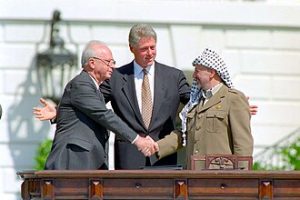
Israeli Prime Minister Yitzhak Rabin, U.S. president Bill Clinton, and PLO chairman Yasser Arafat. Photo by Vince Musi / The White House - gpo.gov - Archived here. Site with better credit info here., Public Domain, https://commons.wikimedia.org/w/index.php?curid=7273344Israeli Prime Minister Yitzhak Rabin, U.S. president Bill Clinton, and PLO chairman Yasser Arafat. Photo by Vince Musi / The White House – gpo.gov – Archived here. Site with better credit info here., Public Domain, Wikipedia

It was 11:00 at night when Yasser Arafat placed his signature on the letter.

The Executive Committee of the Palestine Liberation Organization had spent five hours in a bitter meeting over the agreement. Eight members voted in favor. Four voted against it. One abstained. Three of the committee’s sixteen members did not vote.

Norwegian Foreign Minister Johan Jørgen Holst stood with Arafat as he signed. The cameras were kept outside.

Four days later, the world would see Arafat and Israeli Prime Minister Yitzhak Rabin shake hands on the White House lawn as President Bill Clinton stretched his arms behind them. That image became the symbol of Oslo.

The PLO’s transformation in the eyes of the world began here, in Tunis, with a letter.

Arafat’s letter to Rabin opened by declaring that the coming Declaration of Principles marked “a new era” in the Middle East. He then committed the PLO to a series of specific actions.

The PLO recognized “the right of the State of Israel to exist in peace and security.” It accepted United Nations Security Council Resolution 242, adopted after the 1967 Six-Day War, which called for Israeli withdrawal from territories captured during the conflict while affirming every state’s right to live in peace within secure and recognized boundaries. It also accepted Resolution 338, adopted during the 1973 Yom Kippur War, which ordered a ceasefire, demanded the implementation of Resolution 242, and called for negotiations toward a lasting peace.

It committed itself to resolving the conflict through negotiations and “exclusively peaceful means.” It renounced terrorism and all other violence. It accepted responsibility for all PLO elements and personnel and promised to discipline anyone who violated those commitments.

Arafat also addressed the Palestinian National Covenant, the PLO’s founding document. He declared that every provision denying Israel’s right to exist, along with every provision contradicting the new commitments, was now inoperative and invalid. He promised to submit the necessary changes to the Palestinian National Council for formal approval.


Continue Reading Article

September 9, 2026 | 7 Comments »

Leave a Reply

7 Comments / 7 Comments

  1. They signed on the dotted line. The immediately disagreed with anything they didn’t like. They put their words into action and did their best to kill any and every Israeli or Jew they could find. They broke the agreement paragraph by paragraph while expecting Israel to hold up their side of the agreement in full.

    Actually, they expected the witnesses to the Oslo Accords to ensure that Israel kept strictly to the agreement while breaking every clause. Those countries are willing accomplices, aiding and abetting the terrorists at every turn while calling Israel and its leaders before the international court of justice.

    Actually, Israel is the fool in this agreement and since the Oslo Accords have been declared dead by both sides for years now, it is time that Israel stop being and playing the fool and finally defeat these killers once and for all and that despite any disagreement from abroad.

  2. The PLO’s “Phased Plan”

    In the October 1973 Yom Kippur War, the Arab states launched a surprise attack against Israel on the holiest day of the Jewish calendar. Once again they tried to eliminate Israel, further motivated this time by the desire to redeem their honor after their major defeat in the 1967 Six-Day War. Though Israel was initially caught off guard, it then regrouped and repelled the Arab attack, but not before incurring heavy casualties.

    The war convinced the Arabs that they would not be able to destroy Israel militarily within its post-1967 boundaries. Thus they embarked upon a new three-stage strategy for Israel’s destruction, embodied in the PLO’s 1974 decision commonly known as the Phased Plan (the text of which is below).

    The plan in brief:

    Through the “armed struggle” (i.e., terrorism), to establish an “independent combatant national authority” over any territory that is “liberated” from Israeli rule. (Article 2)
    To continue the struggle against Israel, using the territory of the national authority as a base of operations. (Article 4)
    To provoke an all-out war in which Israel’s Arab neighbors destroy it entirely (“liberate all Palestinian territory”). (Article 8)
    Today, the Phased Plan remains relevant. Speaking just after the 1993 revelation of the Israel-PLO accord, PLO Chairman Yasser Arafat announced that the historic agreement “will be a basis for an independent Palestinian state in accordance with the Palestine National Council resolution issued in 1974…. The PNC resolution issued in 1974 calls for the establishment of a national authority on any part of Palestinian soil from which Israel withdraws or which is liberated.” (Radio Monte Carlo, 1 September 1993)

    It is worth noting that the PLO’s term for the self-rule council now in place in Gaza and the West Bank is the “Palestinian National Authority,” echoing the language of the Phased Plan.

    Also note that Articles 5-6 call for a revolution in Jordan to establish a new Jordanian regime which will ally itself with the Palestinian National Authority. Historically, Jordan comprised the bulk of the Palestine territory, and a majority of its residents are of Palestinian origin. The PLO has never recognized the legitimacy of Kingdom of Jordan as a state independent of Palestine…

    https://iris.org.il/plophase.htm

  3. Arafat compares Oslo Accords to Muhammad’s Hudaybiyyah peace treaty, which led to defeat of the peace partners
    Private recording|May 10, 1994

    “The Hudaybiyyah peace treaty
    former PLO and PA Chairman Yasser Arafat compared the Oslo Accords with the Hudaybiyyah peace treaty – a 10-year truce agreed between Islam’s Prophet Muhammad and the Quraysh Tribe of Mecca. However, two years later, Muhammad attacked and conquered Mecca.”

    https://palwatch.org/page/8

    • The Oslo Accords according to the Palestinian Authority – 25 years in review
      Itamar Marcus|Sep 13, 2018
      “The Palestinian people accepted the Oslo Accords as a first step
      and not as a permanent settlement,
      based on the premise that the war and struggle in the land
      is more efficient than a struggle from a distant land”

      By Itamar Marcus

      Listening to what Palestinian leaders have said
      answers five fundamental questions about the Oslo Accords

      1: Were the Oslo Accords signed by the PLO as a long-term peace treaty with Israel?
      2: What did the PLO hope to achieve through Oslo?
      3: Didn’t Yasser Arafat commit to stop all violence?
      4: Wasn’t the 5-year terror campaign, the “intifada,” a tragedy for Israelis and Palestinians alike? The PA’s terror cost 1,200 Israeli and 3,000 Palestinian lives.
      5: What borders does the PLO seek in a final status solution with Israel?
      PA and Fatah leaders answer these questions in videos and texts below.

      https://palwatch.org/page/14665

        • humor:

          Excerpt: “The Course of Justice” (From “So Sorry We Won – The Story of the Six Day War in Word And Cartoon ” by Ephraim Kishon and Dosh (Kariel Gardosh) Tel Aviv. 1967) (typed from the hardcover)

          “September: a member of the El Fatah murder gang named Mahmoud Hejazi is captured wounded on Israeli territory in possession of an automatic rifle, 12 pounds of explosives, three flamethrowers and a couple of howitzers. The examination of the infiltrator proceeds slowly as when captured, the man was in state of coma induced by fright and he is unable to utter coherent sentences. He cowers in a corner, crawls in the dust and keeps mumbling: “Mahmoud good boy…Have pity on me, great effendis…Pity…Poor Mahmoud…”

          ‘October : Hejazi is tried by a military court and sentenced to death. Upon hearing the sentence, the accused collapses and sobbingly pleads for his miserable life. The Minister of Justice remembers his European heritage and approves the appointment of an Arab lawyer to defend the murderer who appealed the sentence.

          ‘November : The lawyer arrives from Algeria and is handed a memorandum on what is expected of him in court:
          (1) That he should read the Declaration of Independence of the State of Israel to an organ accompaniment.
          (2) That he should express his gratitude and appreciation for the activities of the Government of Israel.
          (3) Hatikvah
          The lawyer refuses to cooperate, he happens to root for the Arabs. Out!

          ‘December : Hejazi stands up for his elementary rights: “I won’t budge without a foreign lawyer,” he announces. The authorities are somewhat perplexed. The Chief-of-Staff’s coaxing of Hejazi falls on deaf ears: “Leave me alone,” says the disappointed infiltrator; “There’s no-one I can talk to in this country.”

          January: The trial is resumed without Hejazi’s approval. “You’re a bunch of crooks, the lot of you!” Hejazi declares. “You’re abominable behavior is in complete contradiction to all the tenets of international law and is repugnant to all freedom-loving people.” The defense attorney asks Hejazi not to make superficial generalizations, whereupon he is fired by him. The lawyer lodges an appeal.

          February: Hejazi convokes a press conference and demands the resignation of the Government, which has entangled itself in its own web of perfidy. “I cannot negotiate with hooligans.” The infiltrator tells the press. “If my case is not settled within a week from today, I won’t answer for the consequences!” The President of the Court appeals to Hejazi’s nobler feelings in an effort to win his co-operation. Hejazi announces over Kol Israel that he is forced to dismiss the court.

          March : Mr. Mahmoud Hejazi’s claim for compensation from the Israeli Army is heard by Mr. Abie Nathan as sole arbitrator. In his defense brief, the Chief-of-Staff claims that the infiltrator’s arrest was carried out without malice. Nor is he willing to accept Hejazi as a war invalid entitled to assistance and a Ministry of Defense pension. A compromise seems to be in the offing. IL.15,000 in cash and a soft drink stand.”
          —-“