
By: Amb. Alberto M. Fernandez | MEMRI | Sept 14, 2026
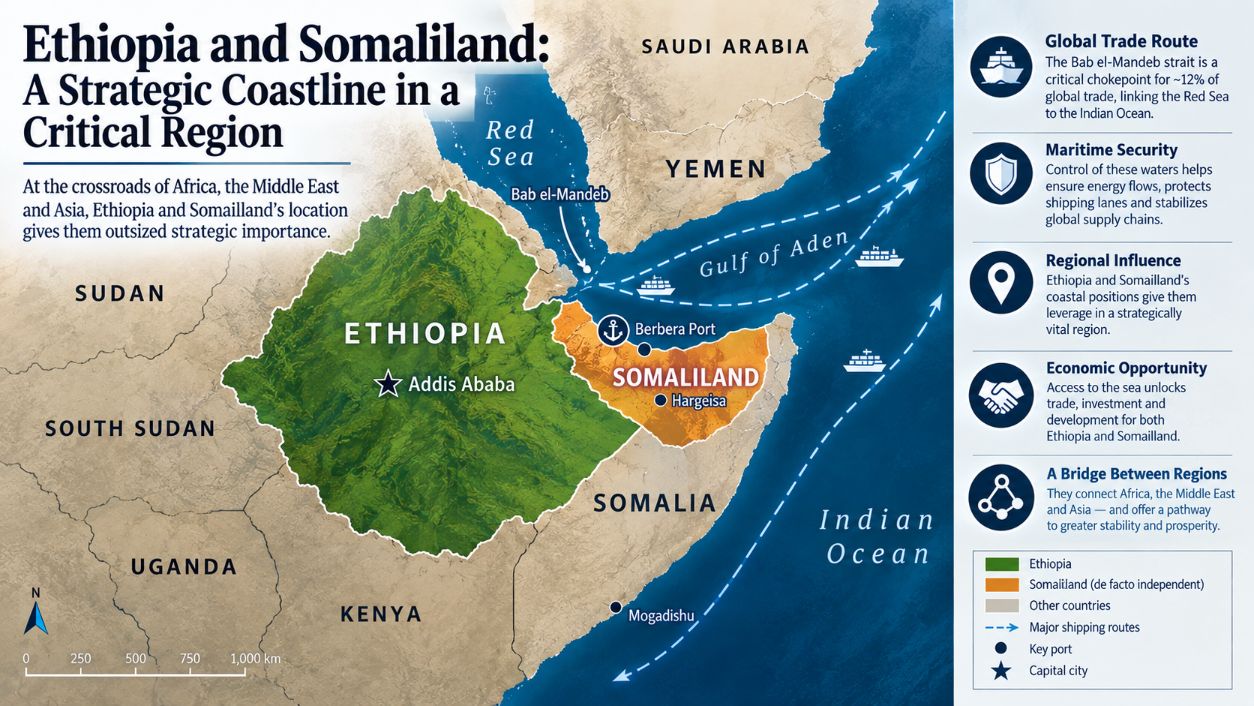 Click image to enlarge. Image created via AI
Houthi fighters have reached Perim Island, the narrowest point of the Bab Al-Mandeb Strait, and now stand within reach of choking the Red Sea’s southern gate. This advance comes as the crisis in the Strait of Hormuz continues, with maritime traffic still severely disrupted. Iran could soon hold leverage over both of the world’s most important oil corridors at once. Washington cannot manage this moment with hedging and half-measures. It needs a clear-cut strategy against Iran and its proxies.
The Houthis’ advance down Yemen’s coast is not a symbolic gain. Control of Bab Al-Mandeb would let Iran-aligned forces threaten roughly seven percent of global petroleum supplies and the roughly 12 percent of global trade that passes through the strait.[1] Iran does not need to win a conventional war against the United States. It only needs to shut two chokepoints at once.
The United States needs a strategy. Washington cannot keep trying to please everyone, because that approach protects no one – least of all the sea lanes it claims to be defending.
Somaliland sits directly on the Gulf of Aden. Formal recognition by the United States would be the clearest signal Washington could send to Iran that it intends to hold the Gulf of Aden. Washington should meanwhile organize its allies, especially in Latin America, to recognize Somaliland as well.[2] Ambiguity has a cost, and the United States has been paying it for years.
Part of that ambiguity traces back to Ankara. Turkey has built Camp TURKSOM, its largest overseas base, in Mogadishu and signed a ten-year defense pact to build Somalia’s navy,[3] largely to block Ethiopian and Somaliland ambitions in the Red Sea. President Recep Tayyip Erdogan has turned Somalia into a Turkish client and used that leverage to keep Washington’s allies boxed out of the Horn of Africa. The United States has let this happen while it tries to please Ankara on other fronts as well.
In addition, Turkey is a supporter of the Muslim Brotherhood, which cooperates with Iran. Sudan offers a particularly important example. The Houthis have established stable ties with the Muslim Brotherhood-backed Sudanese Armed Forces (SAF), keeping a presence around Port Sudan.[4] The United States cannot indefinitely accommodate Ankara while Turkey maintains relationships with Islamist actors whose interests conflict with those of Washington and its regional partners.
Egypt plays a similar game. Cairo supports the Muslim Brotherhood-linked Sudanese Armed Forces (SAF), despite fighting the Muslim Brotherhood at home. At the same time, Egypt seeks to constrain Ethiopia and exclude it from regional security arrangements. Washington cannot expect to secure freedom of navigation while sidelining Ethiopia, the Horn of Africa power best positioned to help protect it. Egypt should be pressed to stop treating Ethiopia’s rise as a threat to be contained.[5]
Ethiopia offers a better path. Landlocked since Eritrea’s secession in 1993, Ethiopia has been rebuilding its naval institutions and signed a memorandum with Somaliland for coastal access. Addis Ababa has the population, the economy and the security interest to become the Red Sea’s principal partner navy for the United States. Washington should back that ambition openly, help fund and train an Ethiopian fleet and stop treating Turkey’s primacy or Egypt’s containment strategy as facts it must accommodate.[6]
Although Houthi gains remain volatile and may prove temporary, their demonstrated ability to project force toward the Bab Al-Mandeb poses a persistent strategic risk to maritime security and regional/global stability. Iran has shown it can strangle Hormuz. The United States cannot answer two chokepoints with one policy of avoidance, while pleasing Turkey and tolerating Egypt’s double game. Recognizing Somaliland, rallying allies behind it and backing an Ethiopian navy would give Washington a coherent Red Sea strategy for the first time in years, one built on committed partners rather than hedged relationships.
*Anna Mahjar-Barducci is MEMRI Senior Research Fellow.
[1] Reuters.com/world/middle-east/houthi-advance-yemen-puts-us-new-bind-2026-09-12, September 12, 2026.
[3] Adf-magazine.com/2026/05/somalia-turkey-partner-on-maritime-security/, June 1, 2026.
[5] Hornreview.org/2026/09/12/egypts-geopolitical-paradox-on-the-nile-selective-partnerships-as-a-strategy-of-containment/, September 12, 2026.


Leave a Reply
You must be logged in to post a comment.