
Harry Liberman
 Click Image to Enlarge. Image via AI.
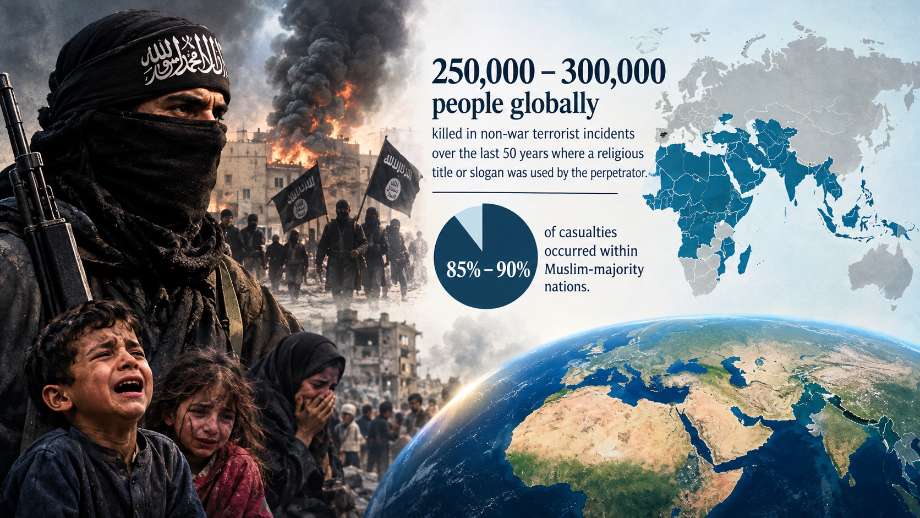
If you look strictly at recorded modern data of non-war terrorist incidents over the last 50 years where a religious title or slogan was actively used by the perpetrator to execute an attack, the documented death toll stands between 250,000 and 300,000 people globally.
The vast majority of these documented modern fatalities are attributed to global transnational Islamist terrorist networks. Documentation from global repositories like the Fondation pour l’innovation politique (Fondapol) places this toll firmly within non-war religious extremism, with an overwhelming 85% to 90% of casualties occurring within Muslim-majority nations. Analysis from international organizations indicates that invoking sacred slogans serves primarily as a psychological branding tool for political dominance rather than theological devotion.
When these statistics are laid bare, the collective human instinct is to seek immediate, clear-cut classification.In an era dominated by rapid information consumption and polarizing political rhetoric, names, labels, and slogans are treated as absolute proof of intent.
When a perpetrator shouts a religious phrase before committing an act of mass violence, the public and the media instantly categorise the tragedy. It is filed away under the banner of a specific faith, transforming a localized act of horror into a data point within a global civilizational struggle. But as we parse the devastating toll of modern religious extremism, a fundamental question emerges:
What is truly in a name?
Does the invocation of a deity define the essence of a crime, or does it merely obscure a far more complex lattice of geopolitics, power, and human manipulation?
This phenomenon mimics the corporate history laid bare in the film The Founder, where an original innovator’s foundational design is aggressively scaled, rebranded, and weaponized by expansionist competitors, ultimately diluting the original source into demographic obscurity.
The Imperial Blueprint of Replacement (Supersessionism)
To map how a localized tribal identity became vulnerable to this global scale of extraction, one must look to the legal and political mechanisms engineered by early empires.
The spiritual framework of the original source was not merely borrowed; it was systematically overwritten through a theological doctrine known as supersessionism, or replacement theology.
This doctrine asserted that the newer revelation had completely replaced, invalidated, and superseded the original covenant made with the Jewish people. This was not a passive shift in belief, but a highly calculated political maneuver designed to anchor imperial legitimacy in the prestige of antiquity while stripping the original authors of their legal and social status.
The historical codification of this replacement model followed a precise structural timeline across two major imperial eras:
313–380 CE (The Roman Empire): Following the Edict of Milan and the subsequent Edict of Thessalonica under Emperor Theodosius I, Nicene Christianity was transformed from a persecuted sect into the official state religion of Rome. The empire required a unifying ideological monopoly. By adopting Hebrew scripture but claiming that the Christian Church was now the “True Israel” (Verus Israel), Rome successfully appropriated the divine authority of an ancient tradition while legally codifying the marginalization of actual Jews.
438 CE (The Theodosian Code): The legal architecture of the empire caught up with its theology. The Codex Theodosianus explicitly stripped Jewish citizens of the right to hold public office, build new synagogues, or proselytize. Conversion to Judaism was made a capital offense. The original innovators were legally frozen in a state of enforced degradation, serving as a political prop to illustrate what the state deemed an “obsolete” faith.
529 CE (The Code of Justinian): Emperor Justinian intensified this structural erasure. The Corpus Juris Civilis stripped Jews of civil rights, barred them from testifying against orthodox Christians in court, and legally compelled them to read scripture only in Latin or Greek translations approved by the state. The empire had successfully taken the product, altered its language, and banned the inventors from practicing their own craft.
7th–8th Century CE (The Islamic Caliphates): As the early Caliphates rapidly expanded across the Middle East and North Africa, they encountered the same structural challenge: ruling a diverse population with a new ideological framework. They implemented a parallel model of supersessionism. Islamic theology asserted that while Judaism and Christianity possessed genuine divine revelations, their texts had been fundamentally corrupted (tahrif), rendering the Quran the final, corrected, and unalterable franchise update.
717 CE (The Pact of Umar): This theological dominance was politically cemented through the Pact of Umar. Non-Muslim subjects were classified as dhimmi (protected, second-class citizens). While allowed to survive, they were subjected to the jizya (a specialized poll tax), forbidden from building higher than Muslim structures, barred from public office, and legally restricted from spreading their faith. The state created an economic and social pipeline engineered to drive mass conversions through institutional subjugation.
The Ultimate Theological Merger: Hamas and the October 7 Manifestation
The modern intersection of this expansionist political philosophy and localized violence found its most extreme contemporary application on October 7, 2023. When thousands of Hamas militants breached the Gaza border to commit coordinated mass slaughter against Israeli civilians, the actions were not executed under the banner of ordinary secular nationalism. Instead, the framework for the attack was explicitly pulled from the 1988 Hamas Founding Charter, a document that fundamentally relies on an uncompromising, literalist interpretation of Islamic scripture to justify the total destruction of Israel and the systematic murder of Jews. [1, 2, 3, 4]
The foundational architecture of the Hamas Covenant establishes that the entire geography of Israel, the West Bank, and Gaza is an irreversible Islamic Waqf—a sacred territory consecrated exclusively for Muslims until Judgment Day. Under Article 11 and Article 13 of the document, the charter asserts that relinquishing any portion of this land is a direct violation of Sharia law, thereby declaring that peaceful negotiations or diplomatic compromises are “futile” and a “waste of time”. By transforming a standard geopolitical land dispute into a cosmic, unalterable religious mandate, the charter legally forbids compromise and mandates Jihad as an individual religious obligation (Fard `Ayn) for every Muslim globally. [1, 2, 3, 4]
Most critically, the document explicitly expands its target from the political entity of Zionism to ethnic Jews globally, relying directly on foundational Islamic texts to sanction violence. In Article 7, the charter invokes a specific apocalyptic Hadith (oral tradition attributed to the Prophet Muhammad): [1, 2]
“The Day of Judgement will not come about until Moslems fight the Jews (killing the Jews), when the Jew will hide behind stones and trees. The stones and trees will say O Moslems, O Abdulla, there is a Jew behind me, come and kill him.” [1, 2]
By weaving this eliminationist rhetoric into its political constitution, Hamas frames the physical eradication of Jewish people not as a secular war crime, but as a mandatory, holy precursor to the end of days. Despite releasing a revised political document in 2017 to soften its international image, Hamas never revoked its original 1988 charter.
The atrocities committed on October 7—where attackers broadcasted religious slogans while executing civilians—were the direct, literal execution of this long-standing theological doctrine, demonstrating the blinding power of an ideology that masks a temporal, political quest for total dominance behind the immutable shield of a divine decree. [1, 2, 3, 4, 5, 6]
The modern demographic consequence of these imperial structures is starkly unequal.
According to global data verified by the Pew Research Center, Christianity commands over 2.2 billion adherents, while Islam follows rapidly as the world’s fastest-growing major faith at 2.0 billion. Combined, they represent over half of the human population—an ideological market share that mimics the corporate boast of “Over One Billion Served.”
In contrast, the global Jewish population sits at approximately 15 to 16 million. This number has remained small over millennia not by accident, but by deliberate, structural design.
The “Founders ” : Judaism does not actively seek or recruit outsiders.
Traditionally, a rabbi is expected to discourage a prospective convert three times, testing their commitment against the historical burdens borne by the community. To become a Jew requires a rigorous, multi-year process of study, a deep immersion into community law, and a total adoption of an identity that functions as both a lineage and a faith.
The major global systems achieved their massive scale by reversing this dynamic, stripping away structural barriers to maximize entry.
The process of joining was compressed into singular, easily replicated moments: the baptismal font in Christianity or the recitation of the single-sentence Shahada in Islam. By reducing the acquisition of membership to a few easily recited words or a localized ritual, these expansive models built an unparalleled engine for rapid, mass demographic growth.
The Blinding Power of Ideological Dominance
When an ideology prioritizes absolute global scale, theological devotion frequently transforms into a mandate for geopolitical dominance.
In this regard, secular and religious systems often use identical mechanisms to capture societies.
The twentieth century demonstrated this blinding power through state-enforced secular dogmas. Historians documenting the casualties of political violence point to Marxism and state communism as the deadliest non-religious ideological frameworks in human history, with historical records attributing tens of millions of peacetime deaths to purges, forced labor, and engineered famines across the Soviet Union and Maoist China.
When theological systems adopt this same driver for dominance, they utilize absolute spiritual claims to bypass conventional human compromise. Political grievances, territory disputes, or resource scarcity can be negotiated through secular diplomacy. However, when an ideology wraps its ambitions in a cosmic mandate, the adversary is instantly stripped of human legitimacy.
This structural drive for absolute expansion has historically manifested through imperial colonialism.
Both Western European empires and early Islamic caliphates used systematic state structures to spread their influence, language, and belief systems across vast geographic zones. Through tax incentives or overt imperial mandates, mass populations were brought into the fold.
This stands in complete contrast to Judaism, which throughout its entire 3,000-year history—predating both Christianity and Islam—never developed a global colonial mandate, remaining an indigenous tribal identity tied to a specific geographic origin.
The Modern Rebranding: Ideology vs. Ethnicity
In contemporary political discourse, a highly orchestrated semantic shift has occurred to shield these expansive, historically colonial ideologies from intellectual criticism. Activists and political groups frequently employ terms like “Islamophobia” attempting to rebrand criticism of a belief system as a form of racism.
This linguistic maneuver serves a specific political agenda: it deliberately conflates an ideology with a race. Islam is a global, multi-ethnic belief systems that transcends any single racial category; it is a sets of ideas, texts, and political frameworks. Under free-speech principles, all ideologies remain open to scrutiny, skepticism, and intense critique.
Defining the fear or rejection of a religious philosophy as “racism” is an intellectual contradiction designed to silence legitimate political analysis of how religious dogmas influence governance and law.
Conversely, anti-Semitism operates on an entirely different structural plane.
Jews are not merely followers of a religious creed; they are an ethnoreligious group—an actual ethnicity bound by shared ancestry, historical genetics, and tribal continuity.
A person born Jewish remains ethnically Jewish regardless of their personal spiritual beliefs or secular lifestyle. Therefore, anti-Semitism is not a philosophical disagreement with a set of ideas; it is a direct, immutable attack on the physical existence of a specific people. By masking expansive global ideologies under the protection of racial identity, modern political movements draw a false equivalence between critiquing a powerful, multi-billion-member global philosophy and targeting a vulnerable, historically persecuted ethnic minority.
Stripping the Core
The consequence of this civilizational expansion is the ongoing attempt to copy, alter, and ultimately delegitimize the original.
Having built global frameworks using the foundational texts of Hebrew tradition, the expansive offshoots frequently assert that the original source has been corrupted, superseded, or rendered obsolete.
When we analyze the historical landscape through this lens, the fundamental question shifts from one of spiritual devotion to one of systemic power. The “over one billion served” model relies on continuous, low-barrier expansion and the aggressive enforcement of its ideological boundaries.
By refusing to adapt its ancient, rigorous criteria for scale, the original has survived as a historical anomaly—small, unyielding, and resistant to the erasing currents of mass homogenization.
To look past the modern slogans and political alliances is to recognize the ultimate structural tension of the global landscape: the enduring resilience of an original creation -Judaism – against the massive, all-consuming power of global replication.
Quote :
“I will insist the Hebrews have contributed more to civilize men than any other nation. If I was an atheist and believed in blind eternal fate, I should still believe that fate had ordained the Jews to be the most essential instrument for civilizing the nations … They are the most glorious nation that ever inhabited this Earth. The Romans and their empire were but a bubble in comparison to the Jews.
They have given religion to three-quarters of the globe and have influenced the affairs of mankind more and more happily than any other nation, ancient or modern.”
– John Adams, Second President of the United States
While this passage stands out as an extraordinary early American tribute to Jewish heritage, historians note that Adams’s views reflected the complex religious philosophy of his era. In later correspondence with Mordecai Manuel Noah in 1819, Adams explicitly reiterated his respect for the Jewish people and wished for them to become an independent nation in Judea once more. However, he also wrote from his perspective as a Unitarian, believing that a restored, unpersecuted Jewish nation would eventually align with liberal Christian values. [1, 2]


Leave a Reply
You must be logged in to post a comment.