
A buried chapter
By Jalal Tagreeb
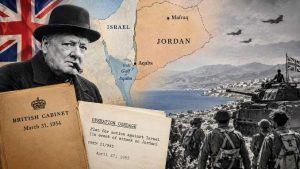 Image via AI
In November 2022, historian and strategist Edward Luttwak published a piece in Tablet titled “The Failed British Double-Cross of Israel.” Drawing on declassified British General Staff files, Luttwak laid out two episodes from the mid-1950s that rarely make it into the standard narrative of Britain’s post-Mandate relationship with Israel.
The first was Operation Cordage, and it’s worth walking through in more detail than the Tablet piece has room for, because the archival trail runs longer and further than a single set of documents.
Cordage’s origins: the 1946 treaty and the 1953 pressure
The legal hook for the whole plan was the Anglo-Jordanian Treaty of Alliance, signed in London in March 1946, which committed Britain to come to Jordan’s defence if it were attacked. Through the early 1950s, as cross-border raids and reprisals between Israel and Jordan escalated — Palestinian infiltrators crossing into Israel, Israeli reprisal raids (Qibya, in October 1953, being the most notorious) striking back into Jordanian-held territory — British and Jordanian officials began treating that treaty commitment as something that might actually have to be exercised, rather than a dead letter.
Declassified State Department correspondence from February 1953 records Jordanian officials pressing the British case directly: a Jordanian representative (Anwar Nuseibeh) told American diplomats that Aqaba — then the only place in the country with a British garrison — was “hardly satisfactory” as a base for coming to Jordan’s aid “in event of Israeli invasion,” and asked that British troops also be stationed at Mafraq in northeastern Jordan. That same document records requests for an immediate visit by the British Commander-in-Chief Middle East and a meeting of the UK-Jordan joint defence board. Mafraq is significant because it’s exactly one of the bases that shows up two years later in the actual operational plan.
The 1954 Cabinet decision and Churchill’s secrecy order
By March 1954, the planning had moved from diplomatic soundings to an actual Chiefs of Staff document. British Cabinet papers, declassified and released in early 1985 under the UK’s 30-year rule and reported at the time by the Jewish Telegraphic Agency, show that on March 31, 1954, Defence Minister Lord Alexander of Tunis told the Cabinet that the Chiefs of Staff had prepared a plan for British military action — including an invasion of Israel from the south — in the event Israel attacked Jordan. Churchill’s recorded response was not to object to the plan itself but to express relief that the Chiefs of Staff did not intend to disclose its existence to the Jordanians, on the grounds that a leak “would have had very grave consequences.” Israel’s own military leadership was not blind to this: Moshe Dayan, then IDF Chief of Staff, wrote afterward that Israel recognized the possibility of a clash with British forces in any major war with Jordan — even as Britain remained, on paper, a co-guarantor of Israel’s borders under the 1950 Tripartite Declaration alongside the US and France.
The April 1955 operational plan (PREM 11/945)
The plan acquired real operational detail the following year. UK National Archives file PREM 11/945 — cited by historian Thomas Suárez, author of State of Terror — contains a summary of plans dated April 27, 1955, which reads in substance: neutralize the Israeli Air Force using all planned reinforcements, operating from bases at Nicosia (Cyprus), Abu Sueir and Fayid (both in the British-controlled Suez Canal Zone), and Amman and Mafraq (Jordan); then conduct operations against military targets inside Israel itself, specifically communications centers and oil installations. In the same period, Britain moved an armored squadron — roughly 20 tanks and 100 men — from the Suez area to reinforce its small garrison at Aqaba, a concrete troop movement rather than a paper exercise. British officials, per the same file, were also privately careful about language: internal correspondence shows a deliberate effort to distinguish whether Israeli reprisal raids counted as “attacking” Jordan (which would trigger the treaty) or merely “raiding” it (which would not) — a hedge that suggests London wanted to preserve the option of intervening without being legally obligated to.
By July 1955, this had also become an explicit topic of Anglo-American coordination. A State Department memorandum of that month records a British Embassy counselor telling his American counterpart that London had “worked out specific actions to be taken to apply both economic and military sanctions” against Israel in the event of open Egyptian-Israeli conflict, and that the British Chiefs of Staff hoped for American cooperation “if it became necessary to impose military sanctions.” The same conversation notes this planning had not yet gone to the British Cabinet for approval — it was being run, at that stage, at the official level, with Washington brought in informally.
Cordage and the Suez crisis: how the name resurfaces, and a caveat
Cordage’s name reappears in the documentary record around the actual 1956 Suez War, but here the picture gets genuinely murky, and it’s worth flagging rather than smoothing over. Historical documentation on Operation Musketeer (the Anglo-French Suez invasion) states that Britain’s defence-of-Jordan plan was still codenamed Cordage as of October 1956, when the First Lord of the Admiralty wrote to Eden on October 2 proposing that the light cruiser HMS Royalist — recently modernized as an anti-aircraft radar picket ship, and considered well-suited against the French-supplied Mystère jets Israel was flying — be assigned to Cordage duty alongside the separate Musketeer operation against Egypt. That reading is consistent with the plan being an active, ship-assigned contingency right up to the eve of the Suez War.
Separately, however, a reference list of British military codenames places “Operation Cordage” on November 6, 1956, as the codename for Franco-British parachute drops during the actual Suez landings — i.e., part of Musketeer itself, not the Jordan-defence contingency. Whether this reflects a codename being reused for an unrelated operation (not unheard of in British planning), a compilation error, or the Jordan-defence Cordage plan being folded into and subsumed by the Suez operation as the crisis unfolded, isn’t fully resolved by the sources available here. Anyone writing this up for publication should track down the primary Air Ministry or Admiralty files rather than rely on the secondary compilations to settle it.
What’s not in dispute across the sources is the substance of the earlier plan: a real British operational scheme, developed over 1953–1956, to use RAF and Fleet Air Arm strikes to destroy Israeli air power and strike Israeli infrastructure in the specific scenario where Israel and Jordan came to blows — with Churchill and later Eden’s governments treating its existence as something to keep from Jordan, from the public, and largely from Israel itself.
The second was Plan Alpha, a joint US-UK diplomatic initiative that ran through 1954-55, worked out by Francis Russell of the State Department and Evelyn Shuckburgh of the Foreign Office. Publicly unveiled by Prime Minister Anthony Eden in a November 1955 speech, Alpha’s core proposal was for Israel to cede a substantial portion of the Negev to Egypt in exchange for a nonbelligerence arrangement rather than genuine peace. Israel and Egypt both rejected it. American declassified files (the State Department’s own Foreign Relations of the United States series) confirm the plan was real and taken seriously in Washington and London, and that British officials were, in parallel, developing contingency plans for economic and military pressure on Israel if war broke out with Egypt.
Neither of these episodes is secret, exactly — they’re in the archives, in FRUS, in historical accounts of Operation Musketeer. But they sit awkwardly against the popular memory of Britain as a reluctant but essentially neutral midwife to Israeli statehood. The documentary record suggests something closer to a great power that recognized Israel diplomatically while working, on parallel and sometimes secret tracks, to keep the new state weak, territorially truncated, and dependent — first through the mechanics of the Mandate’s end, then through arms embargoes and diplomatic manoeuvring, and in Cordage’s case, through a live contingency plan for direct military action against Israeli forces.
It took Nasser’s nationalization of the Suez Canal and the resulting 1956 war — in which Britain, France, and Israel became uneasy partners against Egypt — to scramble this dynamic. Eden resigned in its aftermath, and British power in the Middle East went into terminal decline over the following decade.
A pattern, not just an episode
What’s striking about Cordage and Alpha isn’t that a great power occasionally acted against a small client state’s interests — that’s ordinary statecraft. It’s that the same underlying objective shows up thirty-four years earlier, pursued with an entirely different toolkit, in an episode that gets far less attention than it deserves: the 1921 severing of Transjordan from the rest of Mandate Palestine.
Rewind to March 1921. Britain held the Mandate for the whole of Palestine — both banks of the Jordan River — an assignment the Allied Supreme Council had awarded it at San Remo the previous year, later formalized by the League of Nations. At a conference Winston Churchill, then Colonial Secretary, convened in Cairo, the British decided — administratively, on paper, with no shot fired — to detach everything east of the river, roughly three-quarters of the mandate territory (contemporary British estimates put the reduction at about 75 percent, leaving Palestine proper at roughly 10,000 square miles), and hand it to the Hashemite Emir Abdullah as an Arab client administration that would become Transjordan. The following year, on September 16, 1922, the Council of the League of Nations approved a British memorandum implementing Article 25 of the Mandate, which let London “postpone or withhold” the Mandate’s Jewish National Home provisions east of the Jordan altogether. The practical upshot: before a single Jewish state existed, before a shot had been fired in anger over sovereignty, Britain had already used its position as mandatory power to confine any future Jewish national home to under a quarter of the territory it had been entrusted with developing it in.
Notice how that 1921 move was accomplished. No army was raised, no war was fought, no international confrontation risked. Britain simply exercised the administrative discretion that came with holding the Mandate outright — a conference minute, a diplomatic note, a memorandum to Geneva, “with the stroke of a pen,” as Churchill himself later boasted of the decision. Because Britain was the mandatory power in full and undisputed control, redrawing the map to produce a subordinate Arab buffer state and a territorially reduced Jewish national home was cheap, quiet, and required no meaningful additional garrison.
Now set Cordage against that. By the 1950s, Britain no longer held that lever. It had relinquished the Mandate in 1948, and a sovereign Jewish state had emerged on the ground Britain no longer administered. The administrative pen was gone. What replaced it, according to the declassified record, was a Chiefs of Staff invasion plan, RAF and Fleet Air Arm strike packages aimed at Israeli infrastructure, an armored squadron redeployed to Aqaba, and a warship earmarked for the mission — real hard power, held in reserve for a scenario in which Jordan, the very client state Britain had carved out of Mandate Palestine in 1921, came under attack from the state that now held what remained.
Seen side by side, these read less like two unrelated interludes three decades apart than as the same underlying instinct, expressed through whatever instrument the moment made available. In 1921, when Britain controlled the pen, it used the pen: an administrative partition that handed roughly three-quarters of the mandate to an Arab client and boxed in the prospective Jewish national home before that home had a single citizen. By the 1950s, once Britain had lost the pen — once the territory it had once administered had become a sovereign state outside its control — the same underlying objective (keep the Jewish polity constrained, keep the Hashemite client whole and dependent, keep the option of coercion alive) had to find a cruder outlet: contingency plans for tanks and aircraft. Command of the Mandate had given way to command of a squadron at Aqaba; a memorandum circulated in Whitehall and Geneva had given way to a war plan filed at the Air Ministry. The instrument escalated exactly in step with how much direct control Britain had lost — mild and administrative while the Mandate did the work for free, martial and expensive once statehood had taken that option away.
None of this requires believing the same officials were executing a single unbroken plan across thirty-four years. It means the two episodes rhyme in a specific, structural way: a great power that treated the extent and viability of Jewish self-government on both banks of the Jordan as something for London to calibrate — first through the low-cost, low-risk mechanism of mandatory administration, and then, once that mechanism had disappeared with Israeli independence, through the far riskier and more visible mechanism of military contingency planning against the very state it had recognized.
The other side of it
It’s worth being clear that the 1921 Cairo decision had its own well-documented rationale that had little to do with the Jewish national home one way or the other. Britain had made competing, arguably contradictory wartime promises — to the Hashemites via the Hussein-McMahon correspondence, to itself and the French via Sykes-Picot, and to the Zionist movement via the Balfour Declaration — and installing Abdullah, who had already marched an armed force into Amman and was, by Churchill’s own account, something of a fait accompli London had to accommodate, let Britain discharge its Hashemite obligations, keep his brother Faisal’s new throne in Iraq secure, and economize on its Middle East garrison under the “Economy with Honour” retrenchment policy of the day — all in one move. Many historians read the Transjordan decision primarily through that lens: inter-Arab and inter-Allied politics and imperial cost-cutting, rather than a scheme aimed specifically at the Zionist project, even though its effect on the territorial scope of the Jewish national home was severe, and, per the Colonial Office’s own internal correspondence at the time, well understood and deliberate.
Likewise, Cordage was framed by London, then and in the surviving files, as fulfilling a real, freely entered treaty obligation to Jordan under the 1946 alliance treaty — a defensive commitment triggered only if Jordan were attacked — not as an offensive scheme against Israel. Whether that framing survives contact with the plan’s actual target list, which reached beyond the Jordanian frontier to Israeli air bases, communications centers and oil installations, is, again, a judgment call rather than a settled fact.
Whether 1921 and the mid-1950s are best read as one continuous policy logic — confine the Jewish polity, whatever instrument the era makes available — or as two separate policies that happen, in hindsight, to rhyme because Britain kept encountering the same regional geometry (a small Jewish population or state, a British-sponsored Arab client east of the Jordan, and an interest in managing both) is a genuinely contested question, one reasonable historians answer differently. In any event, what is beyond debate is that as per its connection to the Jewish Homeland, and the Jewish State which followed, the British government earned its moniker of Pefidious Albans, something which continues to stretch forward thru today with its recent move to now sanction Israel.
Sources:
Luttwak, E. N. (2022, November 29). The failed British double-cross of Israel. Tablet Magazine. https://www.tabletmag.com/sections/israel-middle-east/articles/failed-british-double-cross-israel
Canadian Institute for Jewish Research (presenter). (n.d.). British treachery and Israel [Video]. YouTube. https://www.youtube.com/watch?v=ijPoocfRkAU
Historical sources — Operation Cordage and Plan Alpha
Jewish Telegraphic Agency. (1985, January 3). British Cabinet papers reveal that the British army had plan to invade Israel 30 years ago. https://www.jta.org/archive/british-cabinet-papers-reveal-that-the-british-army-had-plan-to-invade-israel-30-years-ago
Suárez, T. (n.d.). 1955: British plans to attack Israel to stop its terror attacks against the Jordanian-occupied West Bank. PalDocs. https://thomassuarez.com/britain_jordanian_defence.html
Wikipedia contributors. (n.d.). Operation Musketeer (1956). Wikipedia. Retrieved September 15, 2026, from https://en.wikipedia.org/wiki/Operation_Musketeer_(1956)
GlobalSecurity.org. (n.d.). United Kingdom – Named operations post-World War II. Retrieved September 15, 2026, from https://www.globalsecurity.org/military/world/europe/uk-ops.htm
U.S. Department of State, Office of the Historian. (n.d.). Foreign relations of the United States, 1955–1957, Arab-Israeli dispute, 1955 (Vol. XIV). https://history.state.gov/historicaldocuments/frus1955-57v14/ch1
U.S. Department of State, Office of the Historian. (n.d.). Foreign relations of the United States, 1955–1957, Near East: Jordan-Yemen (Vol. XIII). https://history.state.gov/historicaldocuments/frus1955-57v13/d7
Economic Cooperation Foundation. (n.d.). Operation Alpha (1955). https://ecf.org.il/issues/issue/201
Historical sources — the 1921 Cairo Conference and the Transjordan memorandum
Wikipedia contributors. (n.d.). Cairo Conference (1921). Wikipedia. Retrieved September 19, 2026, from https://en.wikipedia.org/wiki/Cairo_Conference_(1921)
Wikipedia contributors. (n.d.). Transjordan memorandum. Wikipedia. Retrieved September 19, 2026, from https://en.wikipedia.org/wiki/Transjordan_memorandum
Jewish Virtual Library. (n.d.). When Churchill severed Transjordan from Palestine. https://www.jewishvirtuallibrary.org/when-churchill-severed-transjordan-from-palestine
Center for Online Judaic Studies. (n.d.). March 12th, 1921: The Palestine Mandate is reduced by 75%. https://cojs.org/?p=35999
Economic Cooperation Foundation. (n.d.). Transjordan Memorandum (1922). https://ecf.org.il/issues/issue/233
Jalal Tagreeb is an East Jordanian freelance researcher and translator who works in the United Kingdom and abroad, specializing in Islamic Studies and History. Formerly rooted in conservative Sunni Islam, he was once an active Muslim apologist who frequently debated secularists. Following a series of decisive intellectual defeats, he undertook a profound re-evaluation of his beliefs, ultimately culminating in his public renunciation of Islam.
He now focuses on analyzing cultural and ideological contrasts between the West and the Middle East. Through his writings and translations, he aims to foster meaningful dialogue, encourage critical engagement with Islamic tradition, and promote intellectual honesty. His writings, debates, and a selection of his previously refuted Islamic arguments can be found here: Jalal Tagreeb, Author at The Freethinker.
He can be contacted at servantjiff@gmail.com.


Leave a Reply
You must be logged in to post a comment.