
by Amir Taheri • Gatestone Institute •
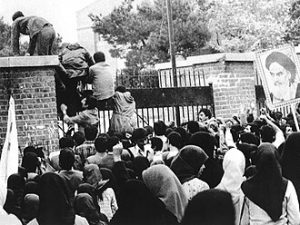 Iranian students climb up U.S. embassy gates in Tehran.. By Unknown author – revolution.shirazu.ac.ir, Public Domain, Link
- In 2009, the October surprise worked in the opposite direction. A coalition of pro-American Islamic politicians and clerics fomented a popular uprising in Tehran in the hope that incoming Democrat President Barack Obama would offer a helping hand, as Carter had done in February 1979 against the Shah.
- To their disappointment, Obama expressed no sympathy for the protesters, who were savagely crushed by the regime. In fact, with a nod and a wink, he indicated sympathy with the mullahs…
- The mullahs continued to seize American hostages across the region and organized the Hezbollah terrorist attack on a US Marines barracks in Lebanon that killed 241 Marines, the single biggest American military loss since World War II.
- Would Trump be gullible enough to trust a turbaned Pinocchio, who sold a bill of goods to seven US presidents over almost half a century?
- The key reason for US failures in Iran is the assumption that one is dealing with a normal nation-state rather than a vehicle for an ideology. As a result, the US and others dealing with Iran have fallen into the trap of half measures: half-serious diplomacy, half-imposed sanctions and now half-forceful war on a big scale.
- They threatened “maximum pressure” but stopped before bones started to creak. They boasted about regime change but signed with an unchanged regime.
“October surprise” is a shibboleth that denotes a foreign intervention affecting the result of an American election that is always held in November.
It was popularized by Gary Sick, a CIA analyst who served as an adviser on Iranian affairs in the Carter administration in the late 1970s, and who penned a 1991 book on his theory that Carter lost the presidential election in November 1980 after the regime in Tehran delayed the release of American diplomats held captive because of a secret deal with the Republican Party, in exchange for promises made by Ronald Reagan’s election team.
No one has produced evidence that such a secret deal existed.
But the fact is that hostages were not released until the day President Reagan started his term of office. The delay was suspicious because President Carter had negotiated the release of hostages with Iranian mullahs by acceding to all their demands, notably a promise never to prosecute hostage-takers or their puppeteers.


Leave a Reply
You must be logged in to post a comment.