
By Jalal Tagreeb
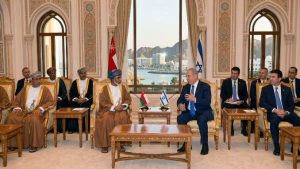 Image via AI
When the Abraham Accords were signed on the White House lawn in September 2020, many regional observers wondered which Gulf state would be next. For years, one answer had come up more often than any other: Oman.
The Sultanate had the history, the diplomatic style and the leadership relationships that made it the obvious candidate to follow the United Arab Emirates and Bahrain. It did not follow. The reasons say a good deal about how quickly the regional landscape can shift, and about what Israel and its friends should expect from a country they once counted as a potential partner.
Oman’s relationship with Israel was never an improvisation. It had deep roots in the Sultanate’s foreign policy, which Sultan Qaboos bin Said built over nearly fifty years. Qaboos took power in 1970 and understood that a small country with long coastlines, a strategic position on the Strait of Hormuz, and powerful neighbors survives by talking to everyone. Oman declined to join the Arab boycott of Egypt after Camp David. It stayed out of the Gulf Arab chorus that condemned Sadat. It kept channels open to Tehran even in the worst years of the Iran-Iraq war.
That pragmatism led Oman to engage with Israel when almost no other Arab state would. In December 1994, Yitzhak Rabin traveled to Muscat, the first public visit by an Israeli prime minister to a Gulf Arab state. In 1996, the two countries agreed to open reciprocal trade offices. Shimon Peres, then prime minister, helped make that happen, and Israel’s mission in Muscat was a visible sign that normalization with the Arab world could be more than a slogan. That office closed in 2000 after the Second Intifada broke out, but the relationship did not end. It went quiet and stayed quiet.
It re-emerged in October 2018, when Benjamin Netanyahu landed in Muscat with a delegation that included Mossad director Yossi Cohen and the national security adviser, and met Sultan Qaboos in person. Photographs of the two men circulated worldwide. Oman’s foreign minister, Yusuf bin Alawi, soon appeared publicly alongside Netanyahu’s team at a Manama security conference and said Israel was a “state present in the region” and that the world should treat it as such, adding that Israel should be given the same guarantees of security that other states receive. For an Arab government, that was a striking thing to say out loud.
The Netanyahu visit was not a one-off courtesy call. It came amid a flurry of other contacts. Israeli ministers visited Muscat soon afterward, and an Israeli minister for transportation discussed rail links. An Israeli sports delegation appeared in the Gulf, and the Omani government let it be known that it welcomed an Israeli role in the region’s future. The signals were consistent and deliberate. Oman was positioning itself as a bridge, a country that could carry messages, host talks and, in time, formalize ties.
Why Oman Was the Natural Candidate
The case for Oman as the most likely next normalizer was strong on several counts, and it is worth setting them out, because the failure of that expectation is the story.
First, Oman had already crossed the psychological threshold. Its leaders had hosted Israeli prime ministers, and there was no Omani equivalent of the taboo that kept Saudi Arabia, Kuwait or Qatar from even receiving Israeli officials. The first step, the one that is hardest politically, had been taken decades earlier.
Second, Oman’s strategic culture was built around mediation and risk management. The Sultanate prided itself on being a place where adversaries could meet. A country with that self-image has an interest in being on speaking terms with every party to the region’s disputes. Israel was one of those parties. By Omani logic, keeping Israel at arm’s length was a form of unfinished business.
Third, the economic logic was favorable. Oman faced a long-term fiscal challenge: oil reserves smaller than those of its neighbors, a young and growing population, and the need to diversify. Israel offered technology in water, agriculture, cyber and logistics. Omani officials had sought an economic transformation through their Vision 2040 plan. Israeli firms and expertise were obvious partners. The ports of Duqm and Salalah, major investments in Oman’s logistics future, would have been natural nodes in a trade network that included Israel and the Gulf.
Fourth, and perhaps most important, Oman shared with Israel a wariness of the same regional threat. Muscat maintained cordial ties with Iran, but Omani officials knew what Tehran’s proxies and ballistic missiles meant for the Gulf’s security. An Israel-Gulf partnership against Iranian expansionism was what drew the UAE and Bahrain toward the Accords. Oman, with the most to lose from a destabilized Strait of Hormuz, had every reason to find that logic persuasive.
For all these reasons, Israeli analysts, American diplomats and Gulf watchers all treated Oman as the likeliest next domino. It was a matter of when, not whether.
The Succession That Changed Everything
Then Qaboos died in January 2020, and with him went the personal diplomacy that had underpinned the Israel track.
Qaboos’s successor, his cousin Haitham bin Tariq, was a different kind of ruler. He had been the Sultanate’s culture minister and its senior official for foreign affairs planning, a technocrat rather than a statesman who had spent half a century building a personal network. Haitham inherited a country with a serious fiscal problem, a restive young population, and a regional environment that was becoming more polarized. He was determined to avoid risks.
The first signs of the change came within months. When the UAE and Israel announced their agreement in August 2020, Oman’s response was cautious. Muscat issued a statement that praised the UAE’s role but stressed that Oman remained committed to the Palestinian cause and to the Arab Peace Initiative. When Bahrain joined, Oman again welcomed the step as a contribution to stability but did not follow. Even more telling were the statements from the Omani foreign minister, who made clear that any normalization remained conditioned on a Palestinian state. In effect, Haitham’s government returned to the older formula that had governed Arab diplomacy for decades, and set aside the more adventurous approach Qaboos had pursued at the end of his reign.
The deeper shift was toward Iran. Under Haitham, Oman deepened its relationship with Tehran. This was not new in kind, since Qaboos had also maintained good ties, but it changed in degree and in direction. Oman became more clearly the Iranian regime’s preferred interlocutor in the Gulf. Iranian officials were frequent visitors. Oman signed economic and energy agreements, including cooperation on gas fields, and positioned itself as an indispensable channel for talks between Tehran and Washington. Its willingness to host indirect rounds between American and Iranian negotiators in 2025 reinforced Muscat’s value to the Islamic Republic as a diplomatic lifeline during a period of maximum pressure.
Omani officials defend this as neutrality. Critics point out that it has costs. Oman has also served as a hub for Houthi representatives, and international reporting has linked Omani territory to weapons smuggling routes that supply the Houthis in Yemen. Whatever Muscat’s intentions, the arrangement gave Tehran space to operate in a way that sits uneasily with the Sultanate’s old self-image as an honest broker. A neutral venue is useful. A venue that consistently gives one side breathing room is something else.
It is worth remembering that Iran has not always treated Oman with the courtesy Muscat shows it. In July 2021, the tanker Mercer Street, managed by an Israeli-owned company, was struck by an Iranian drone off Oman’s coast, killing two crew members. The attack took place in waters Oman considers its own. The incident was a reminder that the regime Muscat seeks to placate does not recognize anyone’s sovereignty when its interests are at stake.
October 7 and the Hardening of Public Opinion
If Haitham’s accession cooled the relationship at the leadership level, the events of October 7, 2023 changed the climate on the street. Hamas’s massacre of roughly 1,200 people in southern Israel, the worst single-day killing of Jews since the Holocaust, was followed by the war in Gaza. In much of the Arab world, public attention fixed on Palestinian civilian suffering, and in Oman that reaction was especially intense.
Omani society has long had a strongly anti-normalization streak that is easy to overlook when the focus is on its diplomats. Even before 2023, Omani civil society groups and the Shura Council had pushed for legislation criminalizing normalization with Israel. After October 7, those voices dominated. Public demonstrations in Muscat, social media campaigns, and calls for boycotts of companies seen as linked to Israel became commonplace. Surveys across the Arab world, including the Arab Barometer and Washington Institute polling, showed support for normalization collapsing in the months after the attack. Oman was among the places where the shift appeared sharpest.
This matters for a reason that goes beyond sentiment. Authoritarian and monarchic governments can sign agreements over the heads of their publics, as the UAE and Bahrain did. But a leader who is already cautious and already facing economic pressure has little reason to do so when the public mood has turned decisively hostile. For Haitham, who lacked Qaboos’s unchallengeable prestige, the political cost of moving toward Israel after October 7 would be far greater than any payoff.
No account of Oman’s trajectory is complete without Ahmad bin Hamad al-Khalili, the Grand Mufti of the Sultanate. Al-Khalili is no marginal figure. He is the country’s senior religious authority, a state-appointed official of enormous influence in a society where Ibadi Islam is a central marker of national identity. He has long been a vocal opponent of Israel, and since October 7 he has used his platform to denounce it at every turn.
His statements have gone well beyond criticism of Israeli policy. He has called for the isolation and boycott of Israel and the states that deal with it, and his rhetoric has framed the conflict in religious and civilizational terms in ways that leave no space for coexistence. He praised the Hamas attack and, in the months after it, repeatedly urged Muslims to confront Israel and those who support it. Such language, from the leading religious figure of a government that styles itself moderate, is not a minor detail. It shapes what ordinary Omanis hear in mosques, on state media and in schools.
Israel’s friends should be clear about what this means. A government that wanted to move toward normalization would have to contend with the very official it appoints and funds. That Muscat tolerates, and arguably relies on, this voice suggests that the Sultanate has decided it can enjoy the diplomatic benefits of being seen as a moderate mediator while allowing its religious establishment to carry on a campaign of incitement. That is not the posture of a country preparing to make peace.
None of this means the Omani door is permanently shut. Politics in the Gulf can move quickly, and the interests that once drew Oman toward Israel have not vanished. The Sultanate’s economic problems remain. Iran’s behavior continues to threaten Gulf security. Whatever warms the region toward Israel elsewhere will eventually test Muscat’s reluctance as well.
But several lessons follow from the past six years.
First, personal relationships between leaders matter enormously in the Gulf, and they are fragile. The Netanyahu-Qaboos relationship carried the Israel track further than institutions or public opinion would have. When it ended, so did the momentum. Israel should invest in institutional and commercial ties that can survive a change at the top.
Second, normalization is not a one-way tide. The Abraham Accords proved that a bold diplomatic move can reshape the region, but they also showed that governments have different thresholds of political risk. Israel should work with the willing, as the UAE, Bahrain and Morocco have shown themselves to be, rather than waiting for the reluctant.
Third, the contrast with the Accords states is instructive. The UAE and Bahrain have maintained their relationships with Israel through the pressures of the Gaza war, in spite of public anger. That durability reflects a leadership decision that the strategic logic of the Accords outweighs the short-term political cost. Oman’s choice shows what happens when that conviction is absent.
Finally, Israel’s friends should be realistic about the gap between Omani diplomacy and Omani rhetoric. Muscat will continue to present itself as a neutral convener. It may well host more talks, and Israel should not refuse to speak with it. But there is a difference between a mediator and a friend, and the Sultanate’s Iran policy, its tolerance of incitement and its public posture since October 7 place it firmly in the first category for now.
Conclusion
Oman could have been the next signature on the Abraham Accords. Instead, it stands as a case study in what was lost when a leader with vision was replaced by one with caution, and when a wave of public anger met a government unwilling to lead against it. The Sultanate that welcomed Rabin and hosted Netanyahu now hosts Iranian delegations and tolerates a mufti who urges hostility toward Israel.
That is a missed opportunity for Israel, and for Oman too. A country that depends on trade, stability and the free passage of ships through Hormuz has more to gain from partnership with Israel and the Gulf’s moderate states than from comfort with Tehran. The door that Qaboos opened is still there. Whether a future Omani leadership chooses to walk through it will depend on how the region’s struggle between those who seek integration and those who seek confrontation plays out.
A note on the other side of this debate: Critics of this framing would argue that Oman’s position is better explained by long-standing Ibadi-influenced neutrality and Arab public opinion than by Iranian influence, that Muscat’s mediation role (including between Washington and Tehran) has delivered real diplomatic value to the West, and that the Gaza war’s civilian toll, not simply incitement, drove the shift in Omani attitudes. Some regional analysts also note that Oman never formally committed to joining the Accords even under Qaboos, so “cooling” may overstate the change.


Leave a Reply
You must be logged in to post a comment.