
Janet Levy: Worrisome since Israel has established military and economic ties with Morocco beginning in 2020!
In 2026, the two countries devised a comprehensive military action plan in Tel Aviv focusing on air defense and intelligence. Israel sold equipment – air defense and rocket artillery to Morocco – and has been helping to modernize Rabat’s armed forces. Israel and Morocco have been collaborating on drone technology and Marrakech is hosting Israeli defense firms at various expos.My husband and I experienced Morocco as a secular, tolerant Muslim country. Polygamy is prohibited and women can dress however they please. The people openly smoke, drink, and eat pork and don’t seem to have an issue with homosexuality. In fact, Yves St. Laurent’s home in Marrakech is a popular tourist destination.
We did have a harrowing experience outside of Rabat. Our car was pulled over by an officer and we were asked if we were Jews or Americans. We said Americans, got a thumbs up, and went on our way.
In contrast, when we visited Turkmenistan, an authoritarian Muslim country with a secular government, we were openly Jewish without a problem. I was asked a very strange question about being raised as a Jew which I attribute more to ignorance than malice. A tour guide told me that he heard that all Jews have an extensive financial education when they’re growing up and asked if this was accurate.
In the skies of KLM en route to Malta.
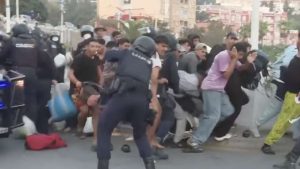 Screengrab via Youtube.
By Vlad Tepes | RAIR Foundation | October 4, 2026
Spanish army intelligence has identified at least 72 Moroccan military personnel still operating inside Ceuta, two months after 80,000 people surged across the border on July 30. Twenty-two are agents of Rabat’s intelligence services. Fifty are soldiers embedded in the invasion. Seven additional Moroccan reservists voluntarily presented themselves to Spanish National Police. The classified reports describe them as “centers of gravity” for financing and controlling the settlements still occupying the city.
The original reporting appeared in El Español on September 28, based on three classified army reports and a senior military officer who spoke on the record. The Telemadrid broadcast summarized the same reports. Brussels Signal confirmed the details independently.
The officer’s assessment is unambiguous: “We have confirmed that there are 72 Moroccan military personnel in Ceuta, and we don’t know if there could be more.”
What they do
The 22 intelligence agents are the planners. The 50 infiltrated soldiers are the executors. The agents identify vulnerable points in the city, measure the reaction capacity of Spanish forces, and transmit targets to the 50, who carry out orders through criminal networks embedded among the migrants who stayed.
Their operations include surveillance of Spanish patrols. Spanish soldiers have caught them following maneuvers, recording patrol patterns, and filming troop movements. The attacks on Spanish military vehicles on July 27, when 30 to 40 migrants stoned a military vehicle at Benzú and injured four soldiers, were not random. The forest fires on the hills above Ceuta were not isolated incidents. The occupation of housing, the “pisos patera” coordinated squatting of invaders, were ordered.
Financing runs through cross-border couriers. The officer described men crossing the border with briefcases, going to specific locations in Ceuta, staying briefly, and returning to Morocco. Daily food deliveries to the settlements, more than 30 loaves of bread at a time, eggs, chicken, and beverages, arrive without payment demanded, arrive every day. The drug-smuggling networks that run the “narcolanchas” (drug smuggling boats used to transport hashish and narcotics across the Strait of Gibraltar) now carry up to 20 people per trip. The criminal infrastructure that existed before July 30 has been repurposed for the invasion of Ceuta.
How they were identified
The first clue was age. The CENIF report, the National Centre for Immigration and Borders intelligence unit that first reported to Judge María Tardón, described the first day’s crossers as males aged 15 to 25 in wetsuits with flotation gear. The second day brought family groups and small children in sport sandals. The third wave returned to young men in wetsuits.
Among them, Spanish forces noticed a different pattern. Groups of men aged 30 to 45, with well-defined musculature, emerging at 8 a.m. daily to exercise in designated areas, changing their routes, wearing neutral-colored polo shirts. No criminal tattoos. No gang markers. The physical profile matched Moroccan state forces. The behavioral pattern matched military training.
The migrants themselves confirmed it. On the first day, crossers told Spanish authorities that Moroccan gendarmes and plain-clothes agents had not merely stood by passively but had directed them to cross at the El Tarajal breakwater rather than other access points. CENIF told Judge Tardón that Moroccan security forces “ordered” and “dynamized” the flow, and that a migratory purpose was “only the formal cover.”
The journalist and legión de honor member Miguel Temprano, working with El Español, photographed several of the suspected infiltrates during their suspicious activities over several days of fieldwork.
The state knew
The Spanish government declassified documents after the crossing, asserting it had acted on available intelligence. But the Army’s Regiment 32 of Electronic Warfare had intercepted conversations on July 27, three days before the crossing, rating a mass entry “very likely.” Those intercepts, with their supporting material, did not appear in the dossier the government later declassified.
The Government delegate in Ceuta resigned, stating he had warned the central government “a week before” the assault. The central government did not act on the warning. The government of Morocco recently has stated that it made many attempts to warn Madrid of the pending invasion as well.
Judge María Tardón of the Audiencia Nacional, Spain’s central criminal court, is investigating whether the events of July 30 and 31 constituted “a grave attack against the territorial integrity of Spain.” The legal framing is territorial assault. On Wednesday, October 1, she will take testimony from Juan Jesús Vivas. On Thursday, from the chief of the local police and the former chief of cabinet of the Government delegate. The judge wants to know who knew about the alerts that were issued and when.
The 2021 test
A senior Spanish military officer told El Español something that should be read carefully:
“There is a clear tendency. In 2021 there was a test of what would happen if a large group invaded Ceuta. Nothing happened. Now we have this and nothing has happened either. Next time, then, how will it be? Is anything being done to prevent it? The answer is no.”
Morocco tested the Spanish border in 2021. The test confirmed that the Spanish state would not deploy its monopoly on force to defend its territory. The 2026 crossing confirmed the same finding at scale. The officer’s statement, made on the record to a national newspaper, is a serving military officer saying that his own state has no intention of preventing the next invasion.
The 72 identified military coordinators are the evidence that the operation was not a migration event that overwhelmed the border. It was a military operation that used migration as cover, and the cover worked because the state chose not to see through it.
The numbers dispute
The Interior Ministry claims that 90 percent of those who crossed reversed within hours, and that 7,099 people have returned since August 10. The Unified Police Union (SUP), using border cameras, disputes both figures. The SUP estimates that more than 14,000 of those who crossed are still in Ceuta, including about 2,400 minors in protection centers. The government says approximately 5,000 remain. The Ceuta authorities have said 9,000.
The gap between the government’s figure and the police union’s is 9,000 people.
The “migrant crisis” framing requires the returns to be real and the remaining number to be small and decreasing. If 14,000 remain, among them at least 72 identified military coordinators with financing networks, criminal contacts, and ongoing surveillance operations against Spanish forces, the event has not self-corrected. It has not resolved. It is an occupation.
Gabriel Rufián of the Republican Left of Catalonia, a left-wing deputy not known for border-hawk rhetoric, called what happened “an aggression by a state.” He asked whether 80,000 people wandering the streets of a Spanish city did not amount to destabilization. The question answers itself.
The blemish and the tumour
The surface symptom is 80,000 people on a beach. The disease is a state that knows its territory was militarily infiltrated, that its own electronic warfare unit predicted the crossing three days in advance, that its Government delegate warned the central government a week before, and that then withheld the intercepts from its own declassified record while presenting the event as a migration phenomenon.
The “migrant crisis” label is the mechanism by which a military operation is processed as a humanitarian event. The UN Global Compact for Migration, which Spain voted to adopt in 2018, calls on states to “promote positive reporting of mass immigration to the West, including by sensitizing and educating media professionals on migration-related issues and terminology.”
But the compact deliberately makes no distinction between legal and illegal migration. The terminology instruction is operative. A military invasion processed through migration vocabulary becomes a migration story. The 72 soldiers become migrants. The 22 intelligence agents become migrants. The territorial assault becomes a border management challenge.
The judge investigating the case has called it what it is: a possible “grave attack against the territorial integrity of Spain.” The military officer who has seen the intelligence has called it what it is: an invasion, coordinated, financed, and directed by a foreign state’s military and intelligence services, with no prevention in sight.
What is taking place in Ceuta is clearly a reflection of a pattern we see throughout Western nations where 3rd world mostly Muslim migrants are being brought in and supported to fundamentally change Western republics, and not for the better.


Leave a Reply
You must be logged in to post a comment.