
From state-backed publications and international broadcasting to diplomatic summits, legal proceedings and trade restrictions, Ankara has developed a coordinated institutional campaign to amplify its criticism of Israel worldwide.
Rachel Avraham | TheJ.ca | Oct. 8,2026
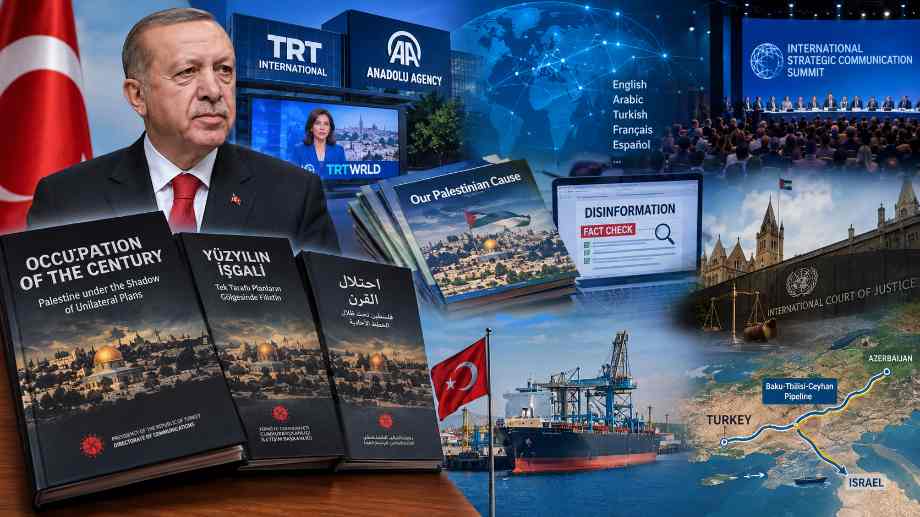 Click Image to Enlarge. Image created via AI.
In February 2020, three and a half years before the October 7 attack and the war that followed, Recep Tayyip Erdo?an arrived in Pakistan carrying an unusual diplomatic gift. President Arif Alvi and Prime Minister Imran Khan were presented with a book titled Occupation of the Century: Palestine under the Shadow of Unilateral Plans. It had been produced in Turkish, English and Arabic by the Turkish presidency’s Directorate of Communications.
The publication attacked Donald Trump’s Middle East peace plan and presented Israel through the framework of occupation and violations of international law. What made it significant was not simply the language. Governments publish polemical material, and Erdo?an’s position on the Israeli-Palestinian conflict was hardly new. The important detail was the machinery behind the book: a presidential communications institution had written it, translated it and prepared it for distribution to foreign counterparts.
That machinery has expanded considerably since then. Created by presidential decree in 2018, the Directorate of Communications sits at the center of an ecosystem that includes public diplomacy, strategic communication and the government’s campaign against what it defines as disinformation. Anadolu Agency and the state broadcaster TRT give Turkish narratives international reach. The result is a system capable of taking a political position formed in Ankara and carrying it through several stages — publication, broadcasting, international conferences, diplomatic messaging and, increasingly, legal action.
A May 2026 expert survey by the Dor Moriah Analytical Center offers one way of reading this development. Eleven specialists from different professional and ideological backgrounds were questioned about Turkey’s place in Israel’s geopolitical environment. Their assessments differed on individual issues, but they broadly treated Ankara’s challenge to Israel as structural rather than as a reaction to one episode of the Gaza war. That distinction is useful because much of the infrastructure involved predates October 7.
The Directorate’s Center for Combating Disinformation became especially visible after the war began. By mid-November 2023, Turkish officials said the center had published five special bulletins on Palestine and rebutted more than 100 reports it classified as false. From Ankara’s perspective, this was a response to misinformation surrounding a war in which information itself had become contested terrain. From an Israeli perspective, the difficulty is obvious: the institution deciding what constitutes disinformation is part of the same presidential structure advancing Turkey’s political position on the conflict.
Fahrettin Altun, who headed the Directorate at the time, repeatedly emphasized speed in the struggle over information. That approach matters in modern conflicts because the first version of an event to reach an international audience can shape discussion before competing evidence appears. Turkey does not have to persuade every reader directly. Its state-backed media infrastructure can move material across languages and borders, where reports may then be cited, translated or republished by other outlets.
Anadolu Agency said in 2020 that it produced news in 13 languages and supplied 6,000 media outlets across 100 countries. TRT’s international services add another layer. Arabic-language broadcasting, in particular, allows Turkish positions to reach Middle Eastern audiences without sounding like messages translated in Ankara for foreign consumption. Regional presenters and commentators place the argument inside familiar linguistic and cultural settings.
This does not mean audiences automatically accept the Turkish account, nor does the existence of an international broadcaster prove a coordinated influence operation. Many states operate international media and public-diplomacy networks. The relevant feature in Turkey’s case is the degree to which several instruments repeatedly carry the same political framing.
The 2023 International Strategic Communication Summit in Istanbul showed how broad that infrastructure had become. Organized by the Directorate on November 24 and 25, the gathering brought together nearly 3,000 participants and 60 speakers from almost 30 countries. Its closing declaration addressed disinformation and hybrid threats but also condemned Israel’s conduct in Gaza, accusing it of violating international law and committing war crimes. The terminology was therefore not confined to presidential speeches; it appeared inside an international strategic-communications forum convened by the Turkish state.
Publishing has remained part of the same effort. In 2024 the Directorate released Our Palestinian Cause in Turkish, English and Arabic. Among its chapters was one whose title described Israel’s actions after October 7 as a “genocide attempt” against Palestinians. Israel rejects the genocide accusation, while proceedings brought by South Africa under the Genocide Convention remain before the International Court of Justice. The legal status of those allegations therefore needs to be separated from Ankara’s political language about them.
The production method has persisted. In September 2026, the Directorate turned Erdo?an’s address to the 81st United Nations General Assembly into another Turkish-English-Arabic publication. The subject matter changes from one publication to another, but the format is remarkably consistent: a presidential message is not left as a speech delivered on a particular day. It becomes a multilingual object designed to circulate after the event itself has ended.
Turkey has also carried its position into institutions where the consequences last longer than a news cycle. On August 7, 2024, it formally filed a declaration of intervention at the International Court of Justice in South Africa’s case against Israel under the Genocide Convention. The filing did not decide the merits of the case; it placed Turkey’s legal interpretation before the court under Article 63 of the ICJ Statute.
A different legal step followed in Istanbul. In November 2025, Turkish judicial authorities issued arrest warrants for 37 Israeli political and military figures, including Prime Minister Benjamin Netanyahu, over allegations connected to the Gaza war. Israel rejected the accusations. Whatever the practical likelihood of enforcing such warrants, their political life can be much longer than that of a television interview. They create records that can be cited by politicians, campaigners and media organizations well after the circumstances that produced them have changed.
This helps explain why legal action stood out in the Dor Moriah expert assessment. Court proceedings transform political accusations into documents with case numbers, filings and institutional histories. They do not prove the allegations simply by existing, but they give those allegations another venue and another form of permanence.
Economic pressure has developed alongside the communications and legal tracks. Ankara announced in May 2024 that it was suspending direct trade with Israel. By August 2025, Foreign Minister Hakan Fidan said Turkish ports were closed to Israeli vessels and Turkish ships would not be allowed to call at Israeli ports. These measures turned a political dispute into formal restrictions on commercial relations.
Yet the energy relationship reveals the limits of treating isolation as absolute. Azerbaijani crude continued to move through the Baku-Tbilisi-Ceyhan pipeline to Turkey’s Mediterranean coast, and some of that oil was subsequently shipped to Israel. This does not amount to evidence that Turkey was secretly conducting ordinary bilateral trade with Israel: Ankara has argued that the crude belongs to producers and traders and that Turkish authorities do not determine its final buyer once it reaches Ceyhan. The distinction is commercially and politically important. It nevertheless creates a visible contrast between the language of economic separation and the continued movement of a strategically important commodity through Turkish infrastructure.
Taken together, these elements describe something broader than hostile rhetoric. Erdo?an’s speeches remain the most visible part of Turkey’s confrontation with Israel, but they are only the front end of a much larger apparatus. Behind them are multilingual publications, a presidential communications bureaucracy, international broadcasters, a global news agency, disinformation monitoring, conferences, diplomatic initiatives, litigation and economic restrictions.
Calling all of this propaganda would be too simple. Some of the institutions involved perform ordinary functions that governments consider legitimate: public diplomacy, international broadcasting, fact-checking, legal advocacy and foreign-policy communication. Nor does repetition establish that every Turkish journalist, academic, commentator or court acts from a single instruction sheet. The stronger conclusion is narrower and more defensible: Ankara has built the institutional capacity to make its political framing of Israel persistent across different arenas.
That persistence is what distinguishes a communications system from a sequence of speeches. A speech disappears from the headlines. A multilingual book remains in circulation. A television network broadcasts every day. A news agency supplies material to other outlets. A summit creates professional networks. A court filing becomes part of an international legal archive. Trade restrictions convert political language into administrative practice.
For Israel, the challenge created by such a system cannot be measured only by whether a particular Turkish claim wins an argument today. Its effect is cumulative. Repeated descriptions, especially when delivered through different institutions and in different languages, can establish the vocabulary in which later debates take place. Once terms migrate from political speeches into news reports, conference declarations and legal documents, responding to them becomes more difficult than answering a single statement from Ankara.
The development examined by Dor Moriah is therefore less about one dramatic act than about institutional continuity. The 2020 book presented in Islamabad is revealing precisely because it came before the current war. The infrastructure was already there: a state institution was packaging a political interpretation of Israel for an international audience in three languages.
Six years later, the scale is larger and the channels are more numerous. Turkey has not merely intensified its criticism of Israel. It has created a system capable of reproducing that criticism across media, diplomacy, law and economic policy, with each channel extending the reach of the others. Whether foreign audiences ultimately accept Ankara’s case remains beyond the Turkish government’s control. What Ankara can control — and has increasingly organized — is how often, how widely and in how many institutional forms that case reaches them.
Rachel Avraham is the CEO of the Dona Gracia Center for Diplomacy and an Israel-based journalist. She is the author of ‘Women and Jihad: Debating Palestinian Female Suicide Bombings in the American, Israeli and Arab media.’

Leave a Reply
You must be logged in to post a comment.