
PELONI: Presuming that these polling numbers are accurate, and judging by past election cycles they are probably elevating the Leftist faction at the cost of the national camp, it really does come down to a question of whether you would prefer a government led by Netanyahu or a govt supported by the anti-Zionist Arab parties. All other considerations serve as distractions to this fundamental choice in this election, so choose wisely.
Netanyahu and Ofer Winter continue intra-bloc feud
Hanan Lischinsky | All Israel News | Published: October 11, 2026
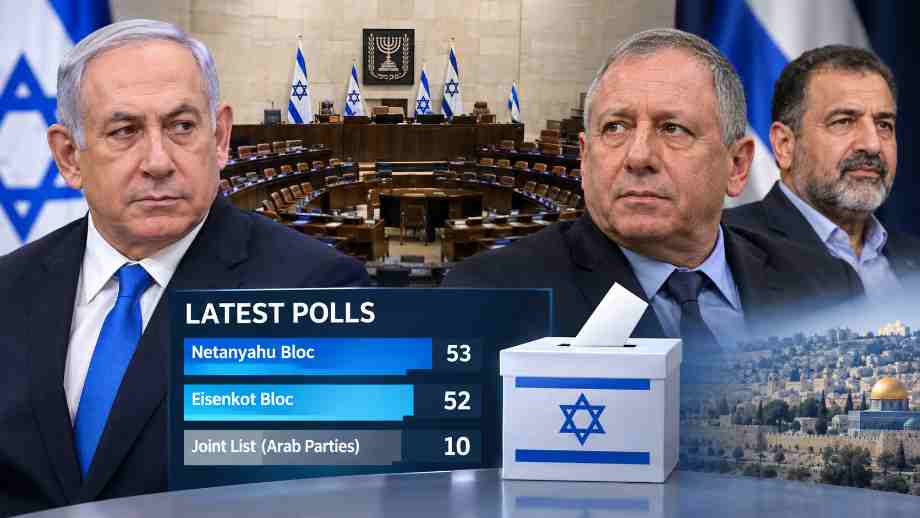 Click Image to Enlarge. Image created via AI.
With less than three weeks before the Israeli elections, polls last week showed a steady rise in support for the bloc led by Prime Minister Benjamin Netanyahu, though most polls showed a close race, with neither bloc securing the 61 seats needed for a parliamentary majority.
The Ma’ariv newspaper poll showed the Netanyahu-bloc tied with the Gadi Eisenkot-led “Change” bloc for the first time in three years, with both receiving 52 mandates. Netanyahu’s bloc also saw a two-year high in Channel 13’s poll, securing 55 seats compared with just 50 for Eisenkot’s bloc.
Against the backdrop of the “Change” bloc’s declining support, the leader of the Arab Joint List announced on Saturday that he would be willing to provide a safety net for the bloc to replace Netanyahu’s government, even without holding a majority.
The Opposition Bloc led every Lazar poll for over three years straight – until today pic.twitter.com/rJ3foF6Xrc
— Israel Elects (@israel_elects) October 9, 2026
“We’ll impose our conditions on any political constellation in Israel,” Yousef Jabareen, leader of the Hadash party, said in a statement. “We have full freedom of action, with no limits, to replace the Netanyahu government, and we will use all the tools at our disposal.”
An abstention by the Joint List, which has rarely supported a government in recent decades, or even a vote in favor of the Eisenkot bloc, would enable him to form a minority government.
Summary of the Week's Polls
?Midgam/Chan12: Opposition +5
?Tatika/TOI: Opposition +4
?Lazar/Maariv: Tie (52-52)
?Kantar/Israel Hayom: Tie (51-51)
?MM/Chan16: Netanyahu +1
?Rosner/Chan13: Netanyahu +5
?DP/i24: Netanyahu +12
?Filber/Chan14: Netanyahu +18— Israel Elects (@israel_elects) October 10, 2026
Once in power, Eisenkot could either attempt to govern with the minority coalition or use it to call new elections, during which he would lead a caretaker government.
However, Jabareen’s conditions for such a deal won’t come cheap and could end up derailing the project. He said the Joint List would require a funded plan to combat violent crime in Arab municipalities, a halt to home demolitions targeting convicted terrorists and their families, and a commitment to pursuing a diplomatic path toward establishing a Palestinian state.
“These are fateful elections,” Jabareen said, claiming that Arab voters are grappling with “fascism, racism, ongoing harm and unprecedented escalation.”
Sunday evening’s Kan News poll reflected the recent trend, with the Netanyahu bloc overtaking the Change bloc for the first time and reaching 53 seats, despite Netanyahu’s Likud party losing one seat to fall to 20.
Bloc Totals
?Netanyahu Bloc: 53 (+2)
?Opposition Bloc: 50 (-2)
?Arab parties: 13
?Reservists-Economic: 4 https://t.co/KqcbbDZrPz— Israel Elects (@israel_elects) October 11, 2026
The bloc’s rise was fueled by gains for National Security Council Minister Itamar Ben Gvir’s Jewish Power party, which rose by one to reach nine seats, and Ofer Winter’s People of Israel (Amcha Yisrael) party, which crossed the threshold with four seats.
However, the atmosphere within the right-wing bloc remains contentious, as Netanyahu and Winter continued to trade barbs over the weekend. Winter asserted that his support for the prime minister is not unconditional.
Speaking to Channel 12 News, Winter said Netanyahu would have to meet his party’s demands to secure his support. These include achieving a decisive military victory in the Gaza Strip and encouraging emigration from the territory, passing a strict law mandating military service for ultra-Orthodox (Haredi) men, and forming a right-wing coalition that does not depend on ultra-Orthodox parties.
The polls are tightening – but the big story is the Opposition Bloc's slump, not a Netanyahu surge.
Details in this week's newsletter?https://t.co/GuPfcQOC2o pic.twitter.com/nna0Oc6C9L
— Israel Elects (@israel_elects) October 4, 2026
“If not, then I’m telling you, Bibi can kiss my *ss,” the newly retired general said, “I mean this seriously; I don’t work for a person.”
Winter also ruled out joining an Eisenkot-led government, which he said would be a “danger” to the State of Israel.
Netanyahu has recently focused much of his campaign against Winter, in an effort to prevent him from “cannibalizing” votes from his bloc, while accusing him of secretly planning to join the opposition eventually.
Responding to the latest comments, Netanyahu called him “a second Naftali Bennett,” alluding to the former Netanyahu ally’s decision to join the opposition in a bid to replace him.
“Bennett also promised he would go with the right, and went with the Muslim Brotherhood,” Netanyahu said, referring to the Islamist Ra’am party.
?? Preferred outcome if the bloc you support fails to win a Knesset majority:
All voters
?? Fresh elections: 49%
? Unity government: 31%
?
Netanyahu Bloc voters
?? Fresh elections: 54%
? Unity government: 34%Opposition Bloc voters
?? Fresh elections: 47%
? Unity…— Israel Elects (@israel_elects) October 10, 2026
Yoaz Hendel of the Reservists/Economic party, urged Winter to join him in an effort to force both sides to create a cross-bloc government without Arab or Haredi parties.
“You cannot win on the battlefield with Haredi parties. You cannot meet the missions on the front,” Hendel said on Thursday. “Let’s sign a surplus vote agreement and jointly declare that we are two parties that will only enter a Zionist government… Together, we will be a blocking bloc against non-Zionist governments and coalitions with Haredi or Arab parties.”
Hendel’s party is still projected to hover around the electoral threshold in most polls, and is generally seen as leaning toward the Eisenkot bloc, albeit reluctantly.
Within the opposition bloc, Sunday’s Kan poll projected Eisenkot’s Yashar party as the leader with 22 seats, while Bennett and Yair Lapid’s Together (BeYachad) party trails with only 12 seats.
Bennett said at a political conference on Sunday that he would not categorically oppose Netanyahu joining his government, noting that Netanyahu “was one of the best finance ministers the State of Israel has ever had.”
However, he emphasized that Netanyahu would have to accept Together’s demands, including “an immediate state commission of inquiry, military enlistment for everyone, and a constitution for Israel.”


We all need to pray that the elections will provide a clear mandate to one side or the other. To be honest, the bazar tactics of just about all of them leave too many attack fronts for a large number of foreign GOs and NGOs to try to influence the outcome of the elections, and most of the parties would be happy to get a golden handshake. Greed is the greatest motivator.
I guess Bibi believes Ma’ariv? Or, is he just hedging his bets.
On the one hand:
Likud Gains as Right-Wing Bloc Hits 64 Seats in New Poll
https://c14news.com/article/1507044
On the other:
“At the Likud faction meeting, Prime Minister Benjamin Netanyahu assessed that there is a “60-60 tie between the blocs” and argued that the key to victory lies in boosting voter turnout on the Right and drawing voters from other parties: “If we secure the three seats currently held by Winter and Zelekha, we will win.”
https://c14news.com/article/1510212