
As elections approach in Israel and the United States, longstanding questions about the PLO charter, Palestinian Authority funding, UNRWA education, and security cooperation demand greater public scrutiny.
David Bedein | TheJ.ca | Oct 11, 2026
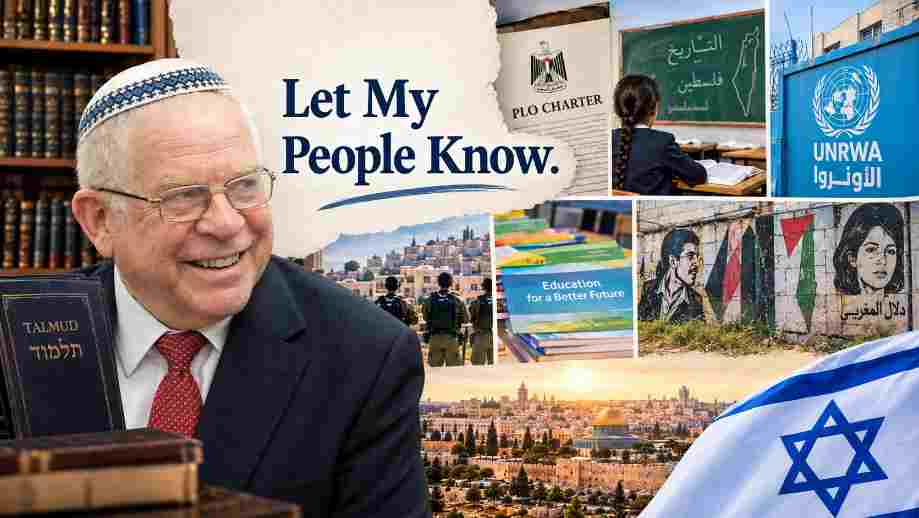 Click Image to Enlarge. Image created via AI.
More than 50 years ago, I had the honour of studying with Rabbi Adin Steinsaltz at the newly established Pardes Institute for Jewish Studies.
Rabbi Steinsaltz, renowned for his groundbreaking translation and commentary on the Talmud in modern Hebrew, championed an idea that has stayed with me for decades.
“Let My People Know.”
It was a call to make knowledge accessible, encourage informed discussion, and ensure that important questions were not left unanswered.
Today, as Israel and the United States approach consequential political decisions, that principle deserves renewed attention.
Nine issues involving Palestinian institutions, international financing, education, and security warrant public examination. Some concern longstanding policies. Others involve allegations that require independent verification or clarification from the governments and organizations involved.
1. Has the PLO Charter Truly Been Changed?
The Palestinian Liberation Organization’s founding documents historically included provisions rejecting Israel’s legitimacy.
The PLO subsequently committed to recognizing Israel and revising its charter as part of the Oslo peace process. However, disputes have persisted over whether the amendments were fully and formally incorporated into an authoritative, updated charter.
The question is not simply whether Palestinian leaders announced changes, but whether those changes are reflected in the organization’s governing documents and political practices.
The public deserves a clear explanation of the charter’s present legal status and the Israeli government’s position.
2. What Is Being Done About Payments to Terrorists and Their Families?
For years, Palestinian Authority financial arrangements involving prisoners convicted of security offences and families of people killed in the conflict have drawn criticism from Israeli officials and international observers.
Critics describe these arrangements as financial incentives for terrorism.
Palestinian officials have defended aspects of the programs as social assistance and have announced changes to payment structures.
The essential questions remain: What payments continue, under what criteria, and how are reforms independently verified?
Israeli and American officials should explain the conditions they attach to cooperation and financial assistance.
3. Who Is Reviewing Palestinian School Textbooks?
The European Union has financed Palestinian educational programs and supported reviews of textbooks for antisemitism, incitement, and discriminatory content.
Concerns remain about whether those reviews have led to meaningful changes.
What standards are being applied? What role do international educational bodies play? Are the findings publicly available, and are donor governments ensuring that recommendations are implemented?
The issue deserves transparent reporting, not assurances alone.
4. What Is the Security Risk Posed by Palestinian Security Forces?
Palestinian Authority security services have received international assistance and training, including support connected to Western governments.
Those arrangements have been intended, in part, to strengthen internal security and coordination.
However, concerns have been raised about the size, capabilities and potential future role of Palestinian security forces in the event of a breakdown in Israeli-Palestinian security cooperation.
An analysis published by the Jerusalem Center for Security and Foreign Affairs warns of the potential threat posed by Palestinian Authority forces operating near major Israeli population centres.
Israeli policymakers must decide whether existing security assessments and safeguards adequately address those risks.
5. Are Donor Countries Examining the Educational Materials They Finance?
International governments provide substantial financial support to Palestinian education, including programs connected to the Palestinian Authority and UNRWA.
Allegations of antisemitic content, glorification of violence, and historical distortion in some educational materials have generated repeated controversy.
Donor governments should be able to explain what they finance, which textbooks are used, and what mechanisms exist to identify and correct problematic content.
Educational assistance should include transparent oversight.
6. How Is UNRWA Funding Monitored?
UNRWA receives substantial international funding to provide education, healthcare, and humanitarian assistance to Palestinian refugees.
The agency has also faced serious allegations concerning the involvement of some employees in terrorist activity and the misuse of facilities.
UNRWA has condemned violations of its neutrality rules and maintains that its humanitarian operations are essential.
The key questions concern financial accountability, independent audits, and safeguards against diverting resources.
Donor governments and Israeli authorities should explain how those safeguards operate and what happens when violations are discovered.
7. Are UNRWA Facilities Adequately Inspected for Weapons?
Weapons and militant activity associated with UN facilities have been documented or alleged during different stages of the Israeli-Palestinian conflict.
Such incidents raise serious questions about protecting schools, clinics, and humanitarian infrastructure.
UNRWA has repeatedly maintained that its premises must remain neutral and free from military use.
The public deserves clarity about inspection procedures, access arrangements, reporting obligations and the consequences of confirmed violations.
8. Why Does the Glorification of Terrorism Remain a Concern?
Images, murals and commemorations honouring individuals involved in attacks against Israeli civilians have long been a source of controversy.
Critics argue that such material normalizes violence and undermines prospects for peaceful coexistence.
When these displays appear in or around internationally supported institutions, donors must establish the facts and determine whether their funding is associated with the material.
Any response should be based on documented evidence, clear standards and transparent enforcement.
9. Why Is Dalal al-Mughrabi Still Celebrated?
Dalal al-Mughrabi participated in the 1978 Coastal Road massacre, in which 38 Israelis, including 13 children, were killed.
Her commemoration in Palestinian public life and educational materials has repeatedly drawn criticism.
The glorification of those responsible for attacks against civilians raises fundamental questions about the values being communicated to younger generations.
Governments supporting Palestinian education should examine whether materials they finance celebrate perpetrators of terrorism and what corrective measures are required.
Let My People Know
These nine questions are not substitutes for evidence, nor should every allegation be accepted without examination.
They concern public accountability, Israeli security, Palestinian governance, international assistance, and the education of future generations.
Citizens deserve to know what their governments have investigated, what they have verified, what policies they have adopted and where important questions remain unresolved.
Rabbi Steinsaltz’s enduring principle offers an appropriate conclusion.
Let My People Know.
An informed public is better equipped to question its leaders, evaluate competing claims and understand the consequences of decisions made in its name.
David Bedein is director of the Nahum Bedein Center for Near East Policy Research.

Good luck
Good .uck!