
PELONI: How long before Iran’s strategy of outlasting America’s efforts begins to backfire? Does the US possess the political will to sustain this strategy indefinitely? While Tehran tries to convince Americans that confronting the Islamic Republic is too costly, Washington is pursuing a far more consequential objective: systematically weakening the economic, military, and regional foundations of the regime’s power. Drawing on a Cold War precedent, Zineb Riboa examines the strategy of “strategic asphyxiation” and why its long-term consequences could reshape the Middle East. Notably, for this to be a successful strategy, it requires American resolve to outlast the radical ideology of the Iranian ideologues. The countering point of this argument is to consider the reality that the resolve of the Iranian ideologues is being strengthened merely by the fact that they have survived the might of both the US and Israeli offenses, and the repeated US attempts to encourage Iran to negotiate while remaining reluctant to deploy significant military action has only served to support the Iranian resolve that they are winning.
Pressure by a thousand cuts
Zineb Riboua | Oct 12, 2026
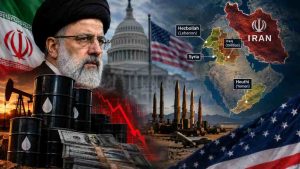 Click Image to Enlarge. Image created via AI.
head of the U.S. midterm elections, one might have expected President Donald Trump to lower the temperature with Iran. Instead, Washington has continued applying economic and military pressure while Tehran has concentrated on convincing Americans that the confrontation is costing the United States more than Iran.
Mohammad Bagher Ghalibaf, speaker of Iran’s parliament, has made that case through U.S. economic indicators. When the 10-year Treasury yield reached 5.1 percent on September 24, he wrote in a post on X, “Happy 5.1% 10Y America,” and warned of “high gas prices” and “diesel shortages.” Three days later, Ghalibaf cited the premium in oil prices to challenge Washington’s claim that Iran had lost control over the Strait of Hormuz, writing that “either the market’s dumb or the US narrative-laundromat is faking it.” On September 30, he projected growing U.S. financial stress through November and into 2027.
In many ways, this is the core of Tehran’s information campaign. Rather than answer questions about the damage the IRGC is absorbing, Iranian officials point Americans toward the costs they can see at home and argue that continued confrontation will only make them worse. The timing, weeks before the midterms, is hardly incidental. Ghalibaf’s message is that Washington may pressure Iran, but Americans will eventually decide the price is too high. That argument, however, tells us little about Iran’s ability to sustain the confrontation or preserve the regional system Tehran spent decades building.
In fact, Washington appears to be pursuing a broader objective. The current approach is better understood as what I would call “strategic asphyxiation,” and it has an interesting Cold War precedent. On January 17, 1983, President Ronald Reagan signed National Security Decision Directive 75, or NSDD-75, which laid out U.S. strategy toward the Soviet Union. Washington would seek “to contain and over time reverse Soviet expansionism” by “competing effectively on a sustained basis with the Soviet Union in all international arenas.”
Israpundit is entirely dependent on readers support. Please help me continue educating people with the truth about what is going on in Israel and around the world.


Leave a Reply
You must be logged in to post a comment.