
Harry Liberman
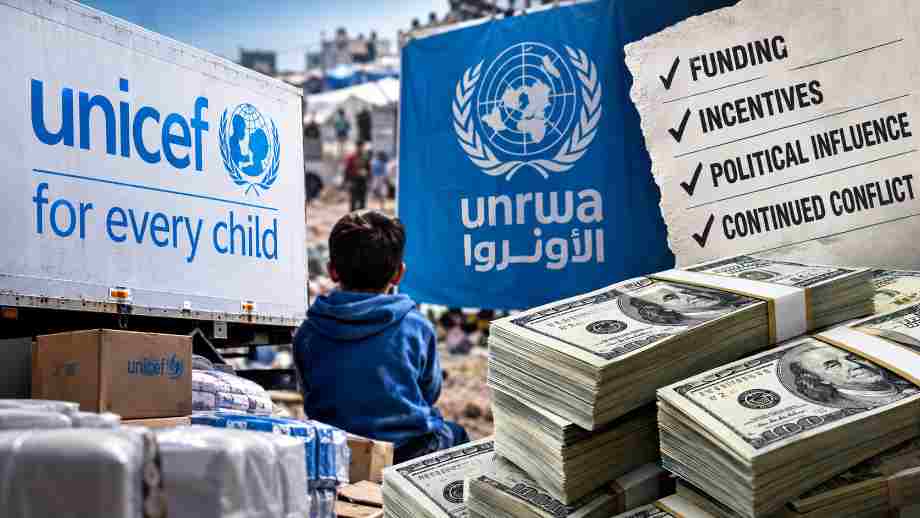 Click Image to Enlarge. Image created via AI.
According to historical data tracked by the OECD and The World Bank, the Palestinian Territories receive significantly more foreign aid per capita than sub-Saharan Africa.
State of Palestine, with a population of approximately 5.7 million people, has historically received an average of $400 to $600 per capita in annual official development assistance (ODA).
Sub-Saharan Africa, with a collective population of roughly 1.3 billion people, averages approximately $35 to $52 per capita annually across its member nations.
The per capita gap is driven by a total annual aid pool that distributes across a population size in sub-Saharan Africa that is nearly 230 times larger than that of the Palestinian Territories.
THE BUSINESS OF MISERY:
For decades, the business model of international relief has relied on a reliable formula: asymmetric emotional blackmail. We all know the imagery. Every few years, a fresh humanitarian crisis prompts a global fundraising blitz, broadcasting explicit close-ups of skeletal children with distended bellies, their suffering transformed into promotional materials. This tactic, often criticized as “poverty pornography,” induces a state of Western guilt that is easily commodified into a monthly recurring credit card donation.
But underneath the idealism of UNICEF’s global mandate lies a darker conflict of interest. When an institution’s operational budget, prestige, and executive compensation expand in direct proportion to global suffering, the organization loses its structural motivation to end the underlying problems.
Managing a crisis is highly profitable; resolving it represents an unacceptable loss of revenue.
The Executive Cartel: High-End Pay in the Name of Famine
While ground-level volunteers face authentic hazards in conflict zones, the executive leadership governing the United Nations apparatus lives a corporate-class existence. Under the standard international civil service rules established by the International Civil Service Commission (ICSC), UN “top brass” enjoy net base salaries paired with extensive perks, including tax exemptions, housing subsidies, hardship bonuses, and post adjustments designed to maximize purchasing power in premier cities like New York, Geneva, and London.
Tax filings and global pay metrics expose the following financial hierarchy within this humanitarian complex:UNICEF USA President & CEO: According to public IRS filings compiled by the ProPublica Nonprofit Explorer, the Chief Executive of the United States Fund for UNICEF pulls in a massive $928,033 in total annual compensation.UNICEF Global Executive Director: Ranked at the UN’s Under-Secretary-General (USG) tier, drawing a tax-exempt base salary that frequently surpasses $250,000 annually once post adjustments and cost-of-living premiums for New York City are applied.UNICEF USA Executive Vice Presidents & Chief Strategy Officers: Tax documents compiled by CharityWatch show that secondary executives routinely earn between $450,000 and $530,000 per year, funded straight out of public donation streams.UN Senior Directors (D-1 / D-2 Levels): Regional managers and division heads enjoy total financial remuneration packages scaling up to $180,000 to $230,000, flanked by specialized education grants for dependents and mobility stipends.
The Moral Failure of Institutional Compliance
The blueprint for this highly coordinated dynamic was drafted during the Biafran War (1967–1970). When the Nigerian government used a total land, sea, and air blockade to starve over two million civilians to death to protect British corporate oil investments, UNICEF used the images of dying infants to pull in massive fundraising revenues. Yet, they refused to publicly expose Great Britain’s covert military pipeline out of fear of diplomatic expulsion.
This behavior continues into the modern era. Because UNICEF is ultimately a product of its UN member states, its bureaucracy repeatedly prioritizes state sovereignty and diplomatic silence over humanitarian truth:
Laundering Dictatorship Propaganda
When severe geopolitical interests cross paths with child protection, the aid complex routinely blinks. For instance, UNICEF faced steep global backlash when it signed on as the “Official Child Rights Organization” for the European Games in Baku, effectively lending its humanitarian branding to the authoritarian regime of Azerbaijan while the government was actively dismantling local civil society and silencing journalists, as documented by the Organized Crime and Corruption Reporting Project (OCCRP).
The Preservation of Famine
By focusing the public’s attention strictly on the mechanical act of sending money to “feed a child,” these multi-billion-dollar organizations construct a smoke screen. They deliberately obscure the structural corruption, Western corporate extraction, and international arms deals that produce the starvation in the first place. If the public realized that starvation is almost always a political starvation crime rather than an act of nature, they would demand structural systemic change—an action that would disrupt the global financial flows that sustain the UN bureaucracy.
Administrative Churn
Every dollar surrendered to massive international aid institutions must first pass through a gauntlet of administrative friction. It feeds international business class travel, high-security regional compounds, media consultants, and public relations firms tasked with finding the next marketable crisis.
When an organization relies on the perpetuation of a crisis to secure its next fiscal budget, it is no longer an agency fighting to end poverty. It has transformed into a self-licking ice cream cone—a multi-million-dollar corporate enterprise that manages human agony, transforms genocide into an advertising asset, and pays its top brass executive salaries to ensure the machinery keeps spinning.
The Silent Bystander: How UNICEF’s Bureaucracy and Compliance Betrayed Biafra
History will always remember the agonizing images of the Nigerian Civil War (1967–1970): skeletal children with distended bellies, their eyes staring blankly into cameras. These haunting photographs became the ultimate fundraising engine for international aid organizations. At the center of this effort was UNICEF, which raised millions of dollars by broadcasting the suffering of the Biafran people to the world. Yet, behind the humanitarian marketing lies a devastating truth: UNICEF functioned as a structural accomplice to the tragedy, prioritizing diplomatic preservation and state sovereignty over the lives of up to two million starving souls.
To understand why UNICEF failed Biafra, one must look at the mechanics of institutional cowardice. UNICEF is not an independent moral authority; it is an agency of the United Nations, a body governed by its member states. During the conflict, the United Nations took a firm, unyielding stance: the secession of Biafra was an internal Nigerian matter. Under the strict doctrine of respecting “state sovereignty,” UN Secretary-General U Thant stubbornly refused to place the Biafran crisis on the UN Security Council agenda. Because the UN recognized the federal military government in Lagos as the sole authority, UNICEF fell directly into line.
This compliance had fatal consequences. The Nigerian government, backed by massive shipments of British heavy artillery and Soviet aircraft, deployed starvation as a deliberate weapon of war. A total land, sea, and air blockade was erected to systematically choke the Biafran enclave. UNICEF, bound by its legal requirement to operate only with the permission of the host government, respected Nigeria’s deadly flight bans. By honoring a legal blockade that barred food and medicine from reaching dying children, UNICEF effectively allowed international law to supersede human survival.
Declassified documents from the British Foreign and Commonwealth Office explicitly lay bare the ruthless economic motivation behind the manufactured famine. Just days before the outbreak of the war in 1967, British officials privately noted, “Our direct interests are trade and investment, including an important stake by Shell/BP in the eastern region.” As the starvation blockade worsened, the declassified state papers reveal that British policy was calculated to maintain trade supremacy, with Harold Wilson’s administration covertly pouring in heavy weaponry while publicly keeping the global community pacified. According to Declassified UK reports on the British files, diplomatic channels were weaponized to prevent international agencies from launching an independent, legal emergency airlift, directly protecting Britain’s corporate footprint at the cost of millions of lives.
Modern Echoes: The Perpetuation of the Gaza Crisis
This exact structural dependency, perfected in Biafra, finds its ultimate modern manifestation in the Palestinian territories through the United Nations Relief and Works Agency (UNRWA).
As investigative bodies like UN Watch have repeatedly detailed, the Palestinian population is the only group on Earth with a dedicated, standalone branch of the United Nations. Unlike the United Nations High Commissioner for Refugees (UNHCR), which operates worldwide to resettle refugees and permanently dismantle their dependent status, UNRWA’s unique mandate allows refugee status to be inherited across generations.
This legal anomaly has transformed an initial population of roughly 750,000 registered refugees in 1950 into nearly 6 million dependants today, locking them into a state of perpetual displacement. For the global aid complex, this expansion represents a guaranteed, permanent revenue stream.
According to congressional testimonies and deep-dive exposés compiled in UN Watch Reports, this multi-billion-dollar apparatus does not merely manage poverty—it actively underwrites regional instability. By operating thousands of local schools using curricula that incite violence and glorify martyrdom, the agency functions as an institutional incubator for conflict.
The moral bankruptcy of this system was explicitly verbalized by the political leadership itself.
In an interview broadcast on Russia Today TV, top Hamas political bureau member Mousa Abu Marzouk was directly questioned as to why the group built a massive 500-kilometre underground tunnel network but never built bomb shelters or safe zones to shield civilians and children from military counter-offensives. Abu Marzouk answered directly:
“We built the tunnels because we have no other way of protecting ourselves from being targeted and killed. These tunnels are meant to protect us from the airplanes… Protecting Gaza civilians is the responsibility of the United Nations and Israel.”
The full exchange, documented via The Middle East Media Research Institute (MEMRI) video archives and reviewed by The Times of Israel, unmasks the predatory reality of the humanitarian loop: the local military infrastructure deliberately leaves children exposed above ground to be used as emotional leverage.
The subsequent civilian deaths fuel international outrage, triggering a massive influx of emergency funds into the UN apparatus.
Just as in Biafra, the true mechanism of the grift relies on hiding the political criminality of a crisis behind a shield of “humanitarian neutrality”. By converting raw geopolitical warfare into a simplified marketing campaign for donations, these multi-million-dollar corporate operations ensure the loop remains unbroken.
They have no incentive to see a conflict resolved; for a global bureaucracy, a permanent peace represents an existential fiscal collapse.
The correlation between massive foreign aid inflows, demographic shifts, and the wealth concentration among political elites is a core focus of institutional critiques globally. Data regarding the scope of global aid, poverty metrics, and the baseline health indicators from sources like the CIA World Factbook highlight these deep disparities.
The African Aid vs. Poverty Paradox
Since 1960, foreign aid and official development assistance (ODA) to Africa have totaled a staggering estimated $2.6 trillion to over $5 trillion (adjusted for inflation). UNICEF operates heavily across all 54 African nations, drawing a substantial slice of global humanitarian funding. [1, 2, 3]
Despite this massive capital transfer, prominent economists like Dambisa Moyo argue that systemic aid has historically trapped the continent in dependency, disrupted local economic growth, and contributed to governance failures. [1]
The Inequality Gap:
In 2000, sub-Saharan Africa recorded zero billionaires on international tracking indexes. Today, the continent features over 20 prominent billionaires with a combined wealth exceeding $112 billion. Meanwhile, over 333 million African children continue to live in extreme monetary poverty. [1, 2]
Wealth Accumulation: Financial watchdogs highlight that the wealthiest 1% in Africa have seen their average incomes grow five times faster than the bottom 50% since 2020. A substantial portion of the continent’s capital has routinely leaked out via institutional corruption and elite enrichment, leaving millions vulnerable to systemic food insecurity and regional famines. [1, 2, 3]
The following is an alphabetical list of prominent Palestinian billionaires and millionaires, including business tycoons, tech investors, and political figures whose wealth has been widely documented by financial analysts and media reports: [1, 2, 3]
Ayman Taha – Millionaire (Hamas official)Bashar al-Masri – Multi-millionaire / Billionaire (Founder of Rawabi city and tech investor)Farouk Shami – Millionaire / Billionaire (Founder of Farouk Systems)Ismail Haniyeh – Multi-millionaire (Late Hamas leader, family asset portfolio)Khaled Mashaal – Billionaire (Hamas political leader)Mahmoud Abbas – Millionaire / Billionaire (PA President, real estate and government fund control)Mohamed Hadid – Multi-millionaire (Luxury real estate developer)Munib al-Masri – Billionaire (Chairman of Padico Holding, often called the “Duke of Nablus”)Musa Abu Marzook – Billionaire (Hamas political wing)Nasser Nasser – Multi-millionaire (Limestone and industrial stone producer)Ramzi Musallam – Billionaire (Financier and private equity executive)Sabih al-Masri – Billionaire (Investor, former chairman of Arab Bank)Sam Bahour – Millionaire (Co-founder of the Palestine Telecommunications Company)Shoman Family – Billionaire family (Founders of Arab Bank) [1, 2, 3, 4, 5]
Baseline Quality of Life Metrics: Palestinian Territories vs. Africa
Baseline public health infrastructure, life expectancy, and childhood mortality data for the Palestinian territories have significantly outperformed large swathes of sub-Saharan Africa and several peer Arab nations.
According to historical and baseline tracking by the CIA World Factbook:
| Region / Country | Life Expectancy at Birth (Baseline Est.) | Infant Mortality Rate (Per 1,000 Live Births) |
| Palestinian Territories (West Bank/Gaza Baseline) | 76.5 Years | 14.2 – 17.0 Deaths |
| Arab World (Average) | ~71 Years | 27.0 Deaths |
| Nigeria | ~55 Years | 70.0 Deaths |
| South Sudan | ~58 Years | 72.0 Deaths |
- The Health Divide: Despite ongoing geopolitical instability, historical indicators in the Palestinian territories have trended closer to mid-tier developed countries than to sub-Saharan Africa. The infant mortality rate in Gaza and the West Bank has historically sat at roughly a quarter of the rates seen in countries like Nigeria or South Sudan. [1]
- The Media and Elite Incentive Structure: These metrics expose an asymmetric media ecosystem. While severe, structural famines in Africa that affect tens of millions of people receive minimal international coverage, crises in the Levant dominate global headlines. This hyper-focus creates an ideal media landscape for the local elite.
By utilizing mainstream media channels to broadcast “GENOCIDE IN GAZA” , political leaders successfully trigger billions of dollars in emergency international funding. These resources are diverted away from civic development to line the pockets of political leadership , sustaining a highly profitable loop of managed misery.
Vlogger Goes To “Palestine” and Was Stunned by What He Discovered!
https://www.youtube.com/watch?v=MAmnSMvWm7U
Israpundit is entirely dependent on readers support. Please help me continue educating people with the truth about what is going on in Israel and around the world.

Leave a Reply
You must be logged in to post a comment.