
From the Grand Mufti of Jerusalem’s wartime alliance with Adolf Hitler to Mahmoud Abbas’s Holocaust distortion, Nazi symbols at Palestinian demonstrations and copies of Mein Kampf discovered in Gaza, a disturbing historical record raises questions about antisemitism within Palestinian nationalism.
Ron East | TheJ.ca | Oct 16, 2026
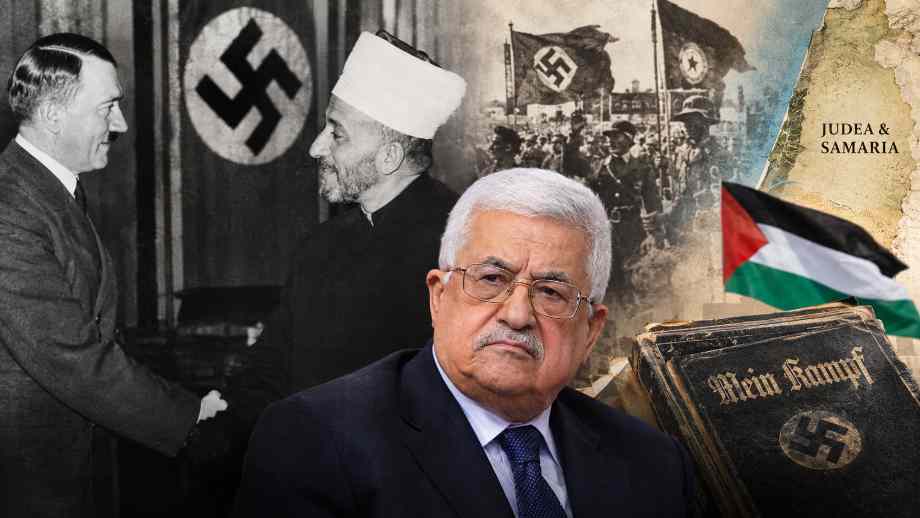 Click Image to Enlarge. Image created via AI.
There is an uncomfortable chapter in the history of Palestinian nationalism that deserves far more attention than it receives.
It begins not with the establishment of Israel in 1948, nor with the Six-Day War in 1967, but with the years preceding the Holocaust, when one of the most influential Arab leaders in British Mandatory Palestine aligned himself with Adolf Hitler and Nazi Germany.
That relationship was not invented by Israeli propaganda. German wartime records, photographs, propaganda broadcasts, and the archives of the United States Holocaust Memorial Museum document it.
Decades later, Palestinian Authority President Mahmoud Abbas would advance his own distorted interpretations of the Holocaust, while Nazi symbols and literature would continue to surface in Palestinian political and militant environments.
These episodes do not establish that all Palestinians support Nazism. Palestinian nationalism encompasses different political movements, beliefs and historical experiences.
They do, however, reveal a recurring problem: the appropriation, justification or normalization of Nazi antisemitism by influential Palestinian figures and some militant groups.
And that history cannot simply be dismissed.
The Grand Mufti Who Allied Himself With Hitler
Haj Amin al-Husseini, the Grand Mufti of Jerusalem, emerged as a leading Arab political and religious figure during the British Mandate.
He fiercely opposed Jewish immigration and the establishment of a Jewish national homeland.
By the late 1930s, having fled British authorities, al-Husseini increasingly looked toward Nazi Germany and Fascist Italy for political and military support.
On November 28, 1941, he met Adolf Hitler in Berlin.
The meeting was documented by Nazi officials and filmed for German propaganda.
Al-Husseini sought German recognition of Arab independence and support for preventing the establishment of a Jewish homeland in Palestine.
Hitler declined to make the formal public commitments the Mufti requested. Nevertheless, he made clear that Nazi Germany’s war against Jews extended to those living in territories under British influence in the Middle East.
The United States Holocaust Memorial Museum documents that Hitler identified the annihilation of Jews in Arab territories as a German objective once Nazi forces reached the region.
For al-Husseini, cooperation with Nazi Germany was more than a diplomatic calculation.
During the war, he participated in Axis propaganda efforts, broadcasting antisemitic messages into the Arab world and encouraging support for Germany.
He also assisted efforts to recruit Muslims into German military and Waffen-SS formations, particularly in the Balkans.
The historical record establishes that an influential figure associated with Palestinian Arab nationalism actively collaborated with the Nazi regime.
That fact should be neither exaggerated nor forgotten.
The Mufti and the Final Solution
Al-Husseini’s relationship with Hitler raises a particularly serious historical question: What role did he play in Nazi Germany’s campaign to annihilate European Jewry?
The Mufti supported Nazi antisemitic policies and advocated violence against Jews. He also sought to prevent Jewish refugees from reaching Palestine.
His actions placed him firmly on the side of a regime carrying out genocide.
However, the distinction between supporting the Holocaust and originating its extermination policy is essential.
Nazi persecution and mass murder of Jews were already underway before the Mufti met Hitler in November 1941.
The United States Holocaust Memorial Museum has explicitly rejected claims that al-Husseini persuaded Hitler to initiate the Final Solution.
The Holocaust was conceived and implemented by Nazi Germany, its allies and collaborators.
Al-Husseini did not invent it.
What he did was support a regime committed to the destruction of European Jewry, spread its antisemitic propaganda and seek political advantage from its victory.
That documented collaboration is sufficiently damning without assigning him responsibility that the historical evidence does not support.
Mahmoud Abbas and the Distortion of Holocaust History
The relationship between Palestinian political leadership and Holocaust distortion did not end with the Second World War.
Mahmoud Abbas, the longtime president of the Palestinian Authority and chairman of the Palestine Liberation Organization, has repeatedly faced criticism over his statements about the Holocaust.
His controversial treatment of the subject dates back decades.
In his doctoral research, Abbas questioned aspects of the accepted historical account of the Nazi genocide and discussed claims concerning Zionist-Nazi collaboration.
He subsequently distanced himself from some of those assertions and has publicly condemned the Holocaust.
Nevertheless, his later remarks revived concerns about his understanding and presentation of Jewish history.
In August 2023, Abbas addressed senior members of his Fatah movement and claimed that Hitler persecuted European Jews because of their social and economic activities rather than their Jewish identity.
He specifically invoked money lending and usury, repeating an antisemitic stereotype historically used to justify persecution of Jews.
The comments drew widespread condemnation after becoming public in September 2023.
The United States, Germany and the European Union criticized Abbas for distorting Holocaust history.
Germany’s ambassador to Israel described the remarks as an insult to the memory of Holocaust victims.
Yad Vashem Chairman Dani Dayan accused Abbas of promoting antisemitic stereotypes and Holocaust denial and distortion.
Abbas’s representatives rejected the criticism, maintaining that he condemned the Holocaust and antisemitism.
But the contradiction remains.
When the head of the Palestinian Authority advances explanations for the Holocaust that echo longstanding antisemitic propaganda, the issue cannot be dismissed as an isolated historical misunderstanding.
It raises questions about political leadership, public education, and the narratives being legitimized at the highest levels.
Swastikas and Nazi Imagery in Palestinian Political Activity
The swastika is among the most recognizable symbols of the Nazi regime and its genocidal antisemitism.
Yet Nazi symbols have appeared in some Palestinian demonstrations, propaganda, and confrontations with Israeli forces.
Photographs and videos circulated over the years have shown swastika flags or Nazi imagery in certain Palestinian protest settings.
In some instances, such symbols have been displayed as expressions of hostility toward Jews or Israel.
In others, Nazi imagery has been used to accuse Israel of behaving like Nazi Germany, an inversion that exploits Holocaust memory for political purposes.
Those uses differ, but both require scrutiny.
Displaying a swastika as an expression of admiration for Nazism is different from using Nazi imagery to condemn an opponent. Context matters, and individual incidents should be authenticated before drawing broader conclusions.
Nevertheless, the repeated appearance of Nazi iconography in a conflict involving the Jewish state carries an unmistakable historical weight.
The swastika is not an ordinary political symbol.
It represents a movement that organized the systematic murder of six million Jews.
When it appears in political activity directed against Israel, the legitimate question is why a symbol of Jewish extermination has been chosen and what message its users intend to convey.
Criticism of Israeli government policies does not require Nazi symbolism.
Nor does advocacy for Palestinian national rights require the rehabilitation of Nazi propaganda.
Mein Kampf and the Persistence of Nazi Literature
The continuing circulation of Adolf Hitler’s Mein Kampf in Arabic translation adds another dimension to the discussion.
The book, originally published in the 1920s, lays out Hitler’s racist worldview, conspiratorial antisemitism, and ideological ambitions.
Its availability in Arabic-language markets has periodically generated controversy.
The mere possession or sale of Mein Kampf does not establish support for Nazism. Historians, researchers and students may examine the text for legitimate educational purposes.
But its appearance in militant environments, particularly when accompanied by approving annotations or ideological material, raises different questions.
In November 2023, Israeli President Isaac Herzog showed an Arabic-language copy of Mein Kampf during a BBC interview.
Herzog said Israeli soldiers had discovered the book in a children’s room in a home in northern Gaza that Hamas had used for military purposes.
According to the Israeli account, the copy contained highlighted passages, handwritten notes and annotations.
The discovery was presented by Israeli officials as evidence of Nazi ideological material appearing in a Hamas-associated setting.
It demonstrates why the presence of Nazi literature in conflict environments deserves investigation, particularly when the material is associated with armed groups whose rhetoric includes antisemitic themes.
The question is not whether every Palestinian who encounters the book embraces Hitler’s ideology.
It is whether extremist movements are drawing upon Nazi ideas and whether their propaganda is being challenged by Palestinian political and educational institutions.
Hamas and the Difference Between Anti-Israel Politics and Antisemitism
The history of antisemitism within Palestinian political movements cannot be examined without considering Hamas.
Hamas’s original 1988 charter contained antisemitic language, including conspiracy theories about Jewish influence and explicit references to the notorious antisemitic forgery The Protocols of the Elders of Zion.
It also incorporated religiously framed hostility toward Jews.
In 2017, Hamas issued a new political document that sought to distinguish Jews as a religious community from Zionists as a political adversary.
That document did not formally revoke the original charter, and the organization’s record of attacks against Israeli civilians remains central to assessments of its ideology.
The October 7, 2023, Hamas-led attacks, in which approximately 1,200 people were killed in Israel and about 250 were taken hostage, demonstrated the catastrophic consequences of violence deliberately directed at civilians.
Hamas is a designated terrorist organization in Canada, the United States, the European Union, and other jurisdictions.
Its history of antisemitic propaganda must be examined alongside its military actions.
At the same time, Hamas does not represent every Palestinian, and its ideology should not be attributed indiscriminately to the entire Palestinian population.
That distinction is necessary for an accurate historical assessment.
The Problem of Historical Accountability
The central issue is not whether Palestinians have legitimate national aspirations or grievances.
Those questions are separate from the documented record of antisemitism among certain Palestinian leaders and organizations.
The Mufti’s wartime collaboration with Hitler is a historical fact.
Abbas’s repeated Holocaust distortion is documented.
The use of Nazi symbols in some Palestinian political settings has been reported.
And Israeli officials have presented evidence of Nazi literature recovered during military operations in Gaza.
These facts and allegations differ in evidentiary strength and significance, but collectively they warrant serious examination.
They also raise questions for governments, international institutions and organizations that support Palestinian education and civil society.
Are antisemitic conspiracy theories being challenged?
Are students receiving historically accurate instruction about the Holocaust?
Are political leaders being held accountable when they distort Nazi crimes?
And are extremist movements being confronted when they adopt the imagery or ideological language of genocidal antisemitism?
These are not unreasonable questions.
They are fundamental questions about historical truth, political responsibility, and the future of Jewish-Palestinian relations.
Palestinians Have a Nazi Problem. It Must Be Confronted.
The history of Palestinian nationalism cannot be reduced to Nazism, and it would be historically inaccurate to portray an entire people as heirs to Hitler.
But neither can the documented Nazi collaboration of an influential Palestinian leader, the Holocaust distortion of a Palestinian Authority president, or the appearance of Nazi ideology in extremist settings be erased from the record.
There is a difference between opposing Israeli policies and embracing the symbols, conspiracy theories, or historical justifications of a movement that murdered six million Jews.
That difference should be unmistakable.
For Palestinian political and educational institutions, confronting this history would not undermine legitimate national aspirations. It would strengthen the credibility of efforts to build a future free of hatred.
For the international community, it requires consistent standards rather than selective outrage.
And for Jewish communities, whose history makes the consequences of Nazi antisemitism painfully clear, the subject cannot be treated as a minor rhetorical controversy.
Palestinians have a Nazi problem wherever Nazi ideas, symbols, and Holocaust distortion are tolerated or promoted.
Recognizing that problem is not condemning an entire people.
Refusing to confront it, however, risks allowing one of history’s most destructive ideologies to remain part of the political conversation long after the defeat of Nazi Germany.
Israpundit is entirely dependent on readers support. Please help me continue educating people with the truth about what is going on in Israel and around the world.


Leave a Reply
You must be logged in to post a comment.