
PELONI: Another brilliant and important analysis by Victor Satya.
The lessons of the failed peace plans over the years should be for Israel to pursue victory, not peace. By creating the conditions of peace, peace may or may not follow in turn, but until such foundations for peace are established, the effect of having achieved victory over its adversaries will leave Israel in a position to survive until these possibilities present themselves. Victory, not peace, is how to build the Iron Wall which Jabotinsky spoke about a century ago, a wall not to hide behind, but to emphasize to our enemies that we are here to stay, that our land is OUR OWN, and that while peace is desirable, it can not be achieved at any sacrifice to our own security, survival or identity.
So, seek victory, support the Iron Wall, and defeat our enemies – in time such efforts will bear the seeds of peace at the expense of our enemies constantly being fed the notion that if only they would remain defiant that everything they desire will be surrendered to them as one concession at a time til we are left utterly defenseless against their desires to effect a final October 7. If peace is possible, it can not be based on Western ambitions, but on Middle East realities, and as Satya explains below,
“[Israel] needs to stop being governed by the fear of what the world will say. Because if the price of being loved is the steady surrender of everything that makes Israel worth defending, then the price is too high.”
Territory surrendered. Sovereignty compromised. Concessions made. And the condemnations keep coming.
Victor Satya | October 17, 2026
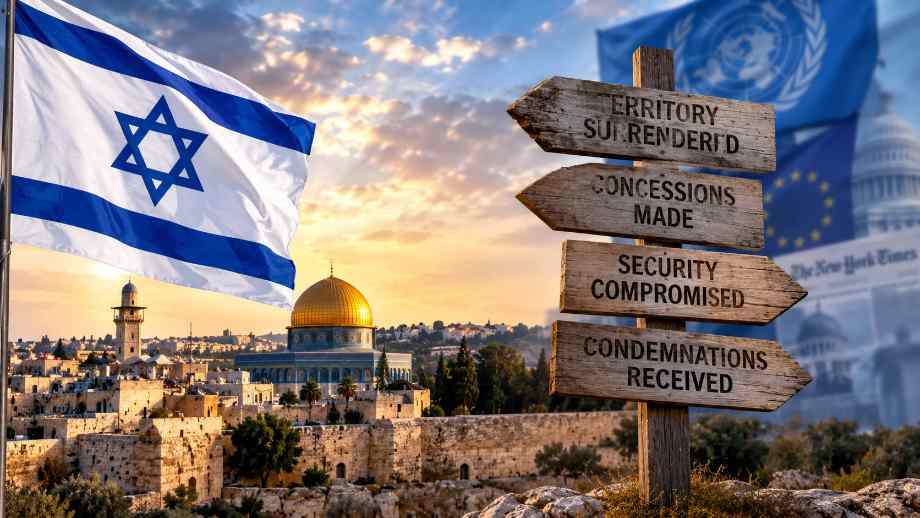 Click Image to Enlarge. Image created via AI.
Israel has spent much of its modern history looking over its shoulder to see whether the world approves of what it is doing. Is Washington pleased? Is Brussels offended? Will the United Nations pass another resolution? Will The New York Times approve? Will the Europeans understand? Will the international community finally recognize that Israel is a democracy, that it wants peace, that it has made concessions, that it has behaved itself?
The answer, by now, ought to be obvious. No amount of explanation, accommodation, or territorial generosity has purchased the affection Israel was promised. The country has made concessions and received condemnations, surrendered strategic advantages and received lectures, and attempted to demonstrate its reasonableness to people whose principal objection is often that Israel exists as a sovereign Jewish state in the first place.
The fundamental mistake is not that Israel maintains diplomatic relations, seeks allies, or cares what its friends think. Every sensible country does these things. The mistake is treating international approval as though it were a strategic asset that can be purchased by relinquishing the things a nation exists to protect: its security, its sovereignty, its historic inheritance, and its capacity to determine its own future.
Consider the bargain Israel has repeatedly been encouraged to make. Relinquish territory, and the world will recognize its legitimate concerns. Make concessions, and the Palestinians will moderate their demands. Demonstrate restraint, and the international community will appreciate the difficulty of Israel’s position. Withdraw from places of strategic importance, and the security situation will improve. Show goodwill, and the goodwill will eventually be reciprocated.
The Gaza disengagement provides a more uncomfortable example. Ariel Sharon’s government argued that unilateral withdrawal could improve Israel’s security, break the diplomatic stalemate, and reduce friction with the Palestinians and the international community. The government’s own disengagement plan explicitly presented improved security as one of its objectives. Whatever the merits of the decision as understood at the time, the subsequent history of Gaza demolished any comfortable assumption that withdrawal alone would produce peace.
Israel is forever being told that it must make another gesture, exercise another restraint, accept another formula, or demonstrate another willingness to compromise. Each new demand arrives dressed as the final test of Israeli reasonableness. Pass it, we are assured, and perhaps the atmosphere will improve.
Nowhere is the contradiction more painful than in Jerusalem. When Israel was established in 1948, the Old City, including the Western Wall and the Temple Mount, fell under Jordanian control. Jewish residents of the Old City’s Jewish Quarter were expelled, and Jewish access to the holiest sites was denied under Jordanian rule. The city remained divided until the Six-Day War of 1967, when Israel captured East Jerusalem and reunited the city under Israeli control. The historical record is summarized in the Knesset’s account of Jerusalem’s liberation.
In 1967, Israel recovered access to the Old City and the Jewish holy places. It had an opportunity to establish a new and lasting reality. Instead, Defence Minister Moshe Dayan chose to preserve the Islamic Waqf’s administration of the Temple Mount, allowing non-Muslim visits while maintaining restrictions on Jewish prayer there. The arrangement became a defining feature of the modern status quo.
There were strategic reasons for caution. But caution has a cost, too. Arrangements introduced under particular historical circumstances can harden into permanent expectations. What begins as a temporary accommodation becomes a sacred international obligation, and what was once a question of Israeli discretion becomes something Israel is told it has no right to reconsider.
The Jewish connection to the Temple Mount is not a recent political invention. It is central to Jewish religious tradition and historical identity. For centuries, Jews prayed for Jerusalem, mourned the destruction of the Temple, and preserved the hope of return. After 1967, Jewish sovereignty returned to the site, but the question of Jewish prayer and the future of the Temple Mount remained constrained by the political arrangements Israel chose to preserve. But Israel must also ask itself an uncomfortable question: how much of its own national and religious inheritance is it prepared to leave permanently beyond reach because the world might become angry if it does otherwise?
The Third Temple is a religious aspiration, not a political project whose realization can simply be assumed to follow from a different decision in 1967. Yet the larger point remains. If Israel believes that Jewish history, religious continuity, and sovereignty matter, it cannot make the mere possibility of foreign disapproval the final answer to every question about them. A nation that refuses even to discuss the future of its holiest places because the diplomatic consequences might be unpleasant has surrendered something before a single negotiation has begun: the freedom to decide what its own inheritance means.
The same dilemma confronts Israel in Judea and Samaria. These territories contain places of profound significance to Jewish history, including Hebron and the Tomb of the Patriarchs. The 1994 peace treaty with Jordan recognized Jordan’s special role in Muslim holy shrines in Jerusalem; it did not, by itself, divide Judea and Samaria into the different administrative areas that exist today. Those arrangements emerged principally through the subsequent Israeli-Palestinian agreements.
The result is a complicated system of overlapping authorities, competing national claims, and unresolved questions of sovereignty. It is difficult to govern, difficult to defend, and perpetually vulnerable to diplomatic pressure.
Israel should therefore ask whether the arrangements it has accepted actually serve its long-term interests. Does it preserve freedom of access to Jewish holy places? Does it establish a stable political reality? Or does it perpetuate a condition in which Israel carries substantial security responsibilities while remaining under constant international pressure to surrender more of its authority?
Retaining or extending sovereignty could provoke sanctions, damage relations with allies, intensify diplomatic isolation. But if the international community is prepared to condemn Israel for exercising sovereignty, it may do so whether Israel acts cautiously or boldly. The relevant question is not whether condemnation can be eliminated, but whether the policy being pursued is worth its strategic, political, and moral costs.
The question of Israel’s Arab citizens presents a different, but related, challenge: the temptation to organize the country’s constitutional arrangements around the desire to impress foreign observers. Israel is a Jewish state with Arab citizens who participate in its political system, vote in its elections, and are represented in the Knesset. Most identify primarily as Palestinian, and their collective attitude toward the Jewish state is overwhelmingly hostile, rooted in a shared desire to see a Palestinian flag raised over the entire country.
The same principle applies throughout this debate: Israel should decide its constitutional arrangements according to a defensible conception of its national interests and democratic obligations, not according to the applause or disapproval of foreign audiences.
Israel has repeatedly acted as though international condemnation were evidence that it had failed to explain itself adequately. If only the government communicated better, if only diplomats found the right words, if only Israel demonstrated greater restraint, if only another concession were made, perhaps the world would finally understand. But there are limits to what public relations can accomplish when the disagreement is not merely about a particular Israeli policy but about the legitimacy of the Jewish state’s actions, borders, or even existence.
Israel faces a choice, although not the simplistic choice between diplomacy and defiance.
It can continue to treat international approval as an objective in its own right, measuring success by the warmth of foreign statements and the temporary absence of diplomatic outrage. Or it can treat approval as a useful consequence of sound policy, worth pursuing when it serves the national interest but never worth purchasing at any price.
The difference is fundamental.
Israel should seek peace, cultivate allies, protect its democratic institutions, and negotiate agreements that improve the lives and security of its citizens. It should also recognize that some decisions will provoke condemnation regardless of how carefully they are made. Some adversaries will reject compromises because they consider them insufficient. Some governments will apply standards to Israel that they do not consistently apply elsewhere. No amount of diplomatic choreography can guarantee otherwise.
Israel cannot build its future around the hope that a sufficiently accommodating Jewish state will eventually become acceptable to everyone. The country has survived because generations of Israelis were prepared to defend a national home that others did not always wish to recognize. They built institutions, developed extraordinary capabilities, and maintained a national identity despite wars, isolation, and repeated threats to their existence. They did not achieve everything by asking permission.
That inheritance imposes a responsibility on the present generation.
Israel must distinguish genuine friendship from conditional approval and legitimate diplomatic counsel from demands that would leave it less secure, it should be willing to earn the respect of its allies, but it must also possess the courage to disappoint them when the national interest requires it. For a country that has spent so much of its history fighting for the right to determine its own future, there is something profoundly tragic about treating that future as a matter on which everyone else must first be consulted.
Israel does not need to become indifferent to the world. It needs to stop being governed by the fear of what the world will say. Because if the price of being loved is the steady surrender of everything that makes Israel worth defending, then the price is too high.
Israel has tried appeasement. It has tried concessions. It has tried explaining itself to a world that seems determined to misunderstand it. So, to those who insist Israel simply needs to give more: how much more must the Jewish state surrender before you finally declare it reasonable? Another territory? Another holy site? Another piece of its sovereignty? Name your price. Israel has been paying for decades.
Israpundit is entirely dependent on readers support. Please help me continue educating people with the truth about what is going on in Israel and around the world.


Leave a Reply
You must be logged in to post a comment.