
Harry Liberman
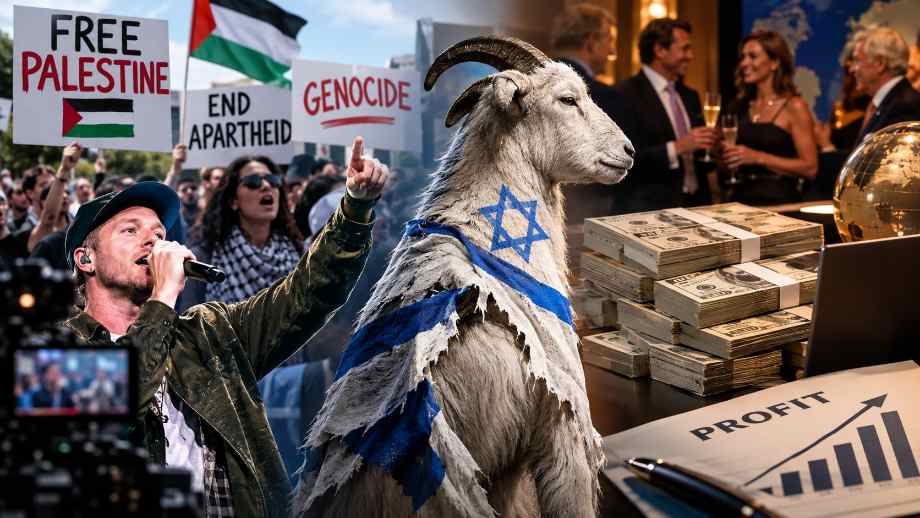 Click Image to Enlarge. Image created via AI.
The Global Ledger of History’s Favorite Scapegoat:
A Master Dossier for the historically illiterate agenda driven investor in Jew Hate.
Why waste your firm’s venture capital on volatile emerging markets when you can park your portfolio in the world’s most reliable, inflation-proof commodities?
For decades, well-meaning philanthropists and celebrity activists have tried to strip-mine the African poverty sector for moral capital. They fly in for a weekend, wear organic linen, take a carefully staged photo with a child, and host a star-studded gala. But let’s be honest: as an investment strategy, the African poverty grift suffers from severe structural fatigue. The geopolitical landscapes of sub-Saharan Africa are far too complex for modern donors; trying to explain multi-factional regional conflicts to a Western audience requires nuance, and nuance destroys conversion rates.
If you want perpetual yields, you need a singular, universally recognized market driver.
Enter The Anti-Semitism Annuity™—the premium choice for discerning politicians, high-paid NGO executives, and A-list celebrities looking to secure lifetime financial and moral liquidity. Forget volatile tech stocks or high-maintenance humanitarian logistics.
When it comes to generating institutional wealth, there is no asset class more lucrative, more reliable, or more perpetually liquid than history’s favorite scapegoat.
The Recurring Revenue Stream
The historical phenomenon of cyclical antisemitism functioning as a recurring societal and economic utility has been extensively analyzed by historians and sociologists. Scholars like Robert Wistrich, author of Antisemitism: The Longest Hatred, document that while the specific justifications for Jew-hatred morph over centuries—shifting from religious anti-Judaism in antiquity to racial antisemitism in the 19th century, and modern geopolitical anti-Zionism today—the underlying structural mechanics remain remarkably consistent. The historical record illustrates how this cycle acts as a recurring societal “reset button” and financial driver across distinct epochs.
Public figures and humanitarian organizations selectively capitalize on anti-Zionist rhetoric and the Israel-Hamas war to maintain public relevance, capture younger donor demographics, or boost digital algorithmic engagement, often while ignoring concurrent global humanitarian crises.
Celebrity, Media Figures, and Career Leveraging
Revive your failing career—it’s easy. Even the most historically ignorant useful idiot can get on a stage and yell out “Free Palestine,” “From the river to the sea,” “Genocide,” “Apartheid,” or “Death to the IDF”—oblivious to the fact that it is the Jews and Judeans who have historically been the victims of indigenous displacement, European colonialism, apartheid, and systematic genocide. They can do this after a single rehearsal or none whatsoever. Public figures utilize the perpetual news cycle surrounding Israel and Jewish communities as a low-cost, high-yield strategy to re-engage audiences or expand their platforms.
The statistics prove that for both faded musicians and high-decibel media talk-show hosts, standing on the graves of historic Jewish atrocities generates immense digital traffic, but it fails to mask the underlying truth: their organic commercial viability is completely bankrupt.
Macklemore: The American rapper released tracks like “Hind’s Hall” following post-October 7 escalations and launched targeted tours. Critics argue that leaning into anti-Israel activism provided a massive, free publicity engine that revitalized his public footprint among younger demographics. According to streaming metrics compiled by Chartmasters, his mainstream commercial viability had substantially waned since his early 2010s peaks; his 2023 album BEN bottomed out with negligible global sales and stalled at a dismal No. 67 on the UK Albums Chart. However, Forbes reports that immediately following stage outbursts where he was dropped from major festival lineups, the resulting algorithmically driven controversy briefly pushed his back catalog onto digital download charts—proving that targeting Israel acts as a low-cost pipeline to revive dwindling public visibility.
Piers Morgan (Citizen of the Colonial British Empire): As a prominent UK media figure and television host, Morgan has faced consistent criticism from multiple sides of the political spectrum for turning the Gaza conflict into a confrontational, high-viewership spectacle on his digital platforms. Watchdogs contend that his sensationalized formats and high-profile debates with figures like Roger Waters function primarily to drive millions of clicks and secure lucrative streaming engagement. This transforms historic human suffering into a reliable revenue-generating talk show asset, masking his own weak commercial footprint. Indeed, despite a collective following of over 10 million on social media, The New York Times and BookScan industry data exposed that his book, Wake Up: Why the World Has Gone Nuts, managed a dismal 5,650 pure copies sold upon release.
Roger Waters (Citizen of the Colonial British Empire): The 81-year-old former Pink Floyd bassist has faced international condemnation for decades over anti-Israel and inflammatory remarks. Following October 7, Waters drew severe backlash—including music bans by Israeli radio stations—after appearing on mainstream broadcasts to contest documented details of the Hamas massacres. Critics argue that his intense focus on Israel allows him to maintain a highly visible, rebellious media persona long after the peak of his musical output.
Hollywood, Independent Writers, and Cultural Figures
Organizations like the Anti-Defamation League (ADL) note a sharp rise in culture-sector campaigns, crowdsourced blacklists, and anti-normalization petitions targeting Jewish artists or those expressing concern over antisemitism. In this climate, critics claim that multiple “has-been” or mid-tier actors, indie screenwriters, and playwrights sign open letters or lead protests to establish ideological compliance within industry subcultures, ensuring professional survival and securing social media validation at zero personal cost.
NGOs and the Accusation of a Selective Lens
A core structural criticism levied by researchers is that major international NGOs and human rights agencies apply a disproportionate amount of institutional resources, legal scrutiny, and public relations maneuvers toward the Jews and the lands named after them—Judea, Samaria, and Israel—effectively giving an “easy pass” to authoritarian regimes globally.
The Erasure of Massive Global Crises:
The global aid industry and its high-profile advocates allocate massive fundraising bandwidth to the Levant while downplaying or entirely ignoring severe regional catastrophes. Crises involving mass casualties and severe systemic atrocities—such as the multi-factional conflicts in sub-Saharan Africa, state repression in Venezuela, or mass displacements in East Africa—frequently receive only a fraction of the media coverage or donation streams because they lack a singular, marketable narrative villain.
The Revenue Incentive:
Because the continuous 24/7 news cycle keeps the Israeli-Palestinian conflict perpetually visible to Western audiences, targeting the Jewish state offers multi-billion-dollar aid agencies a guaranteed return on investment for fundraising campaigns. According to tracking from NGO Monitor, this dynamic fosters an economic incentive to prioritize specific areas of misery over much deadlier global atrocities, funding high-end administrative infrastructures and executive salaries by continually cycling through the world’s most enduring geopolitical scapegoat.
The Business of Misery and the Levant Exception
According to historical data tracked by the OECD and the World Bank, the Palestinian Territories receive significantly more foreign aid per capita than sub-Saharan Africa.
The “Palestinian Territories” with a population of approximately 5.7 million people, have historically received an average of $400 to $600 per capita in annual official development assistance (ODA). In stark contrast, sub-Saharan Africa, with a collective population of roughly 1.3 billion people, averages approximately $35 to $52 per capita annually across its member nations. This vast per capita gap stands across a population size in sub-Saharan Africa that is nearly 230 times larger than that of the Palestinian Territories.
For decades, the business model of international relief has relied on a reliable formula: asymmetric emotional blackmail.
The most reliable investment for over 3000 years : Scape Goating the Jews !
Every few years, a fresh humanitarian crisis prompts a global fundraising blitz, broadcasting explicit close-ups of human suffering transformed into promotional materials. Underneath the idealism of global humanitarian mandates lies a darker conflict of interest. When an institution’s operational budget, prestige, and executive compensation expand in direct proportion to global suffering, the organization loses its structural motivation to end the underlying problems.
Africa is too hard to manage and you wont get many clicks .
Managing a crisis is highly profitable; resolving it represents an unacceptable loss of revenue.
The Value of Dead Jews: The Polish Model
The modern economic infrastructure surrounding Holocaust memory in Poland has been a subject of severe criticism by restitution advocates and legal scholars. Organizations like the World Jewish Restitution Organization (WJRO) have long pointed out a stark asymmetry: while Poland derives substantial annual revenue and international diplomatic clout from managing historic death camp sites, the state maintains some of the most restrictive property restitution laws in Europe, effectively blocking Holocaust survivors and their descendants from reclaiming their stolen homes.
The Polish Model is an industrial cash cow built on the ashes of the Holocaust. Poland’s structural profit incentive relies on a system where dead Jews hold immense economic and diplomatic value for the state, while living Jews and their property rights are treated as a financial liability. The economic and legal mechanics of this dynamic operate across two main pillars:
The Monetization of Memory (The Asset)
The Tourism Cash Cow: The state heavily commercializes the sites of Jewish destruction. According to the Official Auschwitz Memorial Museum Registrar, the site attracts between 1.8 million and 2.2 million international visitors annually. This massive influx of global “dark tourism” funnels hundreds of millions of dollars each year directly into Polish infrastructure, hotels, transport, and state-regulated tour agencies.
Diplomatic Leverage: Managing these global memorial sites grants the Polish state significant international moral authority and diplomatic clout on the world stage, acting as a sovereign cultural asset.
The Systematic Denial of Property Rights (The Liability)
The Permanent Wealth Transfer: While the state profits from the physical locations of the genocide, it has legally blocked the living descendants of the victims from reclaiming their ancestral wealth. Poland remains the only major country in the European Union that has failed to pass a comprehensive law for the restitution of private property seized during the Holocaust.
The 2021 Legal Cutoff: In August 2021, Poland enacted a highly controversial law setting a 30-year administrative cutoff on challenging past property decisions, drawing strong condemnation from the U.S. Department of State. This law effectively extinguished thousands of pending and future Holocaust restitution claims, ensuring that the real estate, land, and businesses of 3.5 million murdered Jews remain permanently on the state’s balance sheets.
Absorbing Heirless Property: Instead of funnelling heirless assets into funds to support needy global survivors under international frameworks like the Terezin Declaration, the Polish state treasury directly absorbs this wealth.
By keeping the living descendants locked out through legal blockades while aggressively promoting the physical spaces of the dead, critics argue the state has engineered a perfect sovereign annuity: maximizing the ongoing revenues of commemoration while permanently keeping the stolen wealth of the victims.
The Asymmetric Math of Modern Leverage: The Gilad Shalit Paradox
This exact pattern of treating Jewish lives as high-yield commodities mirrors the asymmetrical bargaining chips used by hostile regional actors. In modern asymmetric conflicts, a single living or deceased Israeli hostage is routinely leveraged against thousands of convicted adversaries—a historical reality epitomized by the 2011 Gilad Shalit deal, where Hamas successfully traded a single captured Israeli soldier for 1,027 Palestinian prisoners, many of whom were serving life sentences for terrorism.
The Gilad Shalit Paradox represents a bizarre financial equation where a terrorist group’s greatest economic asset is the very life of the enemy they swear to destroy, creating a multi-million-dollar distortion in the market of asymmetric warfare. When you monetize the 1,027-to-1 exchange ratio into cold hard cash, the economic ledger exposes a profound paradox:
The Microeconomic Valuation:
The average annual cost to feed, house, guard, and provide medical care for a high-security prisoner is approximately $32,000 USD per year. Many of the 1,027 prisoners released in 2011 were serving multiple life sentences for terrorism, with an average remaining lifespan of 30 years behind bars. By forcing the release of 1,027 prisoners, Hamas instantly wiped $32.8 million USD in annual liabilities off Israel’s state budget, or a staggering $985 million USD in projected lifetime incarceration costs.
The Macroeconomic Paradox:
From a pure corporate asset perspective, Hamas transformed a single captured private soldier into a financial instrument worth nearly $1 billion USD in saved enemy expenditure and recovered human capital for their organization.
The paradox is absolute:
To maximize its financial and political yields, a genocidal enterprise cannot afford to kill its hostage. The living enemy is meticulously kept alive, fed, and secured in underground bunkers because, on the geopolitical balance sheet, a single captive Israeli soldier is the most valuable liquid asset in the entire Levant, worth more than a thousand of their own fighters combined. This disproportionate exchange rate reflects an ideological framework deeply rooted in foundational regional texts, such as widely cited Hadith narratives outlining an eliminationist doctrine where even nature exposes those hiding behind stones.
For the multi-billion-dollar global aid industry, political entities, and state actors alike, the perpetuation of this cycle ensures a reliable, self-renewing resource: dead Jews fuel a perpetual tourism and diplomatic asset class in the West, while captive or targeted Jews provide the ultimate political currency for genocidal factions in the Levant.
The Selective Blindness of the most Immoral Industry in the history of the world
The ultimate survival strategy for the modern outrage economy relies not just on what it chooses to broadcast, but on what it deliberately filters out.
The industry grifters—the fading pop-culture figures, the high-paid NGO executives, and the corporate talk-show hosts—will never integrate into their marketing materials the visual evidence exposed in the New York Post’s comprehensive investigation of Hamas’s billionaire leadership.
To display photos of a terror baron’s adult son lounging in five-star Doha hotel suites, or to broadcast images of Hamas chiefs operating out of air-conditioned luxury villas while managing an estimated $11 billion USD financial portfolio, would instantly shatter the profitable illusion of the simplified narrative.
It would reveal that the suffering of the local population is not merely an act of nature or a unilateral consequence, but a highly commodified corporate asset for the elite running the conflict.
The global ledger remains perfectly balanced for those who profit from it.
By screening out the luxury sedans, private jets, and five-star compounds of the architects of the conflict, the international aid apparatus and its celebrity useful idiots protect their underlying investment. They preserve a reliable, 24/7 news cycle that keeps the moral clarity manufactured, the executive salaries funded, and the world’s most enduring scapegoat perpetually monetized.
DISCLAIMER / REGULATORY NOTICE: The financial, sociological, and geopolitical analysis presented in this dossier—including all references to The Anti-Semitism Annuity™, the Polish Asset Model, and the Asymmetric Levant Leverage Matrix—is for educational, and informational purposes only. It does not constitute formal investment advice, tax planning, or capital management strategy.
Past performance across the last 3,000 years of historical scapegoating is not a guarantee of future algorithmic yields or institutional donation returns. Investing in geopolitical grifting, sovereign wealth extraction off historical atrocities, or five-star terrorist real estate portfolios carries substantial structural risk, moral bankruptcy, and systemic exposure to regulatory exposure or sudden asset forfeiture by international watchdogs.
Consult a qualified ethical professional, independent historian, or anti-terrorism financial specialist before allocating your firm’s moral capital, celebrity branding, or NGO fundraising budgets to history’s favorite commodities. Capitalize on systemic outrage at your own risk.
Israpundit is entirely dependent on readers support. Please help me continue educating people with the truth about what is going on in Israel and around the world.

Leave a Reply
You must be logged in to post a comment.