
Sinan Ciddi | Oct 22, 2026
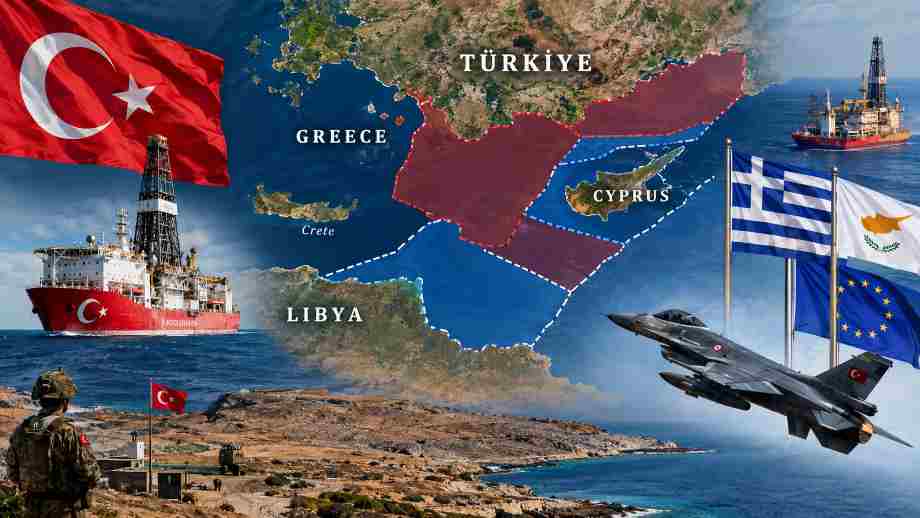 Click Image to Enlarge. Image created via AI.
At the beginning of this year, the speaker of eastern Libya’s parliament described a proposed maritime border deal with Turkey as “built on illegality.” However, on October 20, the same parliament unanimously approved the agreement. The agreement violates Greece’s internationally recognized maritime rights, opens the way for Turkish drilling in contested waters, and raises the prospect for armed conflict between Turkey and Greece.
The approval means that the agreement now has the backing of both Libya’s rival governments. The internationally recognized Government of National Accord (GNA) based in Tripoli in the west assented to the agreement in 2019 — a reflection of its indebtedness to Ankara for military intervention on its behalf in the Libyan civil war. It took Turkey seven years of courting the Benghazi-based Government of National Stability (GNS) to achieve the same outcome in the east, where Gen. Khalifa Haftar leads the government, whose forces once battled Turkey-backed adversaries.
The European Union immediately denounced the deal now concluded with the government in eastern Libya, because it “infringes upon the sovereign rights of third states [and] does not comply with the law of the sea.” Nevertheless, the eastern Libyan parliament’s support strengthens Turkey’s position in contested maritime zones claimed by Greece and Cyprus, advancing the implementation of Turkey’s “Blue Homeland” maritime expansion doctrine.
A Strategic Victory for Ankara
Turkey’s position in Libya has now been shored up in three distinct but interrelated areas. Legally, the GNA vote repairs the 2019 agreement’s principal deficiency, namely approval by only one of Libya’s two rival administrations. Militarily, Turkey’s troop deployment in Libya is now authorized to continue until January 2028; in eastern Libya, Haftar’s faction has reportedly reached agreements with Ankara regarding military bases, surveillance infrastructure, and officer training. Economically, the vote safeguards Turkish commercial interests, as Turkish contractors are engaged in 633 projects in Libya valued at $31 billion.
Major Concerns for Regional U.S. Allies
For Greece, the parliamentary approval represents a setback in its diplomatic efforts to prevent the agreement’s ratification. Athens has consistently maintained that the pact ignores the status of Crete, which lies between the Turkish and Libyan coasts. Greece’s foreign ministry immediately declared the new maritime deal as “null and void.” Ankara already treats this maritime boundary as operational; in April, a Turkish drone traversed the area during a U.S.-led exercise in Libya.
For Cyprus, the primary concern is the potential erosion of regional influence. Ankara has leveraged the 2019 agreement to assert a role in the development of the Great Sea Interconnector (GSI), a planned power cable connecting Greece, Cyprus, and ultimately Israel. The deployment of Turkish F-16s to occupied northern Cyprus in March may also increase the proximity of Israeli maritime assets to Turkish military capabilities.
Without strong pushback from the European Union, whose maritime borders are being challenged by Turkey and Libya, this agreement could precipitate armed conflict between NATO members Turkey and Greece. Turkey now maintains military forces in Libya, Syria, occupied Cyprus, and Somalia, operating bases on three continents and enhancing its capacity to assert its maritime claims through military means.
U.S. Should Support EU Allies in Curbing Turkish Power Projection
Washington should advocate for cooperation grounded in international law. The administration should publicly reaffirm that the memorandum does not impose obligations on other states, aligning with the European Union’s stance. Additionally, it should exert pressure on Haftar, a U.S. citizen, and condition support for any Libyan unity initiative on Tripoli and Benghazi engaging in maritime border negotiations with Greece and Egypt in accordance with the law of the sea. The Pentagon should ensure that AFRICOM exercises do not reinforce Turkey’s maritime boundary, while the State Department should support survey activities for the GSI.
Congress should examine whether Turkey’s deployment of U.S.-manufactured F-16s to occupied Cyprus contravenes end-use regulations. It should establish conditions for future arms transfers to Ankara, including any potential reentry into the F-35 program, by requiring Turkey to relinquish the use of force in pursuing its Libya-based claims. Furthermore, Congress should continue to strengthen security cooperation with Greece, Cyprus, and Israel to ensure that Ankara’s strategy yields greater costs than benefits.
Sinan Ciddi is a senior fellow at the Foundation for Defense of Democracies (FDD). For more analysis from Sinan and FDD, please subscribe HERE. Follow FDD on X @FDD. Follow Sinan on X @SinanCiddi. FDD is a Washington, DC-based, nonpartisan research institute focused on national security and foreign policy.
Israpundit is entirely dependent on readers support. Please help me continue educating people with the truth about what is going on in Israel and around the world.


Leave a Reply
You must be logged in to post a comment.