
PELONI: The Durban Conference was a benchmark for depravity weaponized and targeting the Jewish people with impunity, replicating in many ways the lost weaponization of the faux “Zionism is Racism” standard cherished by the United Nations. In fact, these efforts to target the Jews through international and judicial norms only served to demonstrate how tortuously off-kilter such non-national entities might be moved to achieve a desired goal by the world’s internationalists. To be certain, the promotion and primacy of the projection of the Jewish state as an evil entity has been in effect since the world was unable to stop its reconstitution in 1948. From that time to now, we have seen how easily the world has moved from one extreme to the next, casting aside the standards of Western values to support the promotion of Jew-hatred as a new inalienable right masquerading as international justice. In the same way that the Two-State Solution became the norm for making peace amid a river of Jewish blood, the pursuit of human rights has been leveraged to deny Israel the right to self-defense, even when faced with an entity openly revisiting the horrors of the Hebron massacre with impunity, while the entire world focuses on preventing the Jewish state from responding.
Durban should have been a turning point—a moment when the world confronted the corruption of its institutions and reaffirmed the principle that hatred cannot be made legitimate through diplomatic consensus. Instead, its legacy continues to haunt international community as a plague eating away at the Judeo Christian principles on which the Western civilization was founded. As the Jewish state is judged by separate and higher standards imposed on no other country, the lesson is unmistakable: where the Jewish people are denied the rights afforded to everyone else there can be no honest application of justice, just as peace cannot be erected on anything so self-defeating as demanding that Israel should surrender the means of defending its existence as a pre-condition of peace.
Dr. Alex Grobman
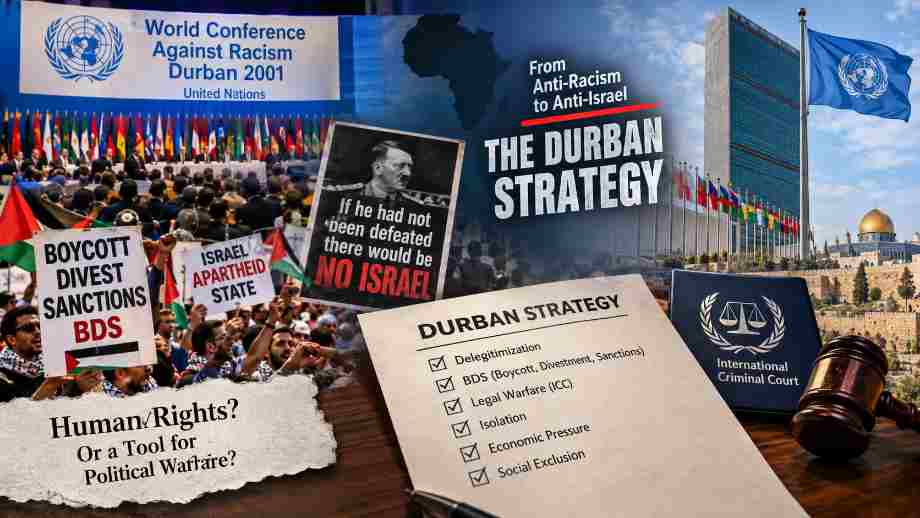 Click Image to Enlarge. Image created via AI.
In late summer 2001, more than 1,500 nongovernmental organizations (NGOs) gathered alongside state delegations at the U.N. World Conference Against Racism in Durban, South Africa. What was intended to be a global summit against prejudice instead became a watershed moment in the development of a new and highly coordinated form of geopolitical warfare against Israel.
Under the influence of the Organization of the Islamic Conference (OIC) and aligned civil society groups, the conference gave rise to what became known as the “Durban Strategy.” According to Gerald M. Steinberg, founder of NGO Monitor and professor emeritus at Bar-Ilan University, this framework laid the foundation for the modern boycott, divestment and sanctions (BDS) movement. Its objective was the total diplomatic, economic and social isolation of Israel: demanding the severance of international ties with the Jewish state while launching a systematic campaign to brand it as an “apartheid regime,” explicitly modeled on the campaign against apartheid South Africa.
The strategy depended on hijacking the language and institutional machinery of global anti-racism and redirecting it against Israel. The late U.S. Congressman Tom Lantos, who served as a U.S. delegate at the summit, observed that the OIC sought to distort the conference’s broad humanitarian agenda by turning Israel into the world’s primary symbol of racism. By caricaturing Israel as the last remaining systematically racist state, this coalition sought to mobilize the international community to shun, sanction and embargo it.
Crucially, this diplomatic offensive unfolded during the daily horrors of the Second Intifada. Lantos warned that branding Israel as a racist state did not advance human rights. Rather, it served a dangerous political function: morally legitimizing terrorist violence and suicide bombings against Israeli civilians.
The toxic atmosphere was most pronounced at the parallel NGO forum, where civil society proceedings degenerated into open hostility. Palestinian Arab activists staged daily anti-Israel and antisemitic rallies, while the venue was flooded with inflammatory propaganda and hate speech. Flyers were distributed featuring photographs of Adolf Hitler with captions asserting that, had he not been defeated, “there would be NO Israel.” Accredited groups, including the Arab Lawyers Union, circulated booklets filled with crude antisemitic caricatures.
Despite the blatant bigotry, senior United Nations officials refused to intervene forcefully. Mary Robinson, then the U.N. high commissioner for human rights and secretary-general of the conference, declined requests to reject the false equivalence being drawn between the Holocaust and the Israeli-Palestinian conflict. Instead, Robinson publicly balanced the historical trauma of the Holocaust against the “accumulated wounds” of Palestinian displacement. By choosing equivocation over condemnation, U.N. leadership effectively legitimized the hijacking of the global human rights apparatus.
The long-term damage of the Durban summit, which concluded just three days before the Sept. 11 terrorist attacks, was the profound inversion of progressive values. Legal scholar Anne F. Bayefsky, director of the Touro College Institute on Human Rights and the Holocaust, identified a deeply troubling connection between Durban’s anti-racism politics and global terrorism. The conference advanced a central pillar of the terrorist agenda: the systematic delegitimization of Israel in order to justify violence against its citizens.
This connection exposed a deeper reality: Racial and religious hatred are not merely byproducts of terrorism, but often among its root causes. Violent actors frequently disguise that hatred by accusing their targets of racism, colonialism or oppression. The ultimate tragedy of the Durban framework was therefore not only that it targeted Israel, but that it denied antisemitism its rightful place as one of the defining human rights issues of the modern era. Ancient prejudice was repackaged in the contemporary vocabulary of social justice.
In the decades since, this blueprint has been aggressively implemented through the social, institutional and professional exclusion promoted by the BDS movement. Prominent British litigation lawyer Anthony Julius describes the structural nature of boycotts not as physical assault, but as a cruel mechanism of recoil and exclusion. When individuals are targeted by a boycott, ordinary social and professional courtesies are stripped away. They are ignored, their goods and services are rejected, and invitations disappear. Pushed away by what Julius describes as a “general horror and common hate,” the targeted person is denied the basic human dignity of self-expression and participation in society.
Yet heavily funded NGO networks continue to deploy specious allegations against Israel while maintaining significant influence within the United Nations, academia and international media. As the Israeli think tank the Reut Institute has argued, these systematic assaults pose an urgent national security challenge. They attack the Jewish people’s right to self-determination under the deceptive guise of peace, international law and progressive values.
This dynamic has also expanded into international legal institutions, fulfilling early warnings about the weaponization of global courts. Former U.S. Secretary of State Henry A. Kissinger was among the first to voice concern over the “unprecedented movement” to submit international politics to judicial procedures, warning that this trend would heavily affect Israel.
Centered on the doctrine of universal jurisdiction, this shift gave bodies such as the International Criminal Court (ICC) broad prosecutorial discretion with limited institutional accountability. Kissinger warned that imprecise definitions of international crimes made the system vulnerable to politicized application, enabling states and prosecutors to launch arbitrary investigations while denying defendants standard due process protections. He cautioned that a “dictatorship of the virtuous” has historically led to inquisitions, and correctly foresaw that the ICC would become a major theater for geopolitical conflict. Overreliance on universal jurisdiction, he argued, risks destroying the political will of sovereign states to uphold the very norms needed to restrain global violence.
Today, the vocabulary of “apartheid” and “genocide” deployed against Israel in international legal forums stems directly from the institutional blueprint established at Durban in 2001. Yet democratic nations have increasingly pushed back against this systemic bias. Recognizing that the antisemitic foundations of the original summit were never seriously confronted, a record 38 nations—including the United States, the United Kingdom, Canada and a broad coalition of European Union member states—officially boycotted the U.N.’s 20th-anniversary “Durban IV” review conference.
The legacy of the 2001 Durban Conference therefore extends far beyond one failed diplomatic gathering. Durban corrupted global humanitarian platforms by institutionalizing anti-Zionism within their core vocabulary. By twisting an anti-racism agenda into a campaign to delegitimize a sovereign Jewish state, weaponize legal bodies such as the ICC and rationalize terrorism, the Durban framework inverted the universal principles of human rights.
Conflating progressive advocacy with geopolitical erasure does not strengthen the international system. It corrodes it. The Durban Strategy remains one of the clearest examples of how the language of human rights can be repurposed to undermine democracy, excuse violence, and deny the Jewish people the same right to national self-determination afforded to others.
Dr. Alex Grobman is the senior resident scholar at the John C. Danforth Society, a member of the Council of Scholars for Peace in the Middle East, and on the advisory board of the National Christian Leadership Conference of Israel (NCLCI). He has an MA and PhD in contemporary Jewish history from The Hebrew University of Jerusalem.
Israpundit is entirely dependent on readers support. Please help me continue educating people with the truth about what is going on in Israel and around the world.


Leave a Reply
You must be logged in to post a comment.