
Radical “Agency” [Torah] Against Unparalleled Trauma: The Architecture of Progress
Harry Liberman
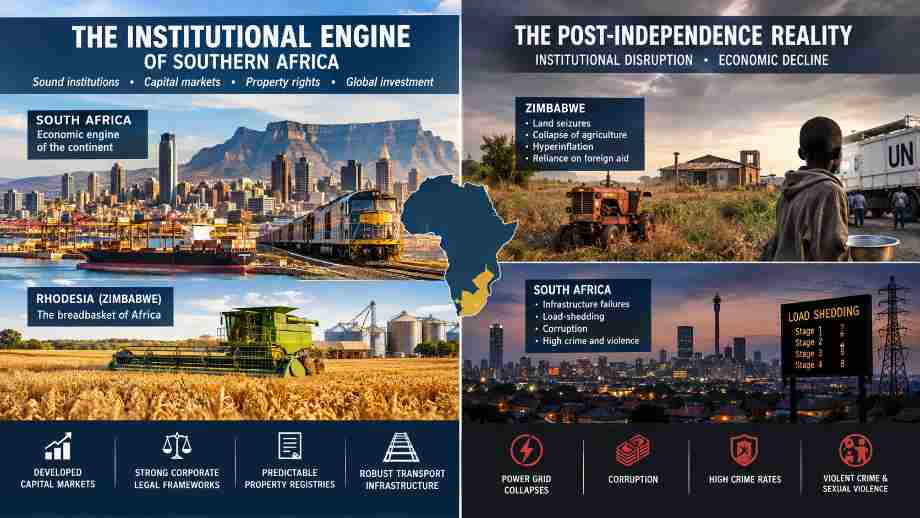 Click Image to Enlarge. Image created via AI.
The global debate surrounding international development is frequently obscured by emotional rhetoric and political correctness. When analyzing why certain nations achieve rapid, sustainable economic growth while others remain trapped in cycles of poverty and foreign aid dependency, a stark reality emerges. Natural resources, geography, and financial handouts are entirely secondary to a nation’s underlying institutional culture and foundational values.
The contrasting trajectories of post-war Japan, modern Israel, and sub-Saharan Africa provide a compelling case study. They demonstrate that long-term societal progress is fundamentally driven by an internal cultural framework of absolute agency and institutional discipline—knowing that when a society points its fingers inward to solve its own structural gaps, it thrives, but when it points its fingers outward to blame external forces, it breeds perpetual victimhood.
The Institutional Engine of Southern Africa
To understand the economic divergence within the African continent, one must examine the objective financial infrastructure of 20th-century South Africa and Zimbabwe (formerly Rhodesia). Isolating these outcomes from the racial ideologies and human rights abuses that defined minority white rule reveals a distinct structural reality: these nations built self-contained, highly advanced industrial economies based on strict Western institutional design.
Unlike standard “extractive colonies” designed merely to export raw minerals to Europe, South Africa and Rhodesia established permanent domestic capital markets, rigorous corporate legal frameworks, predictable property registries, and robust transport infrastructure. This cultural framework of governance attracted massive global investment, transforming South Africa into the economic engine of the continent and Rhodesia into the agricultural “breadbasket of Africa.”
The post-independence era, however, has highlighted the fragility of these systems when institutional continuity is disrupted. Since the transition to majority rule, both nations have experienced significant structural regressions:
Zimbabwe: Following the aggressive, uncompensated seizure and redistribution of commercial farmland in the late 1990s and 2000s, the nation’s agricultural output collapsed. By dismantling Property Rights Enforcement—the single most critical economic policy for wealth creation—a country that once exported food to the entire continent succumbed to hyperinflation, institutional flight, and long-term reliance on United Nations emergency food aid.
South Africa: Since 1994, while the political landscape was successfully democratized, the nation’s core operational metrics have severely declined. South Africa faces chronic infrastructure failures, including persistent electrical grid collapses known as Load-Shedding, high levels of public corruption, and some of the highest recorded rates of violent crime and sexual violence globally.
These declines occurred despite South Africa inheriting the most sophisticated industrial base on the continent.
Historically, the security and economic pull of this infrastructure was so profound that it acted as a massive sanctuary. This structural demographic migration is famously mirrored in literature, such as Wilbur Smith’s epic historical saga The Courtney Novels, which dramatizes the centuries-long economic development of Southern Africa, illustrating how its industrial hubs consistently drew waves of African populations seeking survival, employment, and refuge from the brutal realities of regional tribal conflicts elsewhere on the continent. Preserving this physical infrastructure, however, is impossible without maintaining the rigorous cultural and institutional discipline required to run it.
The Jewish Model: Radical Agency Against Unparalleled Trauma
The argument that historical victimization or a lack of natural resources permanently prevents economic development is directly refuted by the history of the Jewish people. As an ethno-religion, Jewish culture is rooted in a foundational theological and societal pillar: radical personal and collective agency. Rather than projecting blame outward onto a hostile world, the cultural blueprint teaches self-reliance, intellectual inquiry, and rigorous accountability.
Historically, the Jewish people have been subjected to an architectural campaign of persecution unparalleled in human history:
- Historical Trauma: Fractured by Roman conquest in the first century, commemorated by the Arch of Titus as a monument to Italian-Roman enslavement of Jews, the population was driven into diaspora. Over centuries, they were victimized by systemic scapegoating—falsely blamed for the Black Plague and Jews—and targeted by continuous pogroms, expulsions, and legal segregation across Europe. Even progressive steps, like the 1782 Edict of Tolerance in Austria, were not acts of equality but transactional policies designed to strip away Hebrew/Yiddish culture and assimilate Jews for state utility.
- The Holocaust: The systematic genocide of six million Jews—one-third of the global Jewish population—where virtually no European country was safe, and Western democracies like America and Canada tightly restricted entry, a closed-door policy solidified during the tragic Evian Conference.
- The Geopolitical Betrayals: Upon attempting to return to their ancestral land (where the very name Judea means land of the Jews), the indigenous Jewish population was repeatedly betrayed by the British Empire. Seeking to placate regional Arab leaders for lucrative oil concessions, Britain enacted a policy of territory carve-outs and immigration bans. First, they sliced away 77% of the original geographic mandate to establish Transjordan, ensuring Jordan was explicitly barred from the promised Jewish homeland. Second, via the White Paper of 1939, Britain barred Jewish refugees fleeing Nazi extermination from entering their ancestral land. Finally, during the 1948 war, British allegiance shifted directly to the invading Arab forces: the British military officer Sir John Bagot Glubb led and commanded Transjordan’s Arab Legion to ethnically cleanse every single Jew from Judea, Samaria, and the Old City of Jerusalem—even turning Jewish tombstones into military toilets.
Despite an international arms embargo and inheriting a tiny, fragmented territory—much of it malaria-ridden swamp and barren desert—the Jewish people did not build an economy based on global pity or permanent handouts.
Through strict property rights, massive investment in human capital, and advanced agricultural engineering, Israel transformed its harsh geography into a lush, thriving nation. Today, constituting less than 0.2% of the world’s population, Israel is a global powerhouse in technology, defense, and water-recycling, directly refuting the contemporary, politically driven narratives that baselessly accuse it of “apartheid,” “genocide,” or “occupation.”
In an absurd geopolitical irony, Israel’s regional Arab enemies—who command 99% of the landmass in the Middle East and remain fractured by internal tribal wars—frequently rely on Israel’s cutting-edge agricultural, medical, and technological innovations for their own basic regional stability.
The Fallacy of the Aid Paradigm: Handouts vs. Reciprocal Trade
To fully understand why culture is the deciding factor in development, one must contrast the nature of the aid flowing into different regions. The mainstream media frequently mischaracterizes all international funding as charity, yet the structural design of these financial flows reveals two completely different economic philosophies:
THE CONTRAST IN INTERNATIONAL FUNDING
[ UN Aid to Africa ] ———> Unmonitored Humanitarian Handouts (Consumptive)
[ US Funding to Israel ] —–> Circular Defense Procurement & Reciprocal Trade
($3.8B spent back in US / $54B global ecosystem)
In the case of Israel, the widely cited $3.8 billion in annual assistance is governed by a strict bilateral U.S.-Israel Memorandum of Understanding. Structurally distinct from traditional foreign aid, it serves as an internal circular procurement mechanism: uniquely, 100% of this Foreign Military Financing must be spent directly within the United States on American-manufactured defense goods, supporting domestic aerospace jobs and financing American technological research and development.
Furthermore, this arrangement is entirely overshadowed by massive reciprocal trade benefits.
While Israel uses these specialized defense frameworks to protect its borders, the broader Office of the United States Trade Representative data tracks overall annual bilateral goods and services trade at over $54 billion, supplying Western economies with vital innovations in semiconductors, cyber security, and medical technologies. Israel does not survive on aid; it is an economic powerhouse whose trade yields massive returns for its partners.
Japan and the Power of Inward Reflection
Similarly, post-war Japan demonstrates the power of a culture focused entirely on inward accountability rather than permanent external reliance. Following the devastation of two nuclear weapons and complete military defeat in 1945, Japan lacked natural resources and geographic dominance. Yet, it leveraged deep-rooted cultural values of collective responsibility (Shadan Hojin) and a historic dedication to craftsmanship (Monozukuri).
Rather than adopting a mindset of permanent grievance or seeking open-ended global welfare, the population focused on manufacturing high-value, exportable technology. They culturally digested Western management principles and evolved them into the revolutionary Kaizen (continuous improvement) model that powered global giants like Toyota, proving that cultural software matters far more than physical assets or foreign subsidies.
Ideological Deterioration: Marxism, Islamism, and External Blame in Africa
When contrasting these successes with sub-Saharan Africa and parts of the Arab world, the core contradiction of the modern humanitarian framework becomes evident. As historical financial ledgers show, the United Nations, global NGOs, and international donors have funneled over one trillion dollars in aggregate aid into Africa over the past several decades.
Yet, across many resource-rich nations, dependency has deepened rather than diminished.
To sustain a comfortable, “quality” life in Africa, historical economic data shows that a single person needs an annual income ranging between only $5,000 and $18,000 USD ($400 to $1,500 USD per month). Given this relatively low local baseline for a high standard of living, the trillion-dollar influx of global capital should have theoretically catalyzed widespread, continental prosperity. Instead, the bottleneck remains cultural and institutional fragmentation—a vulnerability weaponized by pervasive, destructive ideologies that dismantle development from within.
THE ANTI-PROGRESS AID CYCLE
[ Influx of External UN Aid ] —> Outsources Basic State Responsibilities
|
[ Local Resource Wealth Diverted ] -> Enriches Fractional Tribal Elites
|
[ Ideological & Security Collapses ] -> Marxism & Islamism Destroy Infrastructure
|
[ Chronic Structural Decay ] —-> Perpetuates Domestic Instability
Beyond regional tribal patronage networks, Africa’s institutional growth has been systematically hollowed out by two distinct ideological forces that are fundamentally antithetical to capital accumulation and civic stability:
- The Legacy of Subversive Marxism: During decolonization and the Cold War, many newly independent African regimes eagerly imported Soviet- and Chinese-backed Marxist-Leninist doctrines. These ideologies replaced functioning economic institutions with centralized command economies and state monopolies. The resulting nationalizations of private industries, collectivization of agriculture, and outright hostility toward foreign capital destroyed native asset ownership, repelled international investors, and created a ruling bureaucratic elite focused on resource redistribution rather than wealth generation.
- The Rise of Militant Islamism: Across vast expanses of the continent—most notably in the Sahel, West Africa, and parts of East Africa—radical Islamism has acted as a primary engine of destruction. Extremist groups systematically wage war on modern educational institutions, infrastructure, and secular governance, creating massive, violent governance vacuums that eradicate the safety needed to preserve property rights or attract sustainable enterprise.
When states collapse into internal regional war, Western powers consistently manipulate the resulting misery to guard their resource extraction.
The most flagrant example occurred during the Nigerian Civil War, where the British government intervened to orchestrate the blockade and eventual starvation of up to two million Biafrans between 1967 and 1970. This catastrophic enforcement of starvation was entirely driven by British state efforts to protect the lucrative petroleum infrastructure of Shell-BP in the Niger Delta.
This dynamic creates a lucrative industry for opportunistic NGOs, agenda-driven politicians, and international bodies like the United Nations.
By continuously pointing fingers outward and blaming external historical factors, these entities profit immensely from the managed misery of local populations. Because the United Nations and global charities step in to provide emergency food, refugee management, and healthcare infrastructure, corrupt state systems are absolved of the basic responsibilities of governance. Resource wealth is stripped for private gain, while the survival of the populace is permanently outsourced to the international taxpayer.
The data of the past century delivers a clear, unsentimental verdict.
Natural resources and foreign aid do not build prosperous societies; institutions, property rights, and cultural values do.
[Israel’s supreme natural resource : Jews and the Torah /Agency ]
Nations and cultures that cultivate a framework of strict inward accountability, personal agency, and institutional integrity can rise from total destruction to global dominance, regardless of their lack of resources or history of trauma. Conversely, regions that choose to point fingers outward, relying on the crutch of international aid, fractional tribal patronage, and destructive political or religious extremisms, will continue to see their vast natural wealth wasted, remaining permanently dependent on the systems they seek to transcend.
- African Arguments. (2026). Beyond Load-Shedding: How South Africa’s Electricity Crisis Scarred Industry. African Arguments Infrastructure & Development Series. Available at: africanarguments.org
- Cato Institute. (2007). How Loss of Property Rights Caused Zimbabwe’s Collapse. Economic Development Bulletin, No. 4. Washington, D.C.: Cato Institute. Available at: cato.org
- Declassified UK. (2023). How Britain’s Labour Government Facilitated the Massacre of Biafrans in Nigeria to Protect Its Oil Interests. Available at: https://www.declassifieduk.org/how-britains-labour-government-facilitated-the-massacre-of-biafrans-in-nigeria-to-protect-its-oil-interests/
- Jevon, Graham. (2017). Glubb Pasha and the Arab Legion: Britain, Jordan and the End of Empire in the Middle East. Cambridge: Cambridge University Press.
- Office of the United States Trade Representative. (2025). U.S.-Israel Trade Facts & Bilateral Investment Profile. Executive Office of the President. Washington, D.C.: USTR. Available at: ustr.gov
- The White House. (2016). Fact Sheet: Memorandum of Understanding Reached Between the United States and Israel (2019–2028). Office of the Press Secretary. Washington, D.C.: The White House. Available at: archives.gov
- United States Holocaust Memorial Museum. (2024). The Evian Conference, July 1938. Holocaust Encyclopedia. Available at: https://encyclopedia.ushmm.org/content/en/article/the-evian-conference
- Wikipedia. (2026). 1782 Edict of Tolerance (Austria). Available at: https://en.wikipedia.org/wiki/1782_Edict_of_Tolerance
- Wikipedia. (2026). The Courtney Novels Series Overview. Available at: wikipedia.org
- Wikipedia. (2026). The White Paper of 1939 and the British Mandate for Palestine. Available at: https://en.wikipedia.org/wiki/White_Paper_of_1939
- Wikipedia. (2026). The Nigerian Civil War (1967-1970). Available at: https://en.wikipedia.org/wiki/Nigerian_Civil_War
Israpundit is entirely dependent on readers support. Please help me continue educating people with the truth about what is going on in Israel and around the world.

Leave a Reply
You must be logged in to post a comment.