
PELONI: Unity is the answer to the question of how we might survive the maelstrom which faces us. Indeed, only a strong Israel can withstand the forces aligned against the Jewish People around the world, and a strong Israel requires a sense of unity which faced its many enemies in turn around the world since October 7.
In the months since the attacks, Israel has confronted not one enemy but many — in Gaza, on the northern border, and in the courts of public opinion abroad. Each front has demanded something different: resolve, endurance, clarity. And each has reinforced the same truth the pre-war years had obscured — that the state is not a collection of factions but a single body, and that its strength is measured not in weapons alone but in the cohesion of the people who wield them.
The wars wage onward, and so too does the need for unity — unity of purpose, of survival, and of destiny. Not the unity of agreement, which no nation achieves, but the unity of a people who have chosen, out of their own free will, to stand together against what would unmake them. That choice is what makes the state more than a territory, and the people more than a population. It is destiny in the truest sense: not what our enemies intend for us, but what we choose to become. And in doing so we will frustrate their objective to destroy us in this age as we have done in past ages.
Harry Liberman
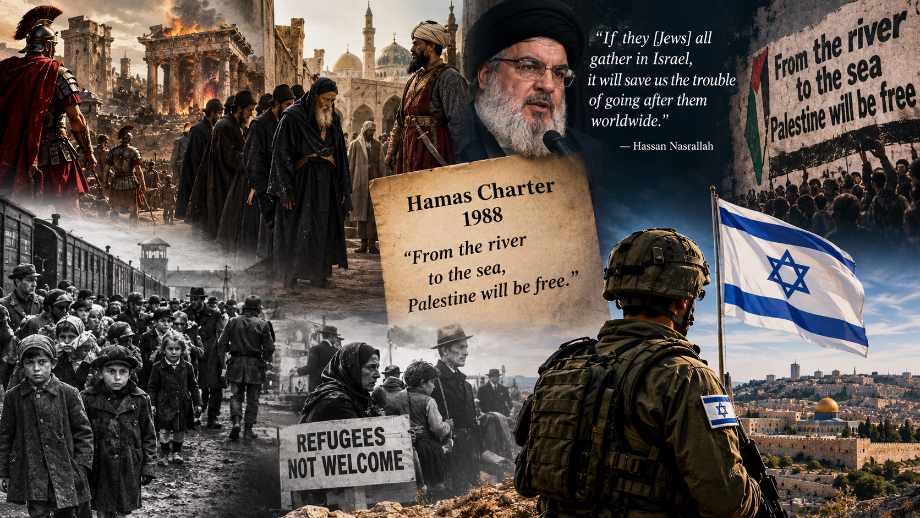 Click Image to Enlarge. Image created via AI.
Is the Holocaust not lesson enough for the Jews in and out of the Jewish state ?
History will judge nations not by the noise of their internal debates, but by their resolve in the face of annihilation. Today, Israel is locked in a multi-front existential war, fighting a network of adversaries committed to its total destruction. In such an unprecedented hour of peril, the fundamental principle of nation-state self-defense demands a clear, unyielding truth: a country fighting for its survival requires absolute national solidarity and strong, uncompromising leadership.
Now is not the time for political experimentation or leadership transitions that would only serve to embolden our enemies.
The Pragmatic Realities of Wartime Command
The core argument for maintaining Prime Minister Benjamin Netanyahu’s leadership rests on the pragmatic realities of wartime governance. Changing the civilian commander-in-chief while soldiers are actively deployed on multiple battlefields is a luxury a besieged nation cannot afford. First and foremost, a leadership shakeup projects an image of internal weakness and instability to external adversaries. Sophisticated terrorist networks and foreign regimes closely monitor domestic dissent, interpreting political fractures as a sign that the nation’s will to fight is eroding. To replace a seasoned leader mid-conflict is to signal to our enemies that their strategy of exhaustion is working.
Furthermore, military continuity is vital to victory. The complex coordination of multi-front intelligence, strategic deployments, and long-term defense planning requires deep institutional knowledge and established relationships with military commanders. Disrupting this chain of command at the political level risks introducing bureaucratic friction and strategic hesitation at the exact moment when decisive, rapid action is paramount. A transition of power inevitably fractures domestic resolve, redirecting national energy away from defeating external threats and toward exhausting domestic political campaigns.
The Subversive Narrative of the Red-Green Alliance
In this high-stakes framework, political opposition—particularly from far-left factions and anti-Zionist activists—cannot be viewed as mere routine political debate. There is a coordinated, progressive leftist “red-green alliance” spanning international and domestic media that fundamentally aligns against the Jewish state’s security. Critics argue that outlets like the Green Party Platform abroad and domestic organizations like Haaretz and B’Tselem function as anti-Israel entities. By routinely publishing material that accuses Israel of severe systemic crimes, labels its operations as illegitimate, and demands international pressure or sanctions against its leaders, these groups weaponize the language of human rights to subvert the state from within.
To these extreme ideological elements, a defeat for Israel is seen as a victory for their global narrative.
This multi-front assault is amplified by international bodies and media machines that are systematically unmoored from reality. As highlighted by investigative Journalists like Matti Friedman writing for The Free Press, mainstream global journalism has abandoned objective reporting in favour of aggressive ideological activism designed to portray Israel as malevolent. Friedman exposes how a toxic fusion of Marxist-rooted radicals and Islamist ideologues—the Red-Green alliance—has effectively captured key institutional centers throughout the West.
This institutional takeover is visible across major global hubs. The cultural and political landscape has shifted dramatically across the United Kingdom, Paris, wider Europe, Canada, Australia, and New York, where disruptive street agitation and campus occupations have transformed historic neighborhoods into functional “Little Ramallahs” deeply hostile to Jewish existence. From Dearborn, Michigan, to the halls of Western academia, this alliance actively sanitizes extremism under the banner of progressive liberation. This relentless propaganda machine feeds directly into hostile international bodies, transforming organizations like the United Nations into a weaponized apparatus of lawfare.
Without structural guardrails, a corrupt UN will feel entirely unconstrained to attack the Jewish state.
A Closing Strategic Window
Israel’s strategic window of security is exceptionally narrow.
Following the 2024 U.S. election, President Donald Trump has only two remaining years in office. The diplomatic shield currently maintained by the Trump administration—anchored by staunch allies like Secretary of State Marco Rubio—leaves Israel with a very thin margin of error.
Israel must fortify its military position independently right now, under the protection of this current administration, before the clock runs out. If the opposition successfully forces an early political transition in Israel, fracturing the nation’s resolve, it plays directly into the hands of adversaries who are actively betting on a victory by the extremist Democratic Socialist wing in the 2028 U.S. presidential election.
Should a hostile administration reclaim the White House, the institutional protection safeguarding Israel from UN-driven sanctions, boycotts, and international legal targeting will completely evaporate.
After that, Israel and the Jewish people are entirely on their own.
In an unforgiving geopolitical reality, the worst possible outcome must be treated as the most likely outcome. A prepared Israel must be a country ready to face the absolute worst threats to its existence independently, without relying blindly on external powers whose political swings can compromise long-term alliances.
The Historical Imperative for Total Unity
This reality requires an immediate, total closing of ranks among Jews on all sides of the political spectrum. Existential threats do not respect internal ideological definitions. Historical precedents are stark: Adolf Hitler did not care what kind of Jew a person claimed to be—whether assimilated, Orthodox, liberal, or nationalist—before marking them for destruction.
Furthermore, the systematic stigmatization of Jewish populations has deep roots; historical records show that forcing Jews to wear a distinctive yellow badge or belt (known historically as the Zunar) originated under medieval Islamic rulers during the Umayyad and Abbasid Caliphates centuries before the rise of European Nazism.
The external world has long viewed the Jewish nation as a single, collective entity, regardless of internal divisions.
For the Jewish state, the lessons of history are clear: division precedes disaster, while unity guarantees survival. To ensure long-term security, Israel must project total solidarity behind a leadership that refuses to compromise, win the war decisively, and refuse to allow the state to be compromised by nefarious domestic or foreign powers.
Precedents of Solitary and Unified Commands
Israel’s own history provides distinct models for wartime political solidarity and leadership structures during multi-front existential threats. During the founding conflict of the state, David Ben-Gurion exercised highly centralized, uncompromising control over the military and political fronts. Recognizing the danger of internal factionalism, Ben-Gurion dissolved independent paramilitary forces to forge a single, unified command structure (the IDF). He postponed national elections until January 1949, after the existential threat had largely subsided, arguing that national survival required absolute centralization.
In the tense weeks leading up to the 1967 war, facing a multi-front threat from Arab armies, Prime Minister Levi Eshkol bowed to public and political pressure to create the nation’s first National Unity Government. Eshkol brought his chief political rival, Moshe Dayan, into the cabinet as Defense Minister. This move did not replace the prime minister but consolidated the domestic front, eliminating partisan division to project absolute national resolve to external adversaries.
The military and political history of war strongly validates the strategic doctrine that replacing a winning leader mid-conflict fractures national unity and directly benefits the enemy. This philosophy is deeply rooted in the historical reality that changing executive or supreme military command during active victories introduces extreme risks.
The Cost of Compromise and Vindicated Prophecies
The ultimate conclusion is inescapable: the only thing standing between the total annihilation of Israel and the dissolution of Jewish rights abroad is a strong, unified Jewish state that refuses to compromise on its core survival imperatives.
History shows without a doubt that a weak, compromising posture opens the door to devastating tragedy.
One need look no further than the catastrophe of October 7, 2023, documented exhaustively on repositories like Hamas-Massacre.net, to find the bitter culmination of a compromised security strategy.
In 2005, Benjamin Netanyahu and Natan Sharansky explicitly defied Prime Minister Ariel Sharon’s unilateral disengagement policy. Both leaders took the ultimate principled stand, resigning their cabinet positions. Netanyahu explicitly declared that evacuating the territory would transform it into an Islamic terrorist stateand a staging ground for unrelenting violence.
As documented at the time by commentators such as Tom Gross in his photo-montage “Exodus From Gaza,” Israel became the first country in modern history to forcibly remove its own citizens from land acquired in a defensive war, handing it over unilaterally to an enemy that had not made peace.
Decades later, the grim prophecy delivered by Netanyahu and Sharansky has manifested as a brutal reality.
The deep absurdity of the current political environment rests on the fact that those who failed to listen to these warnings now blame the very leader who accurately foresaw the danger and sacrificed his political standing to try and prevent it. For a nation facing an existential threat, the path forward cannot be dictated by those who championed the compromises of the past. The historical record highlights why strategic continuity is maintained when a wartime leader is successfully executing a winning strategy:
Preventing the Illusion of Attrition:
The single most famous articulation of this strategy comes from Abraham Lincoln during the 1864 U.S. Presidential Election. The Union was winning the war globally—General Ulysses S. Grant had broken the Confederate lines, and the industrial might of the North was suffocating the South. Yet, a massive anti-war movement and political opposition on the left demanded immediate peace negotiations. Lincoln campaigned on a singular message: changing leadership at the climax of the war would signal to the enemy that their strategy of attrition was working. If the voters replaced him, the Confederacy would hold out, believing a new leader would compromise. By keeping Lincoln, the Union projected an unbreakable wall of continuity, crushing the South’s political hope and forcing their eventual surrender.
The Preservation of Command Trust:
In military strategy, victory relies entirely on the alignment of the executive commander with the generals on the ground. When a leader is winning, they have established an active, functional rhythm of intelligence sharing, logistical supply chains, and operational trust with the high command. History shows that introducing a new leader mid-war inevitably triggers a “learning curve.” A new administration naturally seeks to audit ongoing operations, review intelligence frameworks, and re-evaluate strategic goals. In a rapid, multi-front war, even a few weeks of bureaucratic hesitation or political adjustment can be exploited by an adversary to reverse battlefield gains.
Denying Strategic Ambiguity:
Wartime adversaries do not just fight physical armies; they fight the psychology of the opposing leadership. When a strong, uncompromising leader is winning, the enemy is forced to operate under absolute certainty regarding their opponent’s resolve. Replacing that leader changes the calculus. It introduces strategic ambiguity, allowing the enemy to pause, regroup, and hope for a diplomatic opening or a weaker stance from the successor. Maintaining the winning leader forces the adversary to accept that no relief is coming, accelerating their psychological defeat and ultimate capitulation.
A Reminder for Historically Amnesiac Jews ”
Geopolitical and Historical Realities of Antisemitism
The argument that hostility toward Israel is rooted in ancient religious and racial animus rather than modern territorial borders is a central tenet of Zionist thought and Jewish security analysis. This perspective emphasizes that anti-Jewish persecution predates the modern State of Israel by millennia, indicating that geopolitical conflicts are often used as modern pretexts for long-standing prejudice.
Deep Historical Roots of Jewish Persecution
Historical records document systematic anti-Jewish actions spanning multiple civilizations long before the 1948 establishment of modern Israel:
The Roman Subjugation: Following the conquest of Judea in the 1st century CE, Roman authorities crushed sovereign Jewish revolts, destroyed the Second Temple in Jerusalem, renamed the region Syria Palaestina to sever Jewish geographic ties, and forced a massive displacement across the globe.
Medieval Islamic Status: Under various medieval Islamic caliphates, Jews were categorized as Dhimmi(protected non-Muslim subjects). While allowed to practice their faith, they faced institutionalized legal discrimination, special taxation (jizya), restrictions on building places of worship, and mandates to wear distinctive clothing—such as the Zunar belt—to visually distinguish them from Muslims.
European Subjugation and Dispersal: For centuries across Europe, Jewish populations faced systemic exclusion from owning land, bans from specific professions, forced confinement to designated areas like the Pale of Settlement, and recurring mass violence, including the medieval Crusades, Spanish Inquisition, and late-modern Russian pogroms.
Ideological Underpinnings of Modern Conflicts
Analysts who view the current multi-front existential war through a historical lens point to specific texts and foundational documents to argue that territorial compromise cannot resolve the underlying threat:
The 1988 Hamas Charter [ “From the river to the sea, Palestine will be free”]
The original foundational Hamas Covenant of 1988, which explicitly cites religious mandates regarding the struggle against Jewish people. The charter integrates conspiracy theories and calls for the elimination of Jewish presence, validating the perspective that the ideological core of the group extends beyond a simple dispute over real estate boundaries.
Linguistic Shifts and Ideological Alignment:
The phrase “From the river to the sea, Palestine will be free” is a clear euphemism for the dismantling of Israel and the displacement or eradication of its Jewish citizens in and outside of the Jewish state .
This phrase mirrors older statements attributed to militant figures, such as former Hezbollah leader Hassan Nasrallah, who famously remarked that a centralized Jewish state would save his organization the trouble of tracking down Jewish targets globally.
In the article, former Iranian Proxy ,Hezbollah leader Hassan Nasrallah was quoted as stating:
“If they [Jews] all gather in Israel, it will save us the trouble of going after them worldwide.”
https://www.ajc.org/news/hezbollah-incites-antisemitism-factsheet-8
Global Indifference and Institutional Complicity
Proponents of absolute Israeli self-reliance argue that the historical record during the Holocaust demonstrates that Western nations—including the United States, Canada, and various European powers—routinely shut their borders to Jewish refugees fleeing annihilation. This historical reality underpins the conviction that Israel cannot safely outsource its long-term survival to international bodies, shifting alliances, or foreign capitals.
The Modern Strategic Conclusion
In an unforgiving geopolitical environment where historic animus remains a driving ideological force, the absolute necessity for a strong, uncompromising, and militarily fortified state becomes paramount. History demonstrates that internal division within a besieged community invariably invites external tragedy. To prevent catastrophic systemic failures like the events of October 7, 2023, the Jewish state must maintain absolute internal solidarity, sustain command trust at the highest executive levels, and refuse to compromise on core survival imperatives.
Israpundit is entirely dependent on readers support. Please help me continue educating people with the truth about what is going on in Israel and around the world.


Leave a Reply
You must be logged in to post a comment.