
by Mohamed Saad Khairalla • Gatestone Institute • November 1, 2026
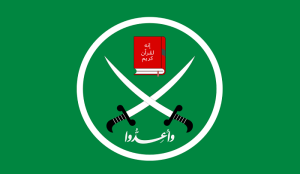 Muslim Brotherhood Flag. Photo: Public Domain, Wikimedia Commons
- How did a group carrying an ideological project that extended beyond the boundaries of the nation manage to convince all these people that it was merely a natural partner in building a democratic state? How did the smiling face that it chose succeed in concealing the true nature of its political project?
- Egypt’s military council did not seem unaware of the Brotherhood’s political vision. Rather, it appeared to see the group as an instrument that could be used to reproduce the very system that the Egyptian people had just brought to an end.
- [T]he Muslim Brotherhood… regards loyalty to itself as the most important criterion and views the state as political spoils whose institutions must be brought under its control.
- Before long… [t]he smiling face gradually disappeared, and the Brotherhood’s political objectives — which it had avoided mentioning — appeared everywhere. These included “Mastery of the World” and “The Caliphate State.” Signs on the walls of every public office stated, “Islam is the solution.” The question now was no longer whether the Brotherhood would govern the state but how far it would seek to reshape the state in its own image.
- What we wanted was a state ruled neither by a military general “protecting the nation” nor by a Supreme Guide “protecting the religion.” We wanted a state in which sovereignty belonged to a constitution, power to the citizens, public positions to those with ability and rights to everyone — without discrimination on the basis of religious belief or political allegiance.
- At the time, however, we did not realize that overthrowing the Brotherhood’s government would pave the way for the restoration of the military regime against which we had originally revolted.
- The Egyptian experience [during the 2011-2013 “Arab Spring”] revealed how a revolution against authoritarianism can become another form of authoritarianism and how an organization that raises the banner of democracy can embody the adversaries of democracy.
- What happens to democracy when power is entrusted to an organization that does not place democratic values and principles above its ideological project?
- The fall of the Ottoman Empire was part of the views at the time in which al-Banna’s project took shape. There was a desire to revive the Islamic nation and restore Islam to a central position in organizing society and the state. Consequently, treating the Brotherhood as an ordinary political party that differs from other parties only in its religion means overlooking the most important question: Is participation in elections the ultimate goal of the project, or is it one of the means that can be employed to achieve objectives that extend beyond the boundaries of the nation-state and liberal democracy?
- The real question is not whether the Brotherhood accepts the ballot box as a means of reaching power, but whether it accepts the constraints imposed by the constitution, the peaceful transfer of power, judicial independence, freedom of religion and expression, and full equality in citizenship even when these principles conflict with its ideological convictions — or whether it seeks to set about changing them to promote its vision of how it believes the world ought to be.
- The difference between rhetoric that reassures the public of moderation on one side, and an ideology that defines the organization’s ultimate objectives on the other, may not become clear until the demands of democratic governance come into conflict with the requirements of the ideological project.
- The Muslim Brotherhood’s emblem features two crossed swords, a Qur’an, and the word “Wa-a’iddu” (“And prepare”), which refers to verse 60 of Surah Al-Anfal: “And prepare against them whatever you are able of power and of steeds of war by which you may terrify the enemy of Allah and your enemy and others besides them whom you do not know [but] whom Allah knows. And whatever you spend in the cause of Allah will be fully repaid to you, and you will not be wronged.” — (Quran,8:60, Sahih International Translation)
- They mean it.
What if the Muslim Brotherhood came to power in this country or that? What would happen to the state and its institutions, to society and its freedoms, and to the democracy that enabled the Brotherhood to reach power?
I lived through the experience — and paid a price. The journey began with the dream of establishing a democratic civil state in Egypt and ended in exile, after confronting two competing projects vying for power that shared a hostility toward the civil state: the project of religious rule and the project of military rule.
Israpundit is entirely dependent on readers support. Please help me continue educating people with the truth about what is going on in Israel and around the world.

Leave a Reply
You must be logged in to post a comment.