
Right Now the US Can’t Fight a Prolonged Conflict
Stephen Bryen | Weapons & Stategy | Oct 31, 2026
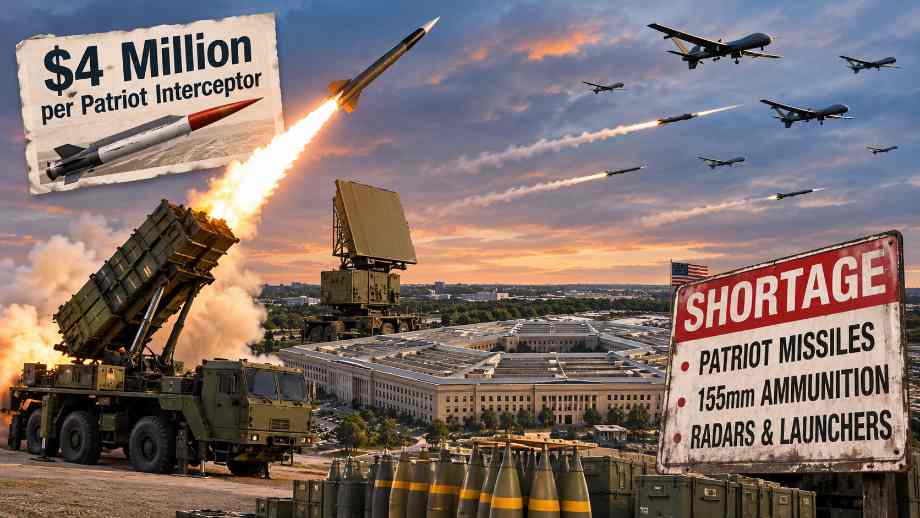 Click Image to Enlarge. Image created via AI.
The Pentagon is starting to understand that the current arsenal of traditional and precision weapons is far too small to fight any prolonged war longer than a few days. The exhaustion of key weapons such as Patriot and Himars missiles, shortages of 155mm ammunition, and lack of replacement radars and missile launch platforms, is illustration enough of the problem. The failure to protect US and allies bases adequately against a second-tier threat such as Iran, illustrates that current-day solutions don’t work.
For sure the Russians and Chinese, plus the Iranians, even the lowly Houthis, have figured out that the US and its allies face a serious problem. Today any conflict in Europe or Asia would prove devastating for the United States.
On top of everything else, American weapons have become uber-expensive and hard to manufacture. A Patriot interceptor costs almost $4 million a shot, and where two are required to knock out a single target with a high kill probability, is unaffordable.
Meanwhile America’s defense industrial base, primarily made up of five huge companies (Lockheed Martin, RTX. Northrop Grumman, General Dynamics and Boeing) where each mammoth company is actually a glued together series of acquisitions, many of which were not designed for mass production. In the more traditional category, ammunition makers, gun tube manufacturing are typically old companies that cannot significantly accelerate production.
The consolidation of America’s defense industrial base was concocted by the Pentagon to reduce overhead and speed up procurement. That got underway on July 21, 1993 when then-Secretary of Defense Les Aspin and Deputy Secretary of Defense Matthew Perry invited a dozen of the top defense companies (at the time there were 20 companies in this category) and told them that in five years time half of them had to be gone. The Defense Department just would not give them contracts. The dinner, at the Pentagon, has been dubbed The Last Supper.
The consolidation promoted by the Pentagon created 5 very large defense companies who controlled most of the top defense systems, priced their output very high and were under no pressure to speed up production, save money, or worry about competition. Foreign competitors were blocked. For example, the superior European Airbus refueling aircraft was scrapped in favor of a problematic and untested Boeing proposed refueler. Even when the UK offered a STOL platform (Harrier), the US forced a redesign and US production, jacking up the cost considerably and delaying deliveries.
The same thing happened with the US now scrapped frigate program called FFG-(X). It was based on Europe’s highly successful FREMM platform. Had the Navy not messed with it, stuffed it with incompatible US systems, and reengineered it when it didn’t need it, the US Navy would have the new frigates at sea today. In fact, it would have made good sense just to buy the ships ready-made from European shipyards. Unfortunately US laws prohibit the use of foreign hulls.
Beyond the failure to outsource, there are serious manufacturing problems at US government controlled arsenals.
A good example is the Watervliet Arsenal in upstate New York. It was founded in 1813 and manufactures the gun tubes for 155mm guns and 120mm guns for US tanks. These gun tubes wear out fairly quickly, or warp, or both, which means they have to be replaced. Watervliet can produce only 216 155mm gun tubes annually, far below the need. In Ukraine fully one third of its big guns are out of action mainly because of missing replacement gun tubes. Today Watervliet has a $900 billion backlog. It takes the Arsenal four months to produce one tube.
Watervliet is a defense “untouchable,” so any idea of funding a competitor is a non-starter. The Arsenal is government owned and government operated.
The search for a cheaper and faster way of doing things is just starting, but it will be years before there is any real reform. Despite the significant defensive failures in the Persian Gulf, where the US, with its most up to date air defense hardware, failed to protect military bases from Iran (and more recently from the Houthis), suggests that even our best “solutions” don’t work well enough.
Consider the Patriot, America’s number one air defense system. It was first deployed in 1985 and over the next forty plus years has been “evolved” in various ways. It was originally designed to shoot down enemy aircraft, like the I Hawk which it replaced.
Improvements in Patriot include the most modern intercept missile, PAC-3, introduced in 1999, better radars, and better integration with other systems, for example THAAD.
Today PAC-3 interceptors are in very short supply. During a single five-week window at the height of the conflict in the Middle East earlier this year, U.S. and allied coalition forces expended an estimated 1,700 Patriot missiles. The current US reserve is estimated at 750 missiles. Lockheed produces about 650 missiles each year, but there have been many delays including the radar seeker which Boeing produces for the PAC-3 and PAC-3 MSE interceptors.
The Pentagon just authorized a sale of 500 Patriot missiles to Ukraine, but as Ukrainian President Zelensky has noted, it will take years before they arrive.
The problem isn’t that evolved Patriots don’t work well, although some question their overall efficacy against modern ballistic missiles. The issue is their survivability under waves of attack that include everything from drones, cruise missiles and ballistic missiles. They also cost a fortune, which has stimulated the hunt for “something” cheaper.
There is no competitor to Patriot in the United States.
While the Department of War is trying to speed up production of interceptor missiles, that is not good enough. The Pentagon needs to figure out how to deal with massed swarm attacks, which likely means that far more air defense platforms are needed and lots of innovations including the use of artificial intelligence, deep networking, and multiple land, sea and air systems that can take out enemy drones, cruise and ballistic missiles.
Instead of the narrow minded “Buy America” approach which is simply a protectionist racket, sharing and distributing production is the only practical way to produce enough to fight with today. The DOW also must rethink the overhead it imposes on production and testing, because bottlenecks are not the way forward.
Our potential adversaries already know that the US is not ready to fight today except in very limited operations. This impacts not only US foreign policy but, ultimately, is a security threat.
Israpundit is entirely dependent on readers support. Please help me continue educating people with the truth about what is going on in Israel and around the world.


Leave a Reply
You must be logged in to post a comment.