
PELONI: Meanwhile Jewish expulsions across Arabia are left unaddressed by the NYT, even as this would seem to be a point of relevance to their libelous claims against Israel for Arabs choosing to leave their homes. I wrote the following many years ago, and I think it is quite relevant to the continued libels of the NYT on this subject:
“Related to this post-war policy of homogenization of nations, the Jewish expulsion from Arab nations should be called to mind. These expulsions evicted nearly a million Jews, dispossessing them of their home, property cumulatively in excess of 4X’s the size of Israel’s current borders, and at a loss of $15 trillion dollars in personal assets. This policy of Arab homogenization was most notably relevant in the Old City of Jerusalem where the Jordanian conquerors displaced the long standing residents, again, exclusively due to their Jewish heritage. Hence the double standard of policies pursuing homogenized state residents to remove the societal cleft has a much closer, and dare I say a much more relevant, model in pre- and post-’48 War Arabia, than even those to be found in Europe post-WW2 Europe.”
The Times’ embarrassing bias on display once again.
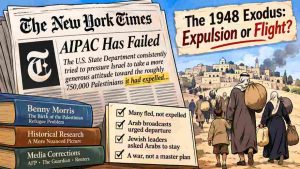 Click Image to Enlarge. Image created via AI.
by
The New York Times, like the BBC, displays its anti-Israel animus whenever it reports on the Jewish state. The latest outrage can be found here: “Incorrect Times,” by Omri Tubi, CAMERA, October 23, 2026:
The New York Times recently published an erroneous claim regarding the 1948 War and the making of the Palestinian refugee problem. In an Oct. 5, 2026, guest essay entitled “AIPAC Has Failed,” Eric Alterman writes:
The U.S. State Department consistently tried to pressure Israel to take a more generous attitude toward the roughly 750,000 Palestinians it had expelled before and during its war of independence — what Palestinians call the Nakba, or “catastrophe.” [Emphasis Added]
That all 750,000 Palestinians were expelled, as opposed to fled, is a false claim. Many researchers, including both Israeli and Palestinian historians, have demonstrated this. Moreover, multiple media outlets, including Agence France Presse, Guardianand Reuters Arabic have previously corrected the identical error.
Benny Morris, a top historian on the subject, notes that the refugee problem was created out of war, not out of some grand Israeli master plan. There were some limited expulsions of Arabs by Israeli forces, but many Arabs fled out of fear and uncertainty that war causes. Aside from Israeli actions and intentions, Morris writes:
It is also worth remembering that a large proportion of those [Palestinians] who became refugees fled their towns and villages not under direct Israeli threat or duress. Tens of thousands – mostly from well-to-do and elite families – left the towns in the war’s early months because of the withdrawal of the British administration, the war-filled chaos that followed and the prospect of Jewish rule. And, in the following months, hundreds of thousands fled not under Jewish orders or direct coercion though, to be sure, most sought to move out of harm’s way as Zionist troops conquered town after town and district after district. And most probably believed that they would be returning home in a matter of months if not weeks, perhaps after the Arab armies had crushed Israel.
Morris’ work is highly influential and other historians have echoed it….
The main reason most of the Arabs left Mandatory Palestine beginning in late 1947 and then, after May 14, 1948, was that Arab broadcasts from abroad called upon them to do so. The Arabs assumed that their victory over the despised Jews would be quick, and wanted the Arabs in Palestine to leave, to get out of the way of the fighting, so that they could then return alongside the victorious Arab armies, to reclaim not just their own property, but that of the Jews who would either have been killed or have fled. The first secretary-general of the Arab League, Abdul Rahman Azzam (Azzam Pasha), an Egyptian diplomat, famously predicted in the Egyptian daily Akbar al-Yom, in October 1947, that the establishment of a Jewish state would lead to “a war of extermination and momentous massacre which will be spoken of like the Mongolian massacre and the Crusades.”
When war broke out on May 15, 1948, a day after the state of Israel declared its independence, and five Arab armies invaded to snuff out the life of the nascent Jewish state, the broadcasts from Arab states intensified, telling the Arabs “in Palestine” to “get out so that we can get in.” Poorer Arabs saw the better off Arabs leaving, secure in the belief that they would soon be returning, and followed suit.
Some Israelis had, in anticipation of such flight, urged the Arabs to stay — a fact that the New York Times does not mention. The mayor of Haifa, Shabtai Levy, went on the air on April 22 (before the full-scale war began), and asked the Arabs in his city to remain. He then met with Arab notables, some of them his friends, and tearfully begged them to stay, assuring them that they would be secure.
Another Israeli leader who asked the Arabs not to leave was Golda Meir, who later reminisced: “Ben-Gurion called me in and said: ‘I want you to go to Haifa at once and see to it that the Arabs who remain in Haifa are treated properly. I also want you to try to persuade those Arabs on the beach to come back. You must get it into their heads that they have nothing to fear.’ So I went immediately. I sat there on the beach and I BEGGED them to return to their homes. But they had only one answer. ‘We know that there is nothing to fear but we have to go. We’ll be back.’ I was quite sure that they went not because they were frightened of us but because they were terrified of being considered traitors to the Arab ‘cause.’”
Why did the New York Times not quote Azzam Pasha’s prediction of a “war of extermination” or from any of the Arabs who explained that they broadcasts from Arabs outside Palestine/Israel, or the assurances of Arab military men in the area, had encouraged to leave “Palestine” for a short while, and then to return after the war was inevitably won and the Jews crushed? Why did it not mention that Bishop Hakim of Galilee, an Arab, confirmed to Rev. Karl Baehr, Executive Secretary of the American Christian Palestine Committee, that the Arabs of Haifa “fled in spite of the fact that the Jewish authorities had guaranteed their safety and rights as citizens of Israel”? A report by the Haifa District headquarters of the British Palestine Police sent to police headquarters in Jerusalem included this: “Every effort is being made by the Jews to persuade the Arab populace to stay and carry on with their normal lives.”
Not a syllable of any of this — the Arab effort to persuade the Arabs of Palestine to leave, the Jewish effort to get them to stay — was included in the New York Times report about what the paper calls the “expulsion of 750,000 Arabs” in 1948. Now why, I wonder, is that?
Israpundit is entirely dependent on readers support. Please help me continue educating people with the truth about what is going on in Israel and around the world.


Leave a Reply
You must be logged in to post a comment.