
If Hollywood were ever forced into an interrogation room of its own, its confession would be brief and damning
Harry Liberman
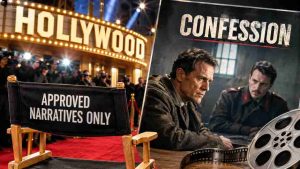 Click Image to Enlarge. Image created via AI.
We care more about keeping our place at the table than telling the truth, and if you are openly conservative—or “too Jewish”—you are not invited.
For years, mainstream Hollywood has operated under an unspoken cultural consensus: stay within approved political boundaries, or risk quiet exile from major studio projects. Behind the red-carpet speeches and practiced moral outrage lies a remarkably simple fear—the terror of losing work, awards, and status. The narcissism and hypocrisy on display in modern entertainment would be comical if the cultural consequences were not so damaging. Celebrities who routinely lecture the public about bravery and speaking truth to power are, in reality, terrified of stepping a millimeter outside approved progressive talking points lest their phone stop ringing.
Yet the release of Confession—the Stalin-era prison drama written by conservative commentator Ben Shapiro and premiering on The Daily Wire—exposes a striking paradox at the heart of modern entertainment. While legacy studios routinely sideline openly conservative voices and themes, an alternative media ecosystem can now attract Academy Award-nominated talent to tell stories the mainstream industry refuses to touch. [1, 2]
Directed by Czech filmmaker Václav Marhoul, Confession takes place in 1938 Moscow inside the notorious Lubyanka Prison, where a disillusioned literature professor (Rob Lowe) is brutally interrogated by his former student (James Franco) over his ties to a dissident priest. Around them stands a remarkably seasoned ensemble—including Jennifer Jason Leigh, Nick Nolte, Brad Dourif, Kodi Smit-McPhee, Emile Hirsch, and Dean Norris. The film’s existence and cast challenge the long-standing Hollywood narrative that right-of-center productions are doomed to remain amateurish fringe affairs. [1, 2, 3, 4]
More importantly, the reaction to Confession highlights how ideological gatekeeping actually functions in the entertainment industry. Censorship in modern Hollywood rarely arrives as a formal government ban; instead, it operates through financial exclusion, distribution bottlenecks, and social stigma.
Traditional studios and major awards bodies overwhelmingly greenlight and celebrate projects that flatter progressive orthodoxies, leaving religious, anti-totalitarian, or traditionally moralistic scripts stranded without backing. Conservative artists—and actors who have fallen out of favor with Hollywood’s cultural arbiters—often find doors quietly closed long before an audience ever gets a chance to judge their work. [1, 2]
The deepest irony of Hollywood’s newfound enthusiasm for ideological exclusion is its own origin story.
The American film industry was built in the early twentieth century largely by Jewish immigrants who had been systematically locked out of mainstream East Coast finance, law, and high society. Confronting an establishment defined by unspoken quotas and ugly exclusionary signs—the era of “No Blacks, No Jews, No Dogs”—those pioneers headed west to create an industry where outsiders could tell universal stories without asking permission from entrenched gatekeepers. [1, 2]
Even more striking is how Hollywood’s own Golden Age cinema testifies against today’s fashionable progressive rewrites of history.
In classic epics like Ben-Hur, Samson and Delilah, and The Ten Commandments, there are no depictions of ancient “Roman-Palestinian wars” or an Exodus into a modern Palestinian state—because the historical record set on screen was unmistakably the story of the Jewish people in ancient Judea and the Land of Israel, resisting imperial powers from Egypt to Rome. Those films were set in the ancestral homeland of the Jews, not Europe, underscoring a historical truth today’s campus and Hollywood activists desperately try to erase: Jews are indigenous to Judea, not European colonizers, and you cannot take Judea out of the Jew. [1, 2]
Yet even as Hollywood grew into a cultural powerhouse, the temptation to assimilate at the expense of identity never disappeared.
In 1952, when director Cecil B. DeMille approached Paramount’s board of directors—many of whom were Jewish executives—to back his epic remake of The Ten Commandments, the board initially rejected the project.
Despite DeMille’s unmatched track record of box-office hits, executives hesitated to back an overtly biblical, unapologetically Jewish story of liberation so soon after the Holocaust and the founding of Israel, relenting only after studio founder Adolph Zukor shamed them into recognizing the moral weight of the story. DeMille—whose mother came from a prominent English Jewish family and whose cousin, First Viscount Herbert Samuel, served as the first British High Commissioner of Mandate Palestine—poured everything he had into bringing the Exodus story to life.
While filming on location in Egypt in November 1954, the 73-year-old director suffered a massive heart attack after climbing a 107-foot ladder to oversee the set, yet he defied his doctors and returned to directing almost immediately so the film would not be halted. In the film itself, DeMille captured the exact tragedy of assimilationist betrayal through Edward G. Robinson’s character, Dathan—the Hebrew overseer who betrays Moses and schemes to return to Egypt simply to stay in the good graces of Pharaoh’s ruling elite. [1, 2, 3]
Today, Cecil B. DeMille would surely be rolling in his grave watching an industry hand out the prestigious Cecil B. DeMille Award at the Golden Globes while practicing the very conformity he fought against—seemingly oblivious to the fact that the award’s namesake was a devout Christian Zionist, a staunch anti-communist, and a lifelong conservative Republican who deeply revered Judaism and the Jewish people.
When Meryl Streep accepted the award in 2017, she turned the stage into a political lecture attacking Donald Trump over his 2015 rally dispute with New York Times journalist Serge Kovaleski.
What Hollywood’s applause line conveniently erased was the substance of the reporting at the center of that clash: a September 18, 2001 Washington Post article co-authored by Kovaleski himself, which reported that law enforcement authorities in northern New Jersey—including [Little Ramallah]the Paterson area—had detained and questioned individuals allegedly seen celebrating the 9/11 attacks on rooftops across the river from Manhattan, mirroring the street celebrations captured on camera in Ramallah and East Jerusalem. Rather than engaging with what Kovaleski’s own 2001 dispatch actually documented about those individuals, Hollywood reduced the entire controversy to an emotional talking point designed to enforce progressive orthodoxy. [1]
A century after its founding, Hollywood’s cultural elite has erected a velvet rope every bit as rigid as the ones its founders fled—now turning that exclusion against fellow Jews and conservatives like Ben Shapiro who refuse to bend the knee.
For many in modern entertainment, leftism has become a secular religion above all else, demanding total ideological compliance. Yet history—from the six million murdered in the Holocaust to the atrocities of October 7—stands as a stark reminder that Judaism is not merely a set of opinions that can be traded away for acceptance by fashionable elites; it is an enduring people hood and identity that no amount of assimilation can erase.
At the same time, the willingness of mainstream actors to sign onto a Daily Wire production reveals a quiet rebellion against industry conformity.
Many working artists care far more about compelling material, steady work, and creative freedom than about passing ideological litmus tests. By bypassing traditional studio gatekeepers entirely—releasing Confession through a coordinated 100-theater members-only eventalongside direct-to-subscriber streaming—independent platforms are proving that they no longer need Hollywood’s permission to assemble top-tier talent or reach millions of viewers. [1, 2]
Ultimately, the lesson of Confession is not that mainstream critics will suddenly abandon their hostility toward conservative creators—early trade reviews have been predictably sharp. Rather, it is that Hollywood’s monopoly on cultural legitimacy is eroding.
Just as Cecil B. DeMille once forced a hesitant studio establishment to bring the story of Exodus to the screen, today’s exiled artists are proving that when major studios prioritize ideological alignment over diverse storytelling, they do not silence dissenting voices; they simply drive talent and audiences to build thriving stages of their own. [1, 2]
Israpundit is entirely dependent on readers support. Please help me continue educating people with the truth about what is going on in Israel and around the world.


Leave a Reply
You must be logged in to post a comment.