
Harry Liberman
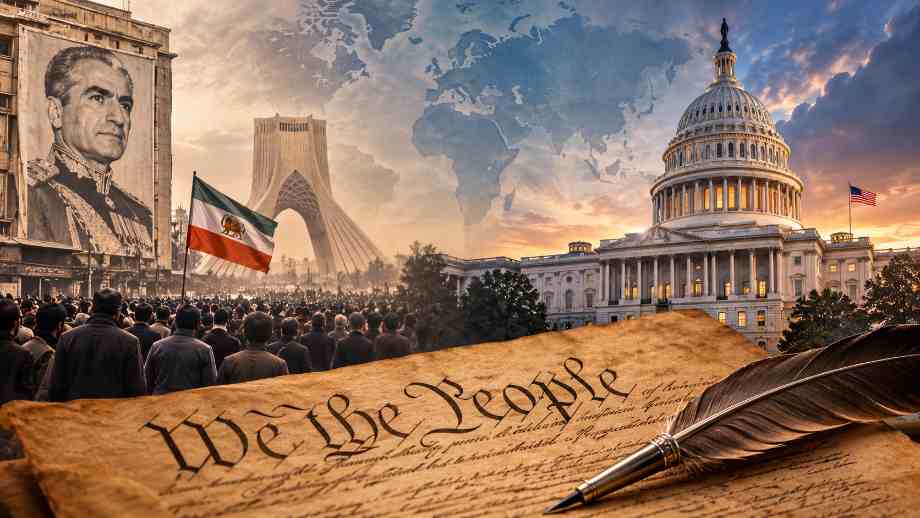 Click Image to Enlarge. Image created via AI.
History rarely repeats itself word for word, yet it often rhymes in ways that demand urgent national reflection.
Looking back at the fall of Iran in 1979, the warning signs were unmistakable: a prosperous, Western-aligned nation took its social freedoms for granted while a tactical coalition of secular Marxists and radical Islamists united to dismantle the state from within. Once the Shah was gone, the clerical regime swiftly turned on its leftist enablers, executing the very Marxists who helped bring it to power. Today, as the United States navigates profound cultural, institutional, and geopolitical turmoil, millions of Americans are asking whether their own republic is following a dangerously similar trajectory.
At the heart of this debate is how a nation remembers its past and guards its institutions.
The Democratic Party has spent decades capturing elite universities and cultural centers to reshape historical narratives. The party of the 19th and early 20th centuries—which enforced Jim Crow segregation in the South and saw progressive figures like Margaret Sanger embrace the era’s eugenics movement—eventually reinvented itself, winning over the very minority communities those policies harmed. This ideological evolution did not abandon authoritarian impulses; rather, it channeled them into a modern progressive movement willing to align with anti-Western forces under the banner of a “Red-Green Alliance.”
In truth, the street protests engulfing Western campuses and cities are not genuinely about Palestine or even Israel.
Israel is merely the small fish used as bait to rally the masses; the true target—the big fish—is the United States. The vast majority of these activists are historically and geographically illiterate regarding the Middle East, unable to name the rivers, seas, or governing realities of the region they claim to champion. Instead, “Palestine” has been engineered into an all-purpose symbol of revolution designed to unite every grievance-driven and insulated sector of Western society.
It brings together the self-declared disenfranchised, LGBTQ activists marching for regimes that would execute them, hardcore Marxists, economically insulated trust-fund radicals, and the Hollywood elite. That historical illiteracy is overshadowed only by what evolutionary behavioral scientist Dr. Gad Saad terms suicidal empathy—a self-destructive pathology in which Western societies prioritize performative compassion for their adversaries over their own civilizational survival. Both Marxists and Islamists counted on this exact psychological weakness, executing a decades-long strategy that turns useful idiots into battering rams against the West.
Behind this ideological subversion lies a broader geopolitical axis.
Communist China acts as the tip of the spear driving the systematic weakening of American power, working in tandem with an American-funded United Nations that routinely betrays the very nation that bankrolls it. While Beijing installs loyalists in key international agencies and bankrolls anti-Western initiatives to erode U.S. sovereignty, UN bodies consistently amplify the propaganda of authoritarian regimes and terrorist proxies—using the Jewish state as a convenient scapegoat while targeting the constitutional order of the United States.
Foreign policy decisions over the past half-century provide the sharpest evidence of how Washington enabled this erosion—and why America has proven to be a fundamentally unreliable ally.
Washington did not back Israel out of timeless moral principle; the United States only fully embraced the Jewish state in 1967 when the Soviet Union secured a stranglehold over Arab oil and regional client states, making Israel a convenient Cold War necessity. Ever since, Israel has been forced to contort its national security around the whiplash of American politics, adapting every four years to the shifting demands of each U.S. election cycle. Ultimately, breaking free from the strings of American aid—ending the dependency on the Memorandum of Understanding—is a strategic victory for Israel, freeing the Jewish state to act decisively and independently in its own defense.
That same pattern of Washington’s unreliability played out catastrophically in Iran.
During the Cold War, the U.S.-Iran strategic partnership under the Nixon Doctrine served as a vital bulwark against Soviet expansion and a cornerstone of Middle Eastern stability. Yet the Democratic administration under President Jimmy Carter dismantled that alliance through relentless human rights pressure and mixed diplomatic signals, undermining the Shah and creating the power vacuum that enabled Ayatollah Khomeini’s 1979 takeover. At a time when Khomeini had become too dangerous for neighboring Arab states—getting expelled from Iraq after years of hosting his agitation and denied refuge by Kuwait—it was France, a nation steeped in socialist politics that was simultaneously willing to construct the weapons-grade Osirak nuclear reactor for Saddam Hussein’s Iraq, that gave Khomeini a safe haven outside Paris to orchestrate his revolution. Decades later, the Obama administration repeated Carter’s error with the 2015 Joint Comprehensive Plan of Action—ignoring the lessons of the failed 1994 Agreed Framework with North Korea by releasing billions in frozen assets to Tehran. Providing financial lifelines to the Iranian regime, alongside leniency toward anti-American regimes in Venezuela and Cuba, represents a deliberate weakening of Western deterrence.
This ideological blind spot becomes even starker when examining the human cost of the Iranian regime’s extremism—a dark reality explored in analyses of Ahmadinejad’s demons.
Driven by apocalyptic messianism and fierce hostility toward the West, former Iranian President Mahmoud Ahmadinejad openly denied the Holocaust and called for the erasure of Israel, viewing global chaos as a catalyst for religious destiny. That same fanatical worldview has long relied on the systemic exploitation of the innocent. During the Iran-Iraq War, the regime mobilized tens of thousands of children through the Basij paramilitary force, sending youths as young as twelve into human-wave assaults and across active minefields—a tactic documented by human rights organizations and revived in 2026 IRGC recruitment campaigns.
Hamas—an Iranian-backed proxy—employs the exact same playbook in Gaza.
Through militarized summer camps, altered school curricula, and the embedding of military infrastructure beneath schools and hospitals, Hamas systematically indoctrinates youths and places Palestinian children directly in harm’s way. Yet, when Israel exercises its right to self-defense against these tactics, an international propaganda apparatus immediately condemns the Jewish state for the resulting casualties, effectively rewarding terrorists for using their own youth as shields. This moral inversion exposes a profound selective outrage: the same political establishment that remained largely silent while Iranian children were sacrificed in the 1980s, and that overlooks ongoing atrocities against children in Sudan, the Democratic Republic of the Congo, and gang-plagued neighborhoods of Chicago, weaponizes humanitarian rhetoric solely when it serves an anti-Western narrative.
Now, the turning point has arrived on American soil.
Following the November 2026 midterm elections, a wave of progressive and Islamist-aligned candidates has secured unprecedented institutional power from Texas to Michigan and New York—delivering historic congressional and Senate victories while elevating ideological allies into the halls of power in Washington. This transformation is unfolding in plain sight, obscured by a complicit legacy media that dismisses legitimate constitutional warnings while amplifying partisan narratives. One need only look across the Atlantic to see where this trajectory leads: Paris is burningamid relentless street unrest fueled by far-left and Islamist agitators; London has become a financial hub for laundering Iranian regime money and evading Western sanctions; and even the United Arab Emirates has cut British universities from its state scholarship lists, refusing to send its own students to the United Kingdom out of fear that unchecked campus extremism will radicalize them into terrorists.
Domestically, unchecked mass migration and porous borders—contrasted sharply with the rapid border enforcement seen under the Trump administration—further strain national cohesion and constitutional norms. Americans face a stark binary choice: preserve the individual liberty, national sovereignty, and free enterprise that define the American experiment, or slide toward the institutional capture and ideological conformity that doomed pre-1979 Iran.
Understanding how we arrived at this crossroads requires stripping away decades of historical revisionism.
In pre-1979 Iran, the Shah had to strictly enforce the rule of law because he recognized the imminent, existential threat posed by radical extremists and foreign subversion. With British and French interests deeply entrenched in Iranian oil, the Shah sought to build a genuinely independent, sovereign, and modern Iran—ultimately taking control of foreign oil operations to free his nation from the lingering grip of the British Empire, a reality deliberately distorted by Western commentators who excused his overthrow. Just as history was rewritten to vilify the Shah, the Democratic Party has mastered the art of ideological camouflage. The party of Jim Crow anti-Black and anti-Jewish racism has not reformed; it remains the exact same movement today, acting as political chameleons that shift their rhetoric to capture new voting blocs while preserving their core hostility toward individual liberty and Western civilization. While mainstream historians and international observers continue to debate the complex factors behind Iran’s internal unrest, 20th-century U.S. party realignments, and United Nations reporting on modern conflicts in Gaza, Sudan, and the Congo, the underlying pattern of ideological subversion remains unmistakable.
Ultimately, whether one views modern America through the lens of an impending ideological crisis or as a resilient constitutional republic navigating fierce partisan conflict, the core lesson of 1979 remains valid. Free societies do not survive on autopilot.
As Benjamin Franklin warned at the founding of the United States, a republic endures only so long as its citizens possess the vigilance, historical clarity, and civic courage to keep it.
Israpundit is entirely dependent on readers support. Please help me continue educating people with the truth about what is going on in Israel and around the world.


Leave a Reply
You must be logged in to post a comment.