
Egypt’s terrorism listing of European Islamic groups revives questions about Muslim Brotherhood ties, and about what new outlets leave out.
By Joe Truzman | Honest Reporting | November 12, 2026
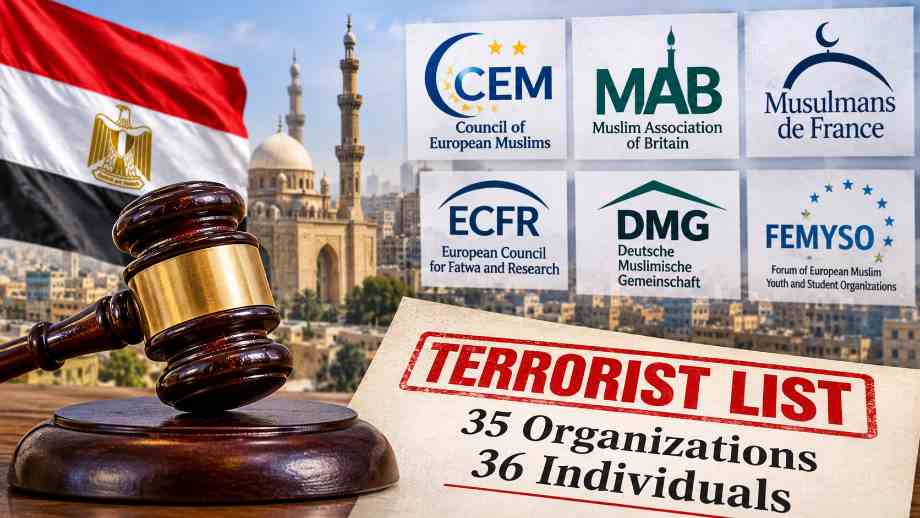 Click Image to Enlarge. Image created via AI.
On November, 10, a Cairo criminal court placed 35 Europe-based Islamic organizations and 36 individuals on Egypt’s terrorism lists for five years, one day after Egypt published the Muslim Brotherhood’s permanent listing.
The list names the Council of European Muslims (CEM) and its branches, including Musulmans de France, the Muslim Association of Britain (MAB), the European Council for Fatwa and Research and the German Islamic Community. The latter is now known as the German Muslim Community (DMG). Those listed also include Anas Altikriti, who heads London’s Cordoba Foundation.
The list also names the “European Islamic Students Forum,” which Egyptian outlet Al Bawaba identifies as the Forum of European Muslim Youth and Student Organizations (FEMYSO).
The Egyptian designation does not automatically make these organizations illegal in Britain or elsewhere in Europe. Those listed can reportedly challenge the decision within 60 days of publication. Altikriti told The New Arab he received no explanation or supporting evidence. MAB denies affiliation with the Brotherhood.
Other governments have looked into some of these organizations’ Brotherhood connections. A British government review, published in 2015 and based on material up to July 2014, found that the Brotherhood had for years “dominated” MAB. It said MAB was connected to the Federation of Islamic Organizations in Europe, which it said the Brotherhood started in 1989. The federation later became CEM.
A 2025 French government report identified Musulmans de France as the Brotherhood’s national branch, a claim the group rejects. On October 8, the European Parliament adopted a resolution by a vote of 381 to 167, with 15 abstentions. It asked the Council of the EU to include Brotherhood-linked entities and individuals on the EU terrorist list if they meet the legal criteria. It also told EU institutions to exclude CEM-linked organizations. The resolution is nonbinding.
The media footprint
The Guardian shows how outlets can omit relevant context. An October 15 opinion column quoted the president of the Forum of European Muslim Youth and Student Organizations (FEMYSO), describing it as a pan-European network of young Muslim organizations. It dismissed French concerns about “Islamist entryism” as “conspiracy theories.” The column acknowledged that FEMYSO was named in the European Parliament’s October 8 resolution on countering Islamist entryism and Muslim Brotherhood influence. It called the allegations unfounded without explaining the specific organizational ties alleged or the resolution’s demand to exclude FEMYSO from EU institutions.
The French government report describes FEMYSO as CEM’s youth arm. The European Parliament’s record explicitly names FEMYSO among the CEM-linked organizations it wants excluded. FEMYSO denies Brotherhood links and says it has never belonged to CEM.
In August, ITV News reported that an Emirati-funded mercenary surveilled Altikriti in London. ITV noted his family’s Brotherhood connections and quoted his favorable assessment of the movement’s ideology. But it described MAB as mainstream and cited the 2015 review’s finding on the absence of evidence of Brotherhood terrorist activity in Britain without mentioning its conclusion about MAB.
An August 21 Middle East Eye column by Peter Oborne described Altikriti as a “London-based analyst” in its subheading. The article identified him as the Cordoba Foundation’s chief executive and discussed the UAE’s terrorism designation of the foundation, but never mentioned the Muslim Brotherhood.
The American connection
These organizations also maintain contacts with American Muslim groups. The U.S. Council of Muslim Organizations, whose founding members include the Council on American-Islamic Relations (CAIR), invited CEM, Musulmans de France, MAB and DMG to a past conference of Western Muslim councils. The invitation documents outreach; it does not establish attendance. The United Arab Emirates listed CAIR alongside MAB in 2014.
FEMYSO’s website lists CAIR among its civil-society partners, alongside Amnesty International. In March 2024, CAIR and FEMYSO endorsed a broader coalition declaration singling out Israel, India, China and France for anti-Muslim policies.
MAB co-organized May’s Nakba march in London and backs The Muslim Vote. In Florida, state designations of CAIR and its Florida chapter as domestic terrorist organizations took effect November 5 after a federal judge declined to block them pending litigation. The court granted limited protection for legal services provided to the groups; the ruling did not resolve the lawsuit. CAIR and its Florida chapter suspended operations in the state, rejected the designations as baseless and announced plans to appeal.
The standard
Journalists need not adopt Cairo’s verdict. They should distinguish terrorism designations from government assessments of ideological or organizational ties, and report the groups’ denials. But those distinctions are a reason to explain the evidence precisely, not to leave relevant findings out. Readers deserve that context when outlets quote these organizations’ representatives.
© Divuach Ne’eman R”A, 2025
Israpundit is entirely dependent on readers support. Please help me continue educating people with the truth about what is going on in Israel and around the world.

Leave a Reply
You must be logged in to post a comment.