
Harry Liberman
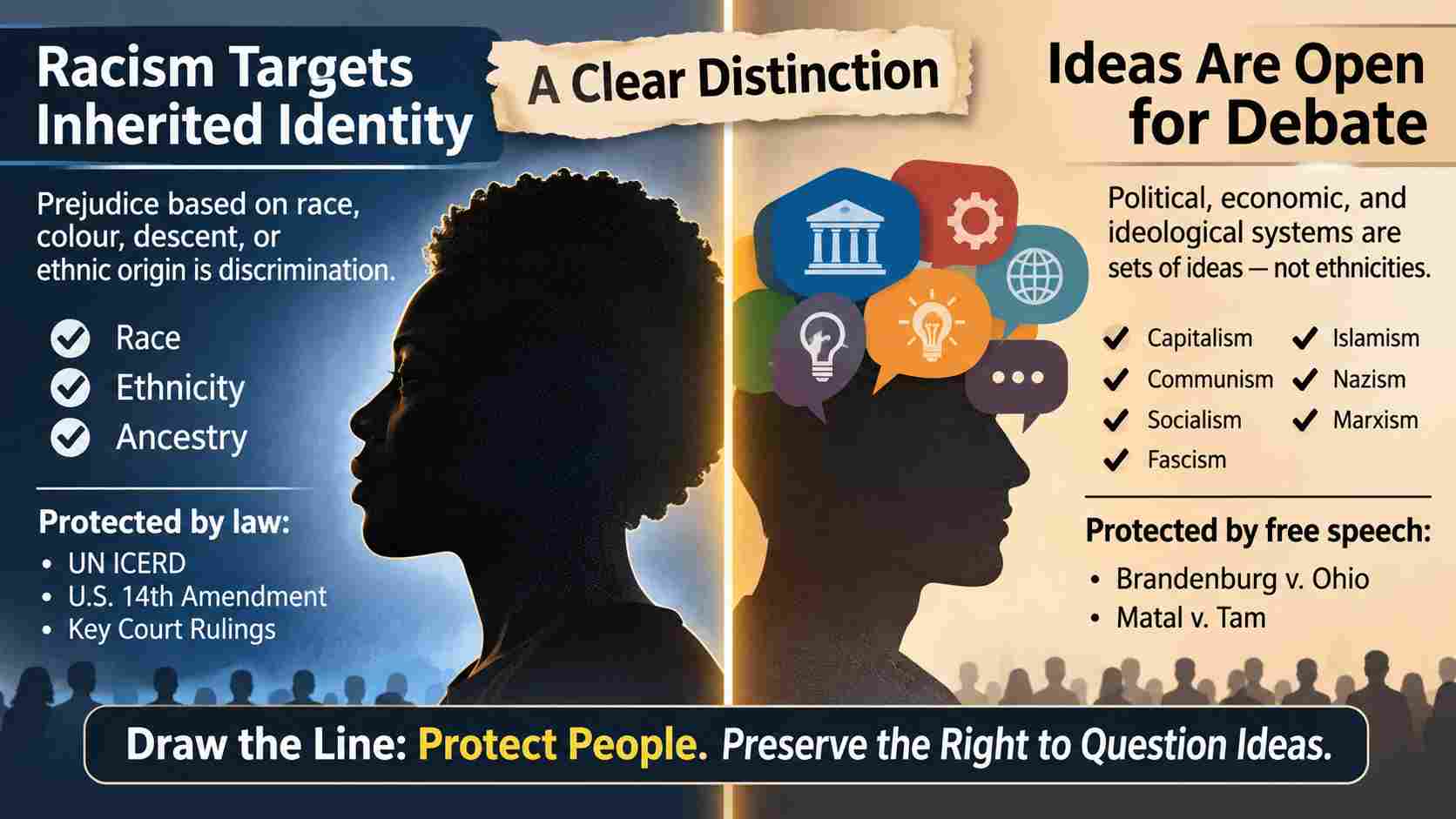 Click Image to Enlarge. Image created via AI.
In public discourse, the word “racism” is frequently stretched to cover any sharp disagreement over beliefs, politics, or culture.
Yet a clear, objective definition requires drawing a firm line between who a person is by birth and what a person chooses to believe.In linguistics, this is the broad term for how the meaning of a word changes over time. When done intentionally to reshape how people think about an issue, it is often called semantic engineering or linguistic engineering.
At its core, international human rights law—such as the UN International Convention on the Elimination of All Forms of Racial Discrimination (ICERD)—defines racial discrimination as prejudice or exclusion based on race, colour, descent, or national or ethnic origin. Under U.S. constitutional law, including the 14th Amendment’s Equal Protection Clause, courts treat race and ancestry as suspect classifications, meaning Black people are protected because race is an inherited, immutable trait.
Similarly, in the landmark 1987 ruling Shaare Tefila Congregation v. Cobb, the U.S. Supreme Court unanimously held that Jewish people are protected under federal racial discrimination statutes because Judaism encompasses a shared ancestral and ethnic identity, a principle also enforced under Title VI by the U.S. Department of Education’s Office for Civil Rights.
Attacking someone for being Black or Jewish targets an inherited identity, which is why the law treats such prejudice as racial or ethnic discrimination. By contrast, political, economic, and ideological systems are sets of ideas, not ethnicities.
Capitalism, Communism, Marxism, Socialism, Fascism,,Islamism and Nazism are frameworks for organizing power and society.
Because ideas do not have DNA, they are—and must remain—entirely open to rigorous debate, scrutiny, and rejection under constitutional free speech protections affirmed in cases like Brandenburg v. Ohio and Matal v. Tam. Calling a critique of Marxism or Capitalism, Islam or Christianity “racist” confuses an argument over policy with an attack on human beings.
This distinction becomes especially clear when examining the term “Islamophobia.”
While discrimination against individual Muslims or people of Arab descent—recognized under ancestry protections in Saint Francis College v. Al-Khazraji—is rightly barred under federal civil rights statutes, Islam itself is a universalizing religion practiced across every race and continent, not a single ethnicity. As civil liberties advocates such as the Free Speech Union have argued, framing “Islamophobia” as a form of racism turns a political and ideological construct into a de facto blasphemy shield, insulating religious doctrines and political Islamism from legitimate critique.
Moreover, classifying criticism of Islamic governance or theology as “racism” collapses under real-world evidence.
According to the UN Refugee Agency (UNHCR), millions of displaced people globally originate from Muslim-majority nations such as Syria, Afghanistan, and Sudan. Many of these refugees—including women, religious dissenters, and political minorities—flee theocratic regimes and Islamist persecution in fear for their lives, seeking safety in secular democracies precisely so they can live free from strict religious enforcement.
Labeling criticism of those very ideologies “racist” ignores the lived reality of the people risking everything to escape them.
A healthy democracy depends on maintaining both principles simultaneously: fiercely protecting individuals from discrimination based on their race and ethnicity, while preserving the absolute freedom to challenge, debate, and criticize every ideology and belief system without fear of being labeled a racist.
Quoting Christopher Hitchens
Hitchens repeatedly warned—both in speeches and in his essays—that the term “Islamophobia” was being used to equate ideological criticism of Islam with racism and to take away the right to criticize religion: [1, 2, 3]
From his 2009 speech on free speech (widely circulated online):
“This is very urgent business, ladies and gentlemen. I beseech you: resist it while you still can… before the right to complain is taken away from you, which will be the next thing. You will be told you can’t complain because you’re Islamophobic. The term is already being introduced into the culture as if it was an accusation of race hatred, for example, or bigotry, whereas it’s only the objection to the preachings of a very extreme and absolutist religion.”[1, 2]
From his August 2010 Slate essay, “A Test of Tolerance”:
“This is why the fake term ‘Islamophobia’ is so dangerous: It insinuates that any reservations about Islam must ipso facto be ‘phobic.’ A phobia is an irrational fear or dislike.”[1] On equating religious criticism with racism (cited in The Nation):Hitchens described “Islamophobia” as a “stupid neologism” that “aims to promote criticism of Islam to the gallery of special offenses associated with racism.”[1]
(Note: Another viral quote often attributed to Hitchens—”Islamophobia: a word created by fascists, and used by cowards, to manipulate morons”—was actually written by Twitter user Andrew Cummins, though Hitchens’s verified quotes above express a very similar warning.) [1, 2]
This is very urgent business, ladies and gentlemen. I beseech you: resist it while you still can… before the right to complain is taken away from you, which will be the next thing. You will be told you can’t complain because you’re Islamophobic. The term is already being introduced into the culture as if it was an accusation of race hatred, for example, or bigotry, whereas it’s only the objection to the preachings of a very extreme and absolutist religion.”
Historical Examples of Semantic Engineering by Tyrannies
- Soviet Union (Communism): Under Joseph Stalin, the regime created an official ideological language (studied by philologists as Novoyaz) that inverted standard meanings. Forced labor camps were labeled “corrective labor,” brutal political purges were called “cleansing,” and state censorship was framed as protecting “people’s democracy” and “truth” (Pravda). Anyone opposing the regime was labeled an “enemy of the people” or “anti-Soviet,” turning political disagreement into a crime against society itself.
- Nazi Germany (Fascism/Nazism): As documented by Jewish-German philologist Victor Klemperer in Lingua Tertii Imperii (The Language of the Third Reich), the Nazi regime systematically altered German vocabulary to normalize persecution and genocide. Mass deportations and extermination were disguised as “resettlement” or the “Final Solution,” aggressive invasions were framed as “self-defense,” and political imprisonment was termed “protective custody.”
- Maoist China (Communism): During the Cultural Revolution, the Chinese Communist Party redefined traditional concepts of family, law, and morality as “feudal” or “counter-revolutionary.” Brutal public humiliations and beatings were called “struggle sessions,” forced ideological indoctrination was termed “re-education,” and total state control was celebrated as “liberation.”
- George Orwell’s 1984 (Literary Synthesis): Drawing directly from the Soviet and Nazi regimes, George Orwell coined the term “Newspeak” to describe how tyrannies shrink and alter vocabulary to make independent thought impossible. In 1984, the regime enforced slogans like “War is Peace,” “Freedom is Slavery,” and “Ignorance is Strength” to demonstrate how controlling definitions allows a state to control reality.
Why Tyrannies Target Language
- Eliminating Vocabulary for Dissent: By redefining words so that criticism of an ideology equals treason, bigotry, or insanity, regimes remove the linguistic tools citizens need to articulate opposition.
- Moral Inversion: By attaching positive or protective words (such as “safety,” “liberation,” or “anti-hate”) to censorship and coercion, tyrannies make state control appear virtuous.
Israpundit is entirely dependent on readers support. Please help me continue educating people with the truth about what is going on in Israel and around the world.


Why is it that DEI is demanded in some areas, but in sports (i.e. NBA and NFL) are overloaded with one race vs another and that is OK?