
Former Prime Minister Naftali Bennett holds unannounced meeting with Prime Minister Netanyahu, as officials from anti-Netanyahu bloc say Bennett is set on forming a national unity government.
By World Israel News Staff | World Israel News | Nov 18, 2026
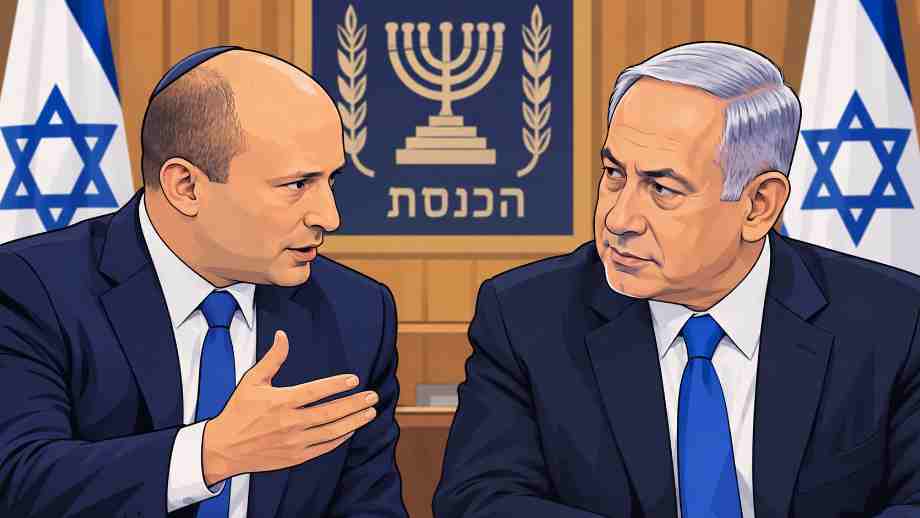 Click Image to Enlarge. Image created via AI.
Former Prime Minister Naftali Bennett met with Prime Minister Benjamin Netanyahu at the Knesset on Wednesday without notifying Gadi Eisenkot, triggering accusations within the bloc seeking to replace Netanyahu that Bennett is attempting to steer its members toward a national unity government.
The meeting took place shortly after noon, approximately an hour before Bennett was scheduled to attend a gathering of the leaders of the change bloc, which includes Eisenkot’s Yashar party, Bennett’s Together faction, Avigdor Liberman’s Yisrael Beytenu and Yair Golan’s Democrats.
Likud confirmed the meeting shortly after journalists filmed Bennett entering Netanyahu’s office, describing it as a security briefing rather than political negotiations.
“Prime Minister Benjamin Netanyahu and Together chairman Naftali Bennett are currently meeting for a security briefing at the Knesset,” the party said in a statement.
However, the meeting’s timing and Bennett’s failure to inform Eisenkot raised suspicions among his political allies, particularly following reports that the former prime minister has been privately advocating a unity government involving Netanyahu.
Eisenkot’s spokesperson confirmed to The Jerusalem Post that the Yashar chairman had not been informed of the meeting in advance.
The gathering of change bloc leaders, originally scheduled for 1:30 p.m., was subsequently postponed until 3 p.m.
According to a report by journalist Ili Zilberberg, senior figures in the change bloc believe Bennett has become determined to establish a unity government with Netanyahu despite campaigning against his continued leadership.
One senior figure compared Bennett to Idit Silman, whose departure from Bennett’s governing coalition in 2022 helped bring down his government.
“It seems that this time, the Silman of the change bloc is Naftali Bennett himself,” the official said.
The criticism reflects growing fears that Bennett could undermine the bloc’s efforts to replace Netanyahu by insisting on an agreement with Likud rather than pursuing a government supported by the ultra-Orthodox or Arab parties.
Political commentator Chaim Levinson was similarly critical, writing: “In short, Bennett is dismantling the change bloc and giving Bibi another election.”
The meeting was the first between Bennett and Netanyahu in nearly five and a half years, since Bennett replaced Netanyahu as prime minister in June 2021.
Israeli media reported that National Security Council head Shmuel Ben Ezra participated in the discussion, while Netanyahu’s military secretary, Maj. Gen. Guy Markizano, joined approximately 20 minutes after it began.
No details of the conversation were released, and there was no confirmation that the two leaders discussed coalition arrangements.
Nevertheless, Bennett has increasingly emphasized the possibility of establishing a broad government that includes both rival political camps.
On Tuesday, Bennett visited a tent established outside the Knesset by Likud MK and disabled IDF veteran Elisha Medan, who has been campaigning for a national unity government.
“If we can fight together in Gaza, we can also work together in the Knesset,” Bennett said during the visit.
“I am very optimistic. I will not elaborate in this forum. There is not much time, and we need to establish a good, Zionist government and simply get to work,” he added.
At an event celebrating Matan Kahana’s election as Knesset speaker, Bennett also called for cooperation between political rivals.
“We are not enemies here in this house,” he said. “We can fix the country together. I’m not sure it’s achievable, but we have to try.”
Bennett nevertheless expressed support for Eisenkot, saying he hoped a Zionist government under the Yashar leader would soon be sworn in.
According to a Channel 12 report Sunday, Bennett believes the change bloc should seriously consider a unity government in which Eisenkot serves first as prime minister under a rotation agreement with Netanyahu.
Bennett reportedly regards such an arrangement as preferable to forming a government dependent on Arab parties or reaching agreements with the ultra-Orthodox factions over military conscription.
The report emphasized, however, that Bennett does not intend to join Netanyahu’s government independently of his political allies and would not prevent Eisenkot from forming an alternative coalition if he can secure the necessary support.
That position has placed Bennett at odds with other leaders of the change bloc.
Golan and Liberman have firmly opposed forming a government that includes Netanyahu, arguing that such an arrangement would undermine the election result and allow the outgoing prime minister to remain in power.
“The most important goal is to put an end to the Netanyahu era,” Liberman reportedly said during discussions over the weekend.
“This isn’t a unity government; this is a trap for Eisenkot,” he added.
Golan has likewise argued that the bloc should explore cooperation with the Arab parties rather than negotiate with Netanyahu.
“The path to change does not run through talks about unity with Netanyahu and Likud,” Golan said Sunday, accusing the outgoing government of responsibility for the failures surrounding the October 7 massacre and the judicial overhaul.
Representatives of Yashar, Together and Likud held preliminary coalition negotiations on Sunday, but the meeting ended without progress.
In a joint statement, the parties said the discussion had taken place in a “businesslike atmosphere” and that negotiations would continue.
The central disagreement remains Netanyahu’s insistence on retaining the premiership and Eisenkot’s determination to lead the next government.
The latest controversy comes a day after Eisenkot’s bloc secured a significant parliamentary victory with the election of Yashar MK Matan Kahana as Knesset speaker.
Kahana defeated Likud candidate Ofir Katz by 66 votes to 52, with decisive support from the Joint List and Ra’am.
While the result demonstrated that Eisenkot’s allies can command a parliamentary majority with the support of Arab lawmakers, forming a government remains considerably more difficult.
Eisenkot’s four-party bloc holds 48 seats, well short of the 61 needed for a governing majority. Cooperation with the Arab parties or ultra-Orthodox factions could provide a path to power, but both options face opposition from elements of the bloc.
Netanyahu, meanwhile, has repeatedly called for a national unity government, arguing that Israel’s security challenges require cooperation across party lines.
Israpundit is entirely dependent on readers support. Please help me continue educating people with the truth about what is going on in Israel and around the world.


Leave a Reply
You must be logged in to post a comment.